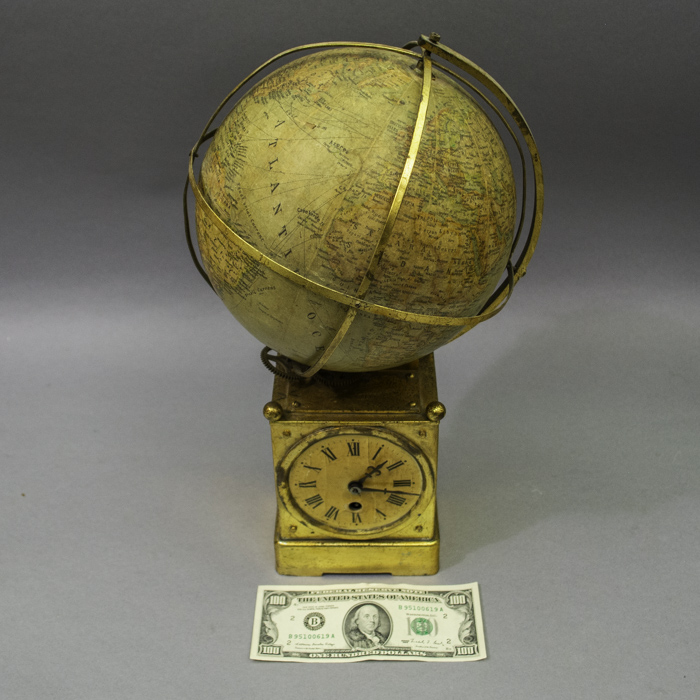
Click main image below to view enlargements and captions.

Globe, Specialty, Clock, 7-Inch Terrestrial World, Continental, c. 1900 (sold)

This item is sold. It has been placed here in our online archives as a service for researchers and collectors.

To buy a globe, browse our currently available Globes & Planetaria or search our site.

• See our guidelines for use and licensing of globe images.
Contact the gallery with purchasing and ordering inquiries, or to sell us your globe.

7-inch Terrestrial Globe Clock
Continental for the English market, circa 1890-1907
Gilt metal rectangular stand
15 inches high, 4.75 inches wide, 3.5 inches deep

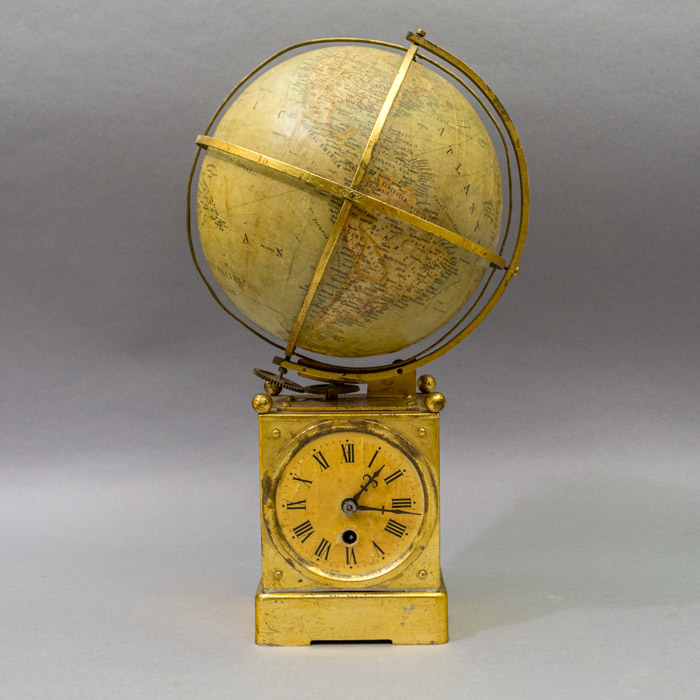
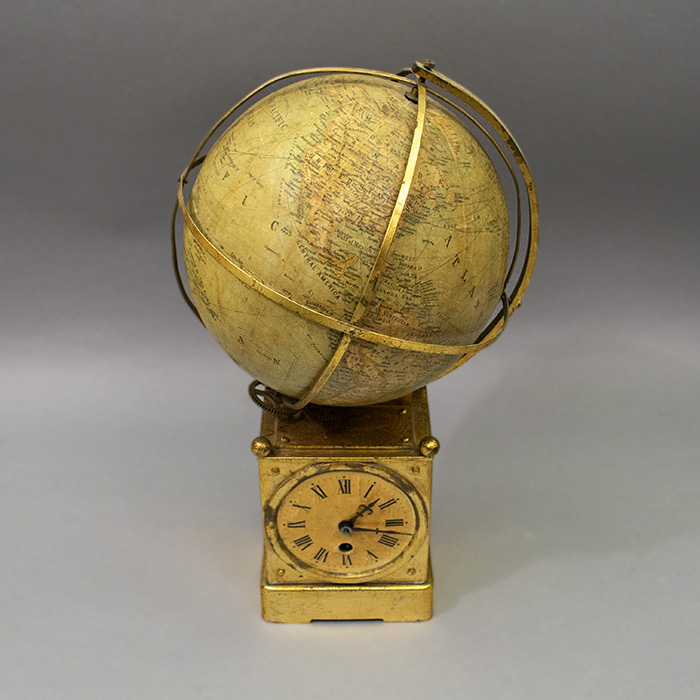
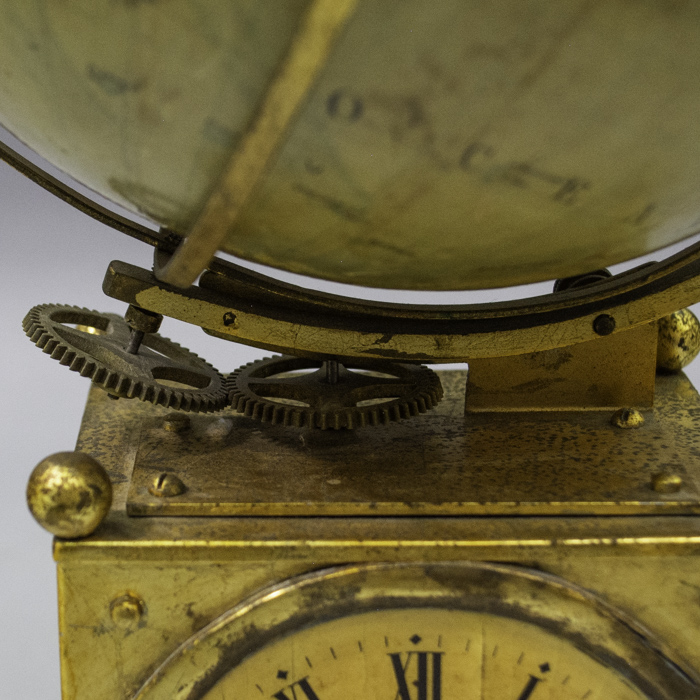
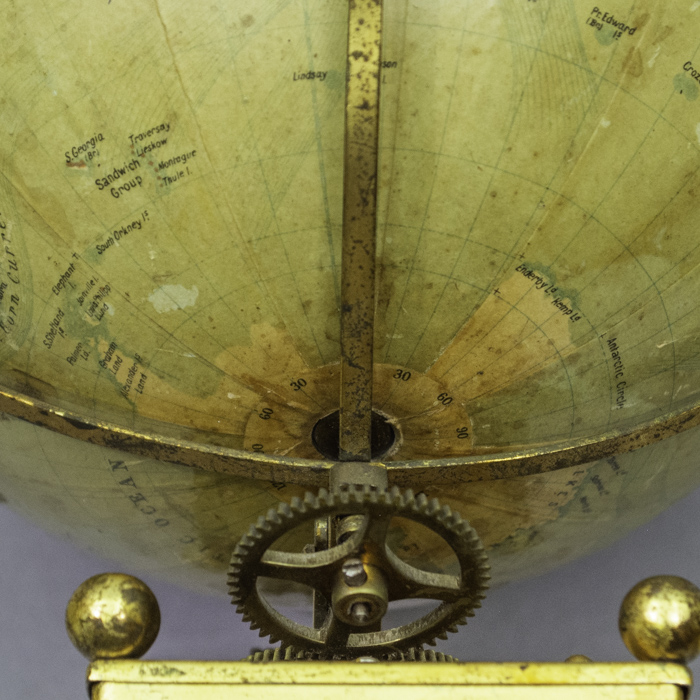
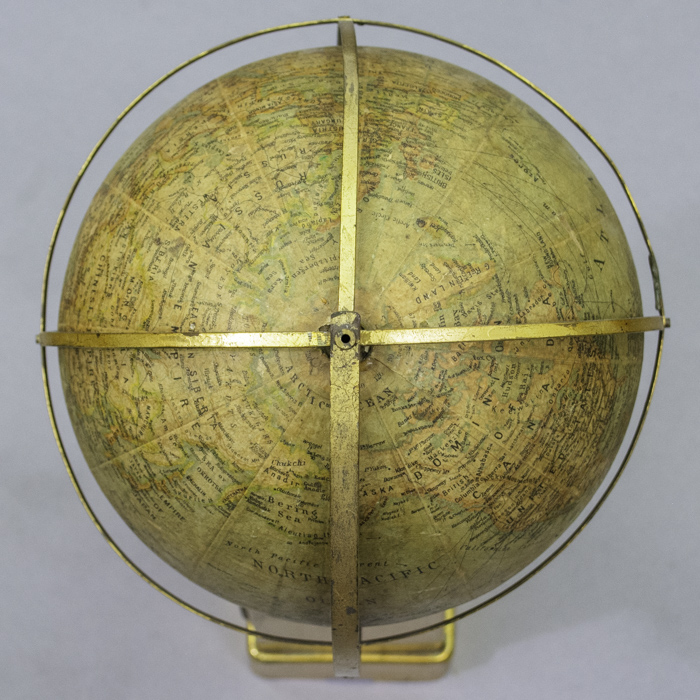
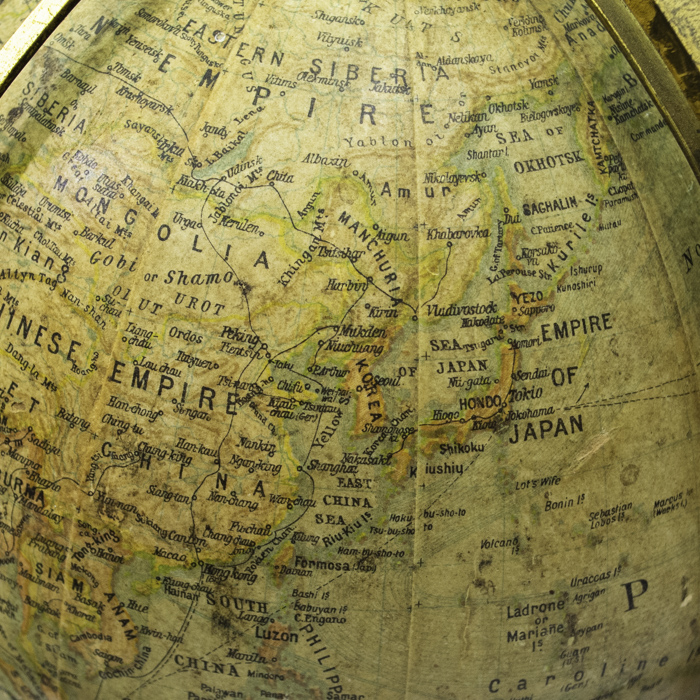
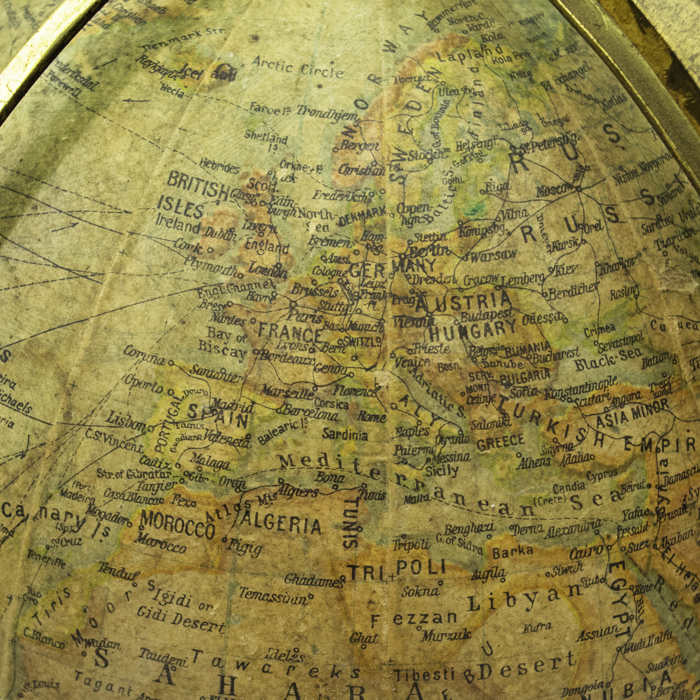
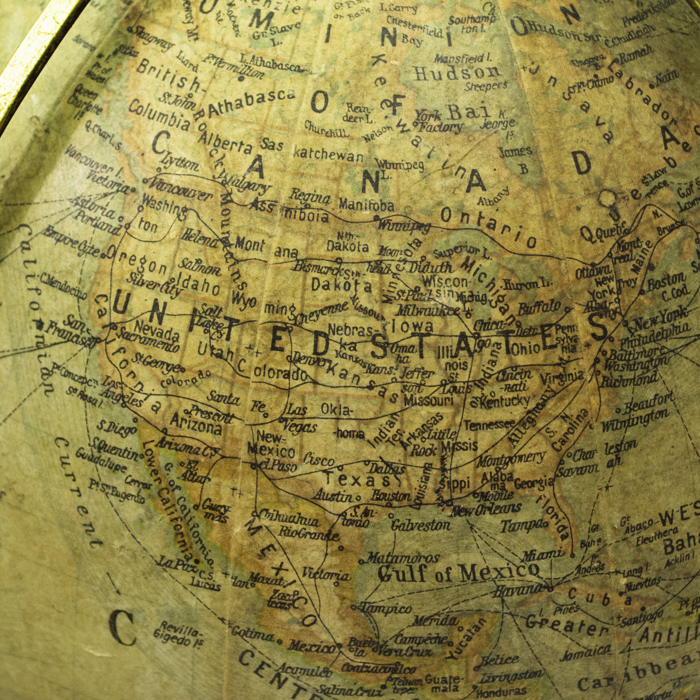
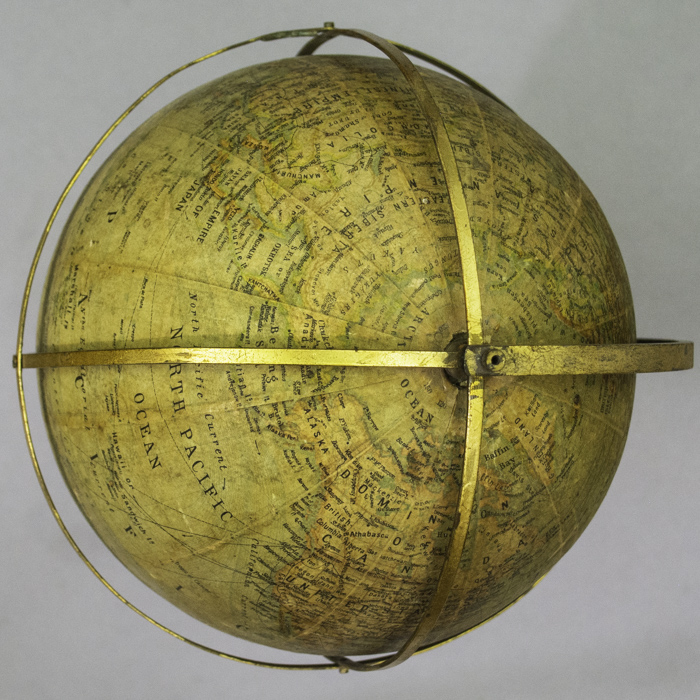
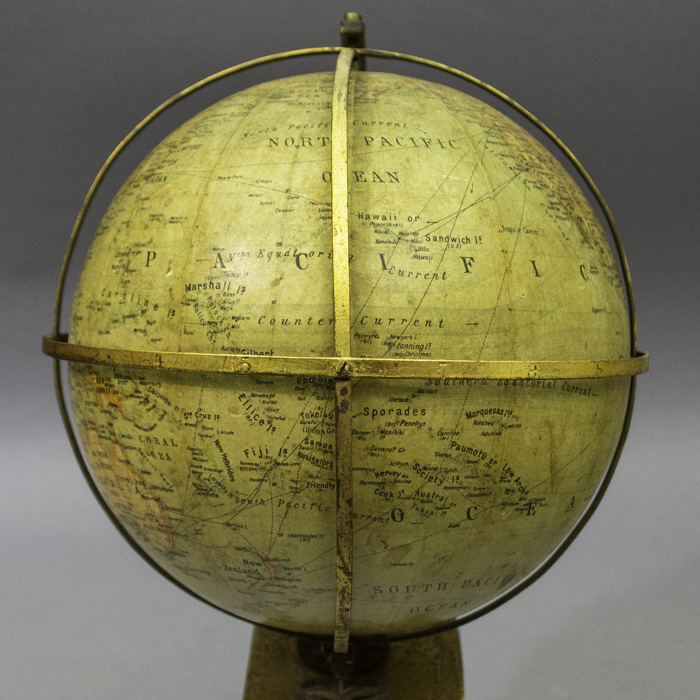
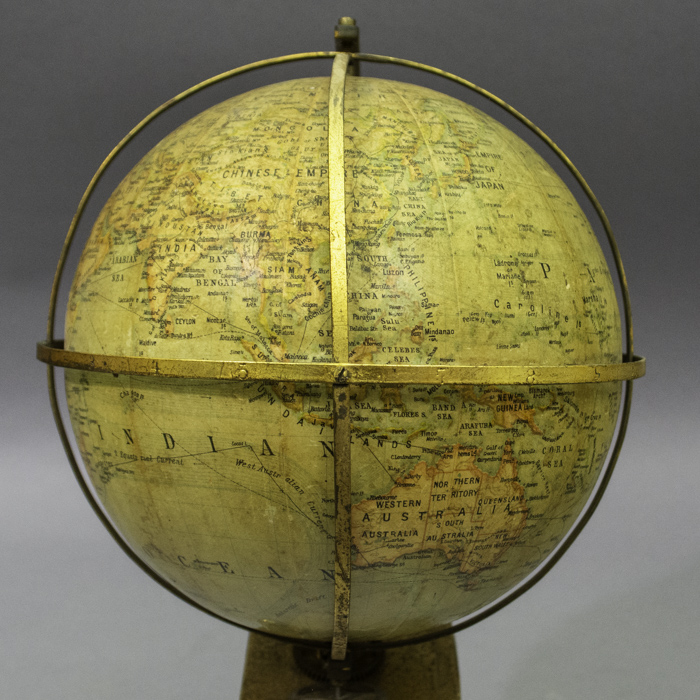
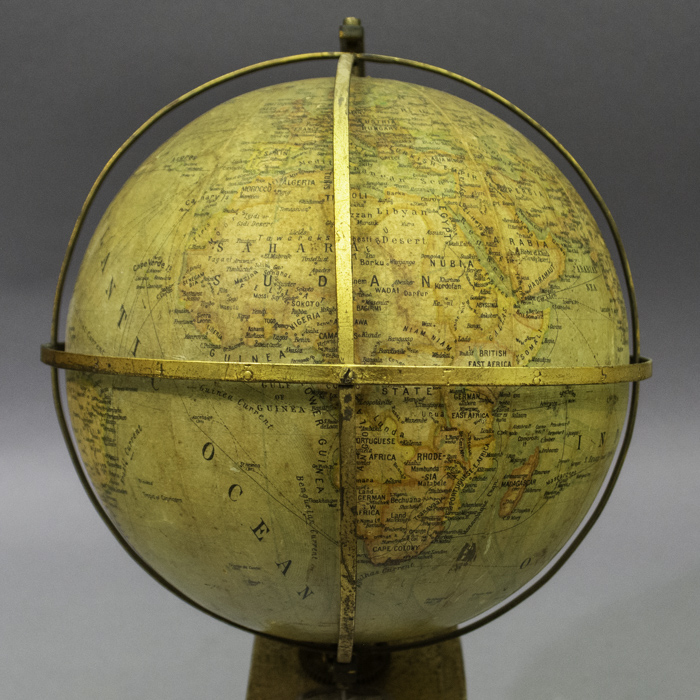
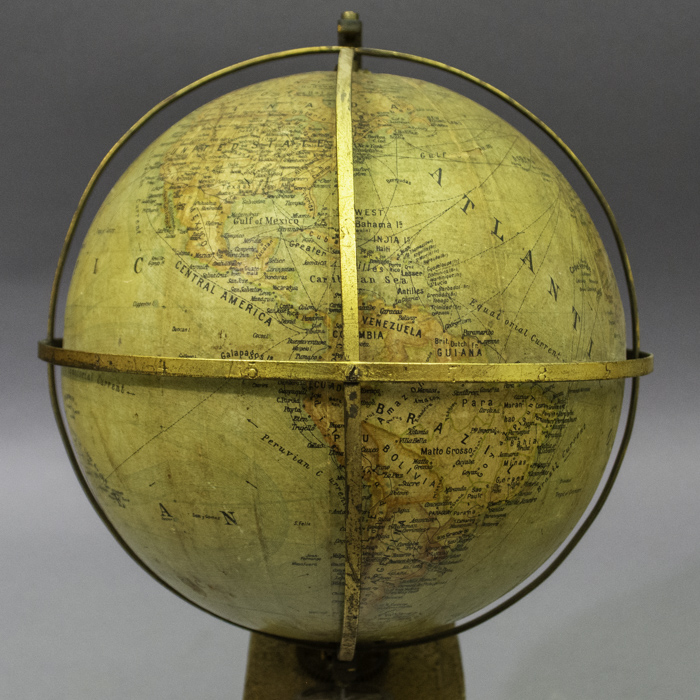
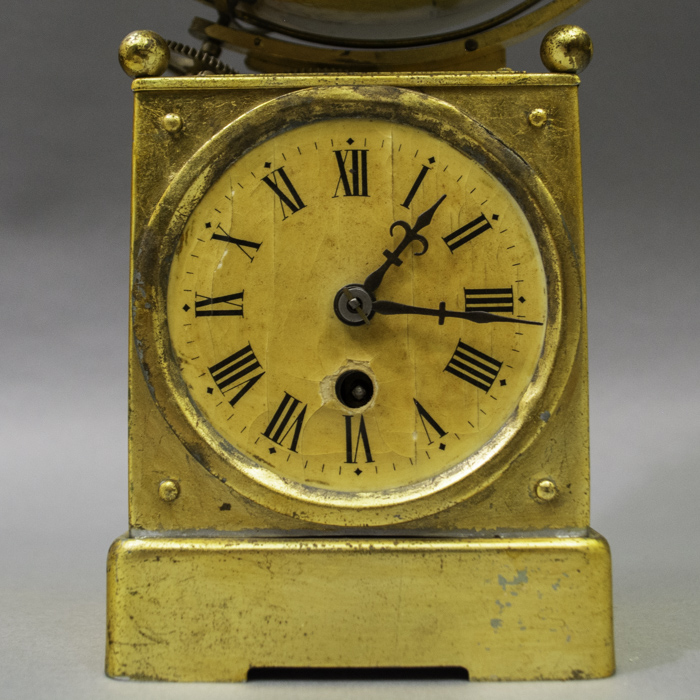
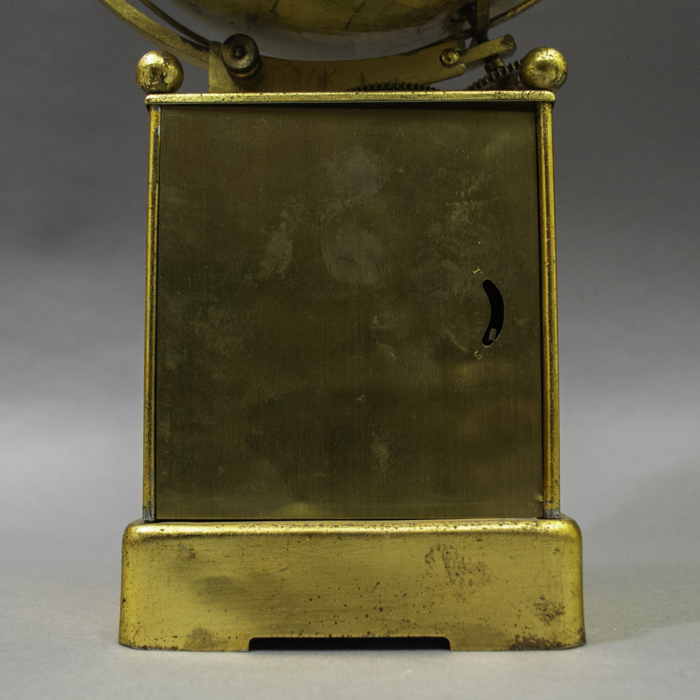
An antique terrestrial globe clock featuring an unsigned 7-inch terrestrial globe canted at 23 degrees within a brass half meridian and framed by a brass equatorial horizon band engraved with the hours of the day in Roman numerals, alongside corresponding solstice and equinox bands. The globe gear assembly is raised on a rectangular gilt metal clock case featuring a paper dial with Arabic numerals. The clock is powered by an unsigned, one-day spring-wound movement. Although the globe is unsigned, it features place names in English, as manufactured for export to England or the United States. Railways, steamship routes, and ocean currents are delineated. In the late 19th and early 20th centuries various Continental, English, and American clock makers produced similar models of a terrestrial globe turning by clockworks on a base with internal works powering a standard clock face with hour and minute hand set within the base. They were designed for parlor or business use to serve as a functional clock to keep local and international time, while also functioning as a decorative arts object. To operate the instrument, the user adjusts the clock hands to local time and rotates the globe until the user’s specific geographic location aligns with the correct time on the equatorial hour circle. Once set, the winding of the clockworks not only powers the traditional clock face but simultaneously turns the globe counterclockwise, completing a full rotation once every twenty four hours. This mechanism allows the user to determine the current local time for any place in the world simply by referencing the equatorial hour circle against the globe’s longitude lines.

Product description continues below.

Description

Certain cartographical features date the globe to between 1890 and about 1907. For example, modern-day Oklahoma is divided between Oklahoma, referring to Oklahoma Territory in the west, and Indian Ter., an abbreviation for the Indian Territory in the east. These boundaries reflect the 1890 Oklahoma Organic Act, which created the Oklahoma Territory and Indian Territory out of a combination of the region’s “unorganized” Indian Territory, Greer County, and the Oklahoma panhandle. Prior to the incorporation of the panhandle into Oklahoma Territory, it had been designated as a “neutral strip” starting in 1820 with the drawing of the 36°30′ line in the Missouri Compromise. In 1907, Oklahoma achieved statehood, and was indicated on globes as such at that time or shortly thereafter rather than a territory in any part. A second telling feature is the division of the Dakotas, named Nth. Dakota and Sth. Dakota, in accordance with the  admission of North Dakota and South Dakota as the 39th and 40th states in November 1889. In addition, St. Petersburg is indicated in the Russian Empire, consistent with a date before about 1914; regardless Oklahoma prior to statehood dates it earlier as set forth above.

Clocks are exceptionally well suited to be combined with globes because world time is inherently based on the full rotation of the Earth every 24 hours. The time of day or night varies with longitudinal location, divided into twenty four standard time zones across the world. Traditionally, globes are divided into twenty four longitudinal lines set fifteen degrees apart. It takes the Earth one hour to turn fifteen degrees and thus a full rotation of 360 occurs once a day.

Reference:

“Globe Clocks.” NAWCC Bulletin, June 1999, p. 423. 

Additional information

Century

20th Century