clock globe

  • Click main image below to view enlargements and captions.

    Globe, German, Heymann, Specialty, Clock, Berlin, Late 19th Century (Sold)

    This item is sold. It has been placed here in our online archives as a service for researchers and collectors.

    To buy a globe, browse our currently available Globes & Planetaria or search our site.

    • See our guidelines for use and licensing of globe images.
    Contact the gallery with purchasing and ordering inquiries, or to sell us your globe.

    Ludwig Julius Heymann
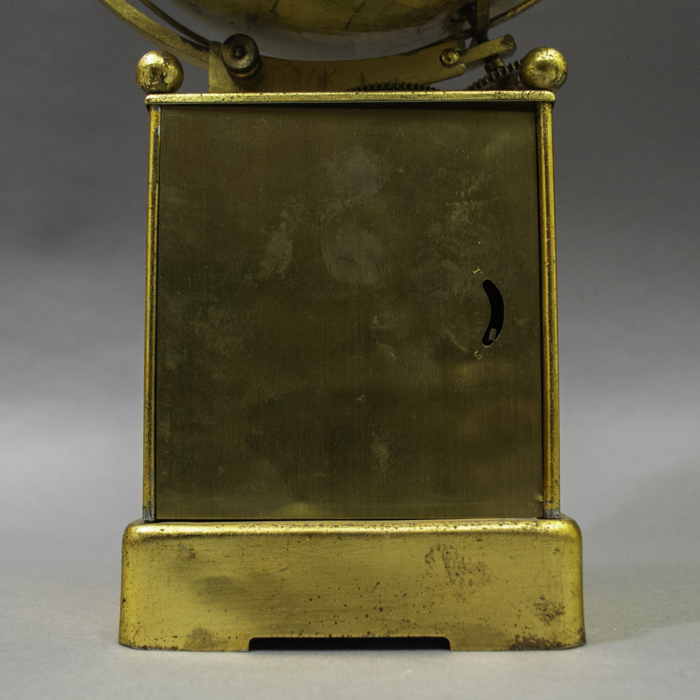
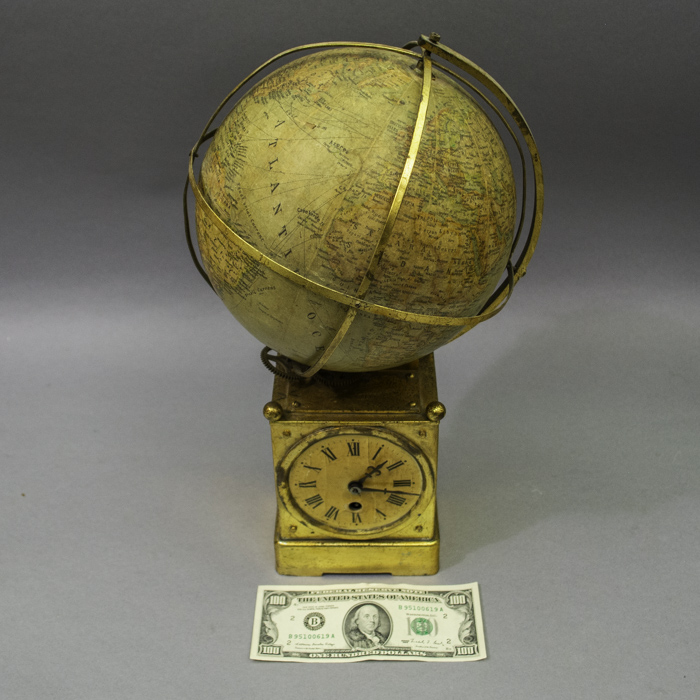
    7.5-Inch Terrestrial Globe, Clock Mount
    Mahogany stand
    Berlin, Germany: c. 1900
    16 inches high; 13 x 4 inch base

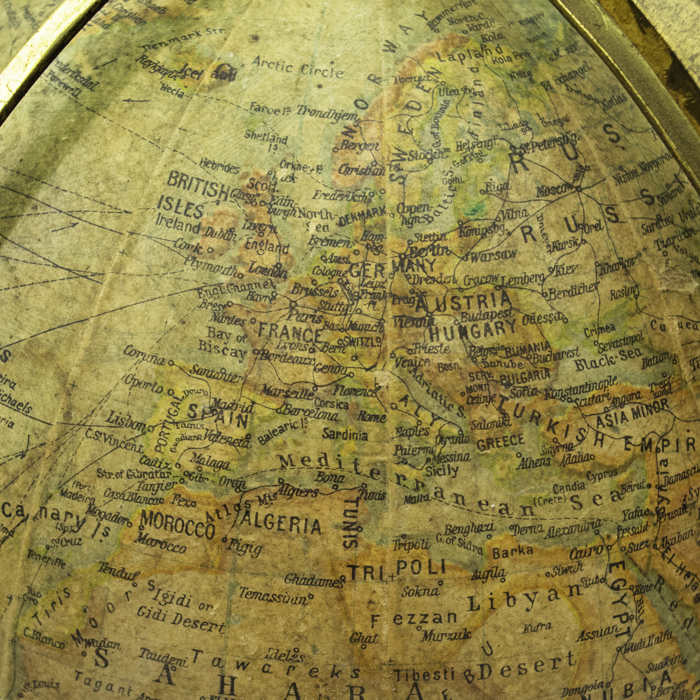
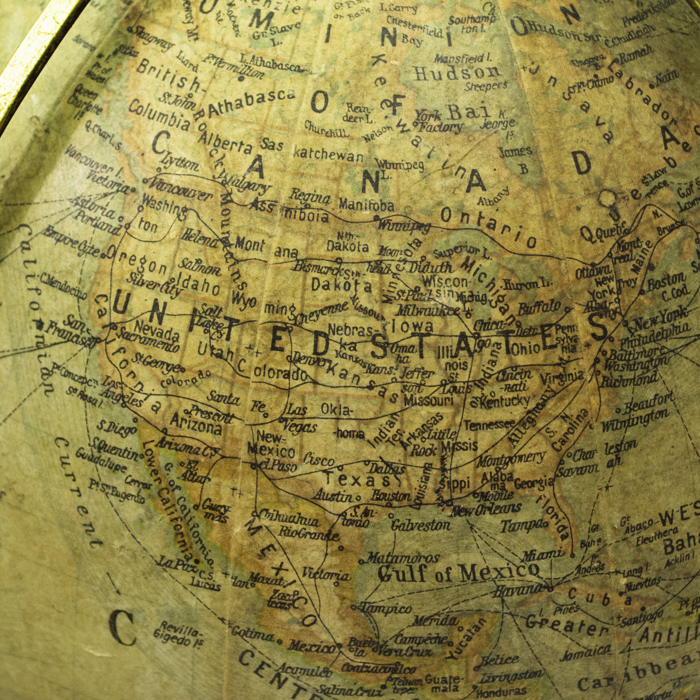
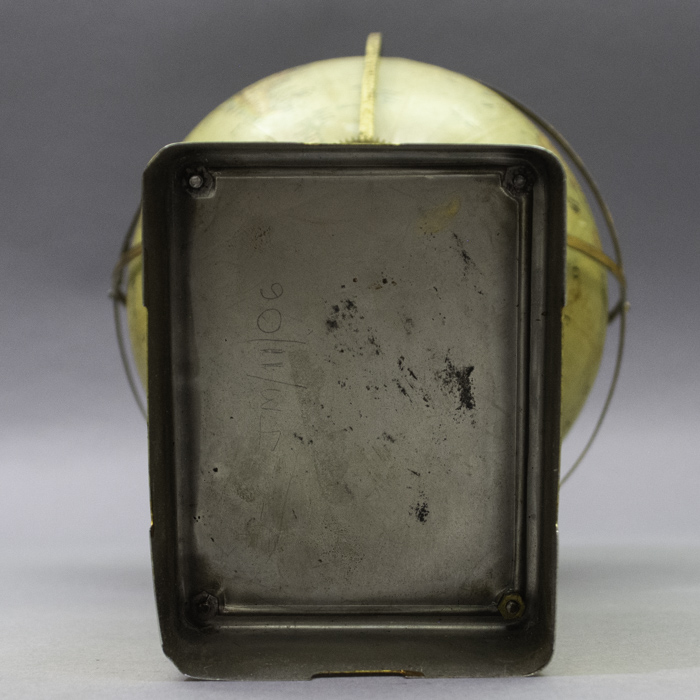
    The terrestrial globe within plated cast-iron calibrated half meridian, and within nickel-plated metal equatorial horizon band numbered with the hours of day, and solstice and equinox bands, raised on a rectangular mahogany clock base with ogee curved sides, having round mahogany dial and glass bezel. The clock movement one-day spring movement, time only no alarm, unsigned. The clockworks turn the globe one rotation every 24 hours.

    Product description continues below.

    Description

    Clocks are well suited to be combined with globes because world time is based on the full rotation of the earth once every 24 hours. A number of Continental, English, and American globes were made incorporating a clock mechanism, to not only show relative time around the world, but to keep time for the user of the globe. The time of day or night on the earth varies with longitude location. There are 24 time zones in the world. Generally globes are divided into 24 longitudinal lines, each 15 degrees apart. It takes the earth one hour to turn each 15 degrees, and in 24 hours it has completely turned once.

    To use the clock globe set the local time on the dial. Turn the globe so that the place of use corresponds to the correct time on the equatorial hour circle. Local time for any place in the world then can calculated.

    The clock movement works. Globe generally good and clean. See generally, Article in NAWCC Bulletin (June 1999, p. 423) showing a related example.

    Ludwig Julius Heymann was a prolific German globe maker based in Berlin. He began as a bookseller in Breslau in 1858 and moved the shop to Berlin in 1861. In 1883, he began producing globes under the company name Geographisch-artistische Anstalt [Geographic Artistic Institute] Ludwig Julius Heymann. Professor Henry Lange (1821-1893) was a longtime Heymann employee and designer of the gores. Heymann produced a wide range of terrestrial globes, from 5 cm to 36 cm in diameter, some of which were for export and thus in languages other than German. The stand styles ranged from simple wooden ones to elaborate decorative metal stands with sculptural figures supporting the globes. After Heymann’s death in 1899, the company was run by a succession of owners and moved to Leipzig around 1909. After World War I it issued some globes with Wagner and Debes. The company went out of business in 1930.

    Cartouche: EDRGLOBUS/ 19cm/ Nach den neuesten Forschungen bearbeitet/ LUDW. JUL. HEYMANN/ Geographischer Verlag.

    References:

    Allmayer-Beck, Peter E., ed. Modelle der Welt: Erd-und Himmelsgloben — Kulturerbe aus oesterreichischen Sammlungen. [Models Of The World: Terrestrial And Celestial Globes — Cultural Inheritance from Austrian Collections.] Vienna: Bibliophile Edition/Christian Brandstaetter Verlagsgesellschaft, 1997. pp. 204-205, 213, 216.

    “Geographisch-artistische Anstalt Ludwig Julius Heymann (1883-1930). Staatbibliothek zu Berlin. https://staatsbibliothek–berlin-de.translate.goog/die-staatsbibliothek/abteilungen/karten/sammlungen/bestaende/berliner-globen-1800-1955/heymann (1 September 2022).

    Lamb, Tom and Collins, Jeremy. The World in Your Hands: An Exhibition of Globes and Planetaria. London: Christie’s, 1994. p. 101.
    Additional information

    Century

    20th Century

  • Click main image below to view enlargements and captions.

    Globe, Specialty, Clock, 7-Inch Terrestrial World, Continental, c. 1900 (sold)

    This item is sold. It has been placed here in our online archives as a service for researchers and collectors.

    To buy a globe, browse our currently available Globes & Planetaria or search our site.

    • See our guidelines for use and licensing of globe images.
    Contact the gallery with purchasing and ordering inquiries, or to sell us your globe.

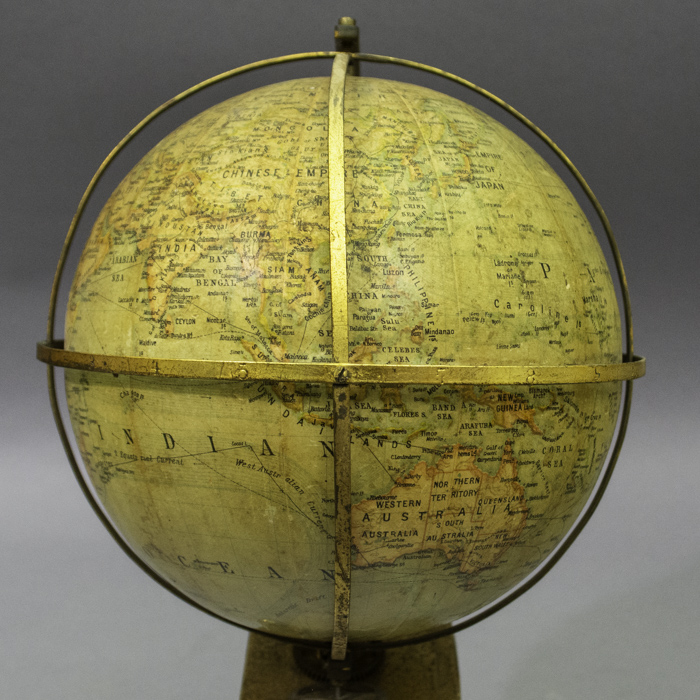
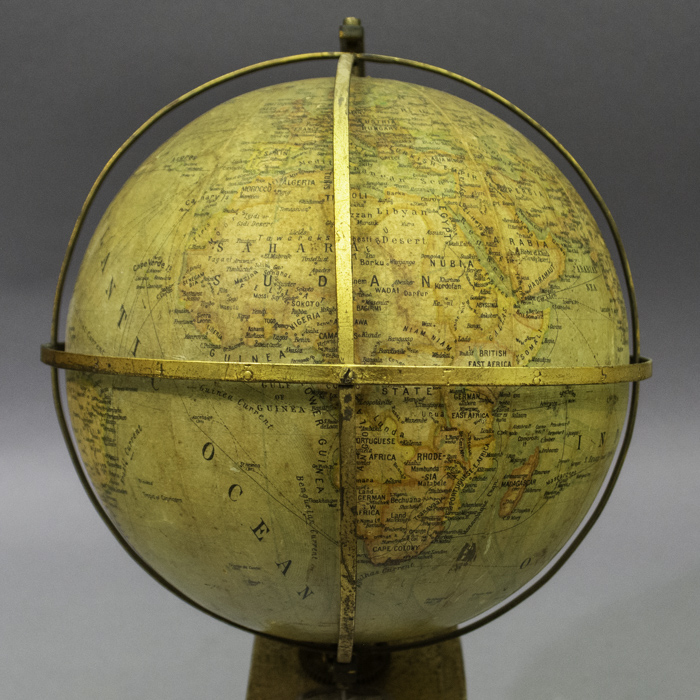
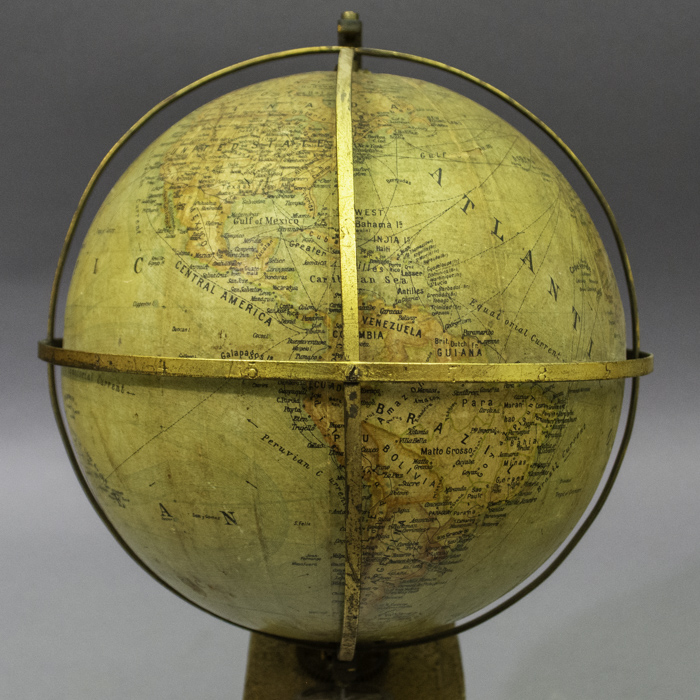
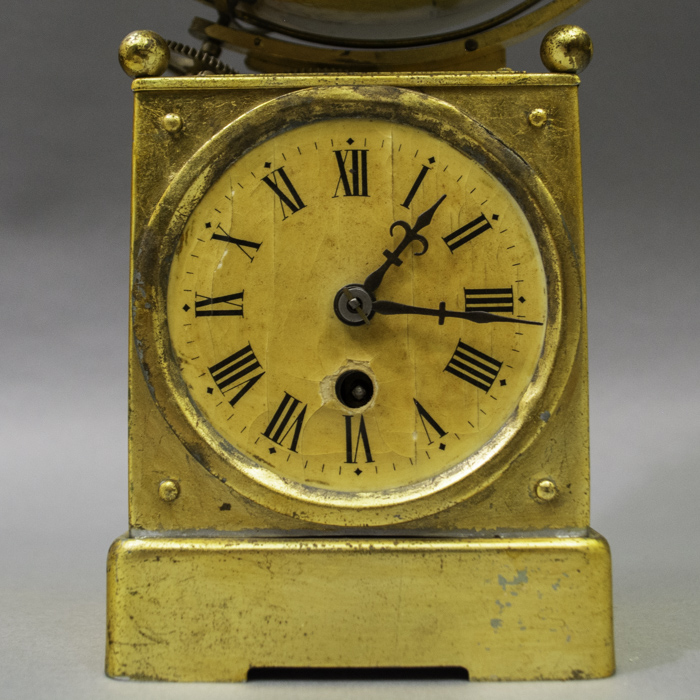
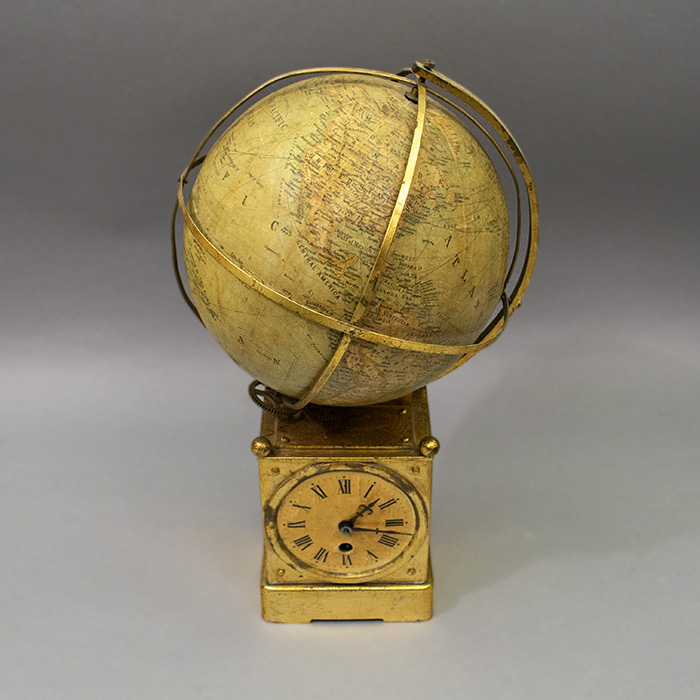
    7-inch Terrestrial Globe Clock
    Continental for the English market, circa 1890-1907
    Gilt metal rectangular stand
    15 inches high, 4.75 inches wide, 3.5 inches deep

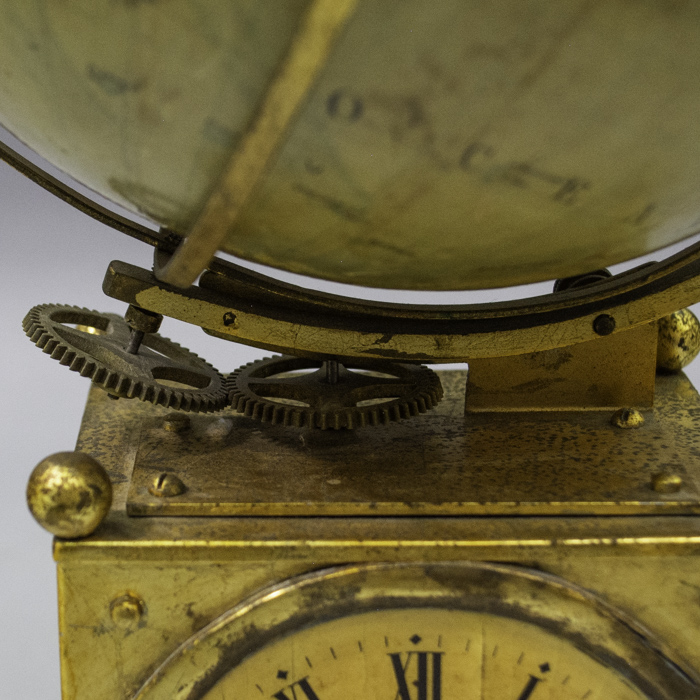
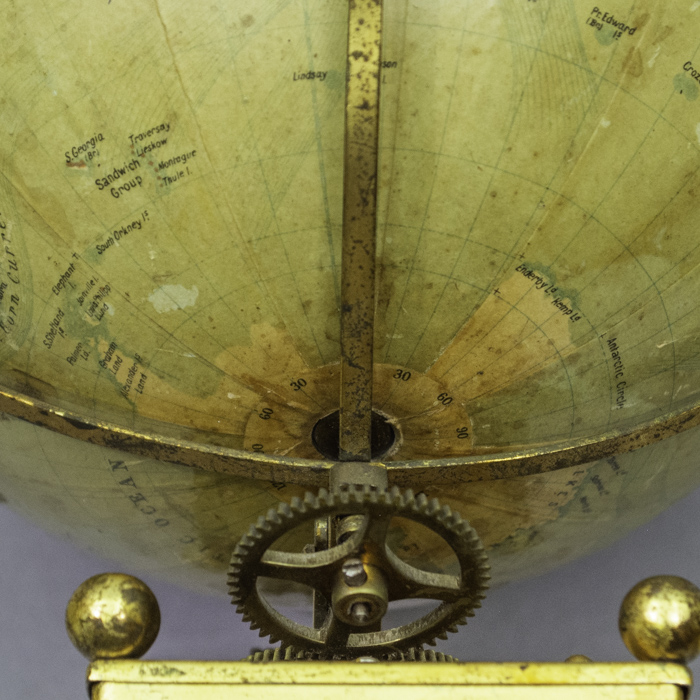
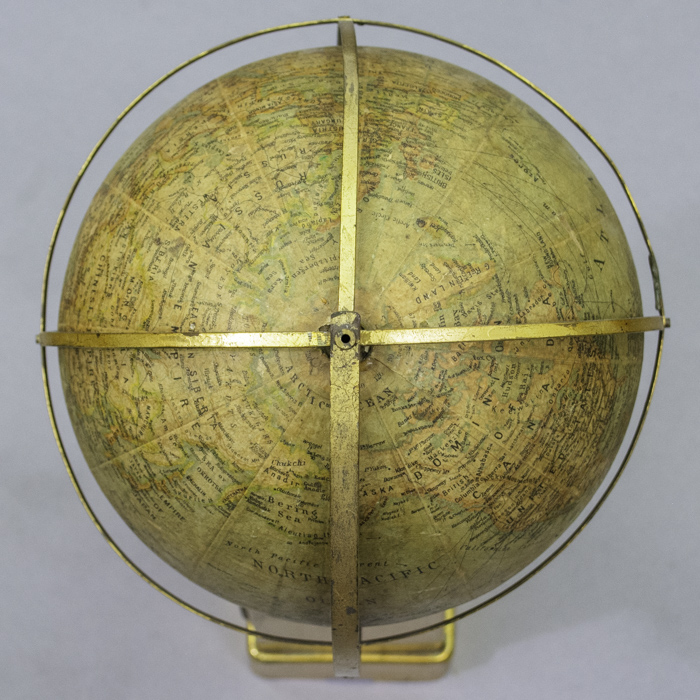
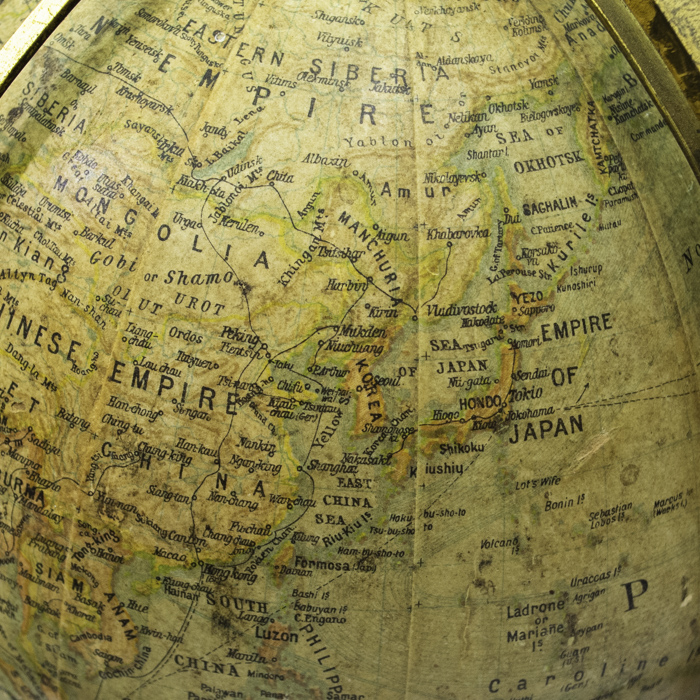
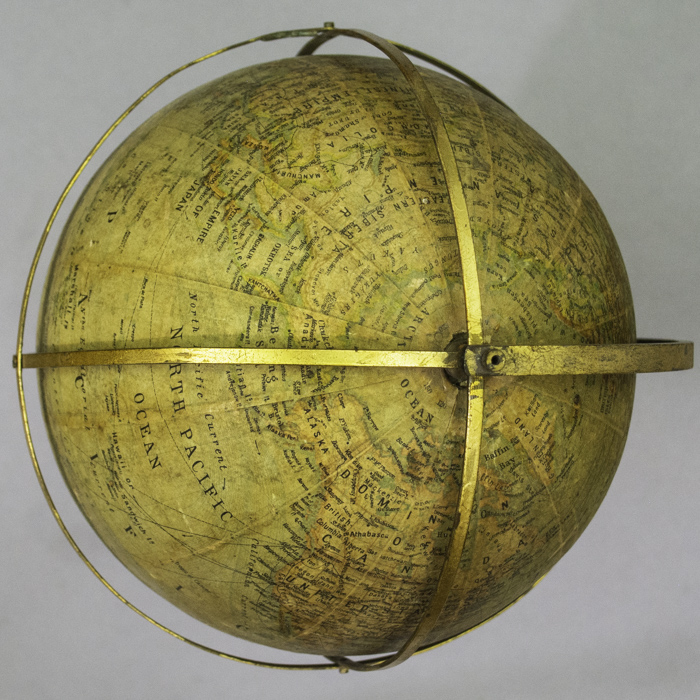
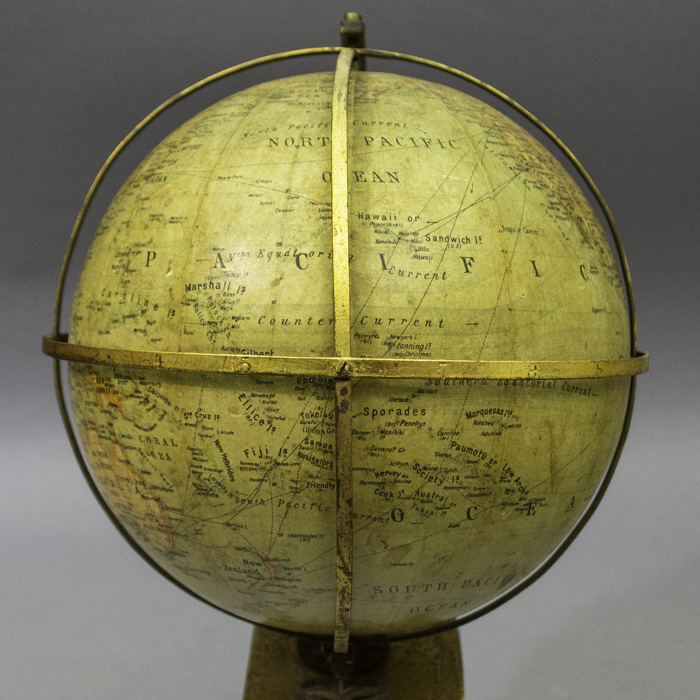
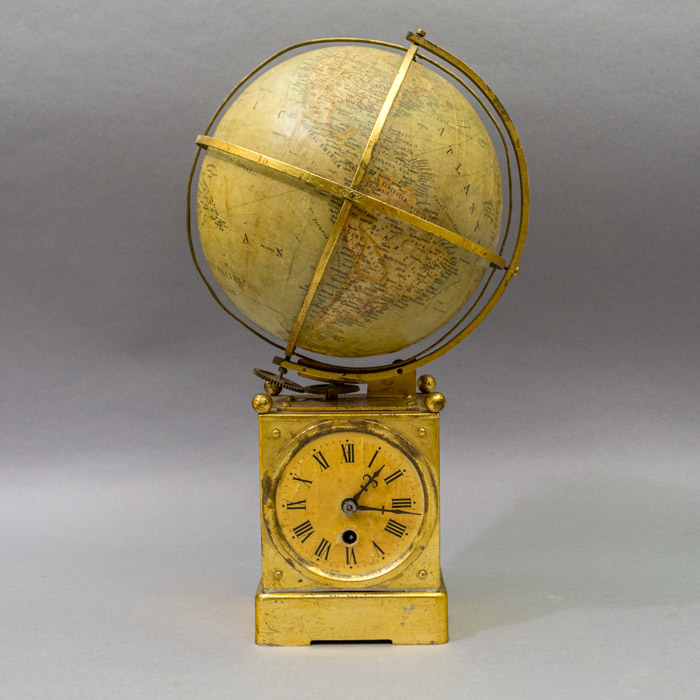
    An antique terrestrial globe clock featuring an unsigned 7-inch terrestrial globe canted at 23 degrees within a brass half meridian and framed by a brass equatorial horizon band engraved with the hours of the day in Roman numerals, alongside corresponding solstice and equinox bands. The globe gear assembly is raised on a rectangular gilt metal clock case featuring a paper dial with Arabic numerals. The clock is powered by an unsigned, one-day spring-wound movement. Although the globe is unsigned, it features place names in English, as manufactured for export to England or the United States. Railways, steamship routes, and ocean currents are delineated. In the late 19th and early 20th centuries various Continental, English, and American clock makers produced similar models of a terrestrial globe turning by clockworks on a base with internal works powering a standard clock face with hour and minute hand set within the base. They were designed for parlor or business use to serve as a functional clock to keep local and international time, while also functioning as a decorative arts object. To operate the instrument, the user adjusts the clock hands to local time and rotates the globe until the user’s specific geographic location aligns with the correct time on the equatorial hour circle. Once set, the winding of the clockworks not only powers the traditional clock face but simultaneously turns the globe counterclockwise, completing a full rotation once every twenty four hours. This mechanism allows the user to determine the current local time for any place in the world simply by referencing the equatorial hour circle against the globe’s longitude lines.

    Product description continues below.

    Description

    Certain cartographical features date the globe to between 1890 and about 1907. For example, modern-day Oklahoma is divided between Oklahoma, referring to Oklahoma Territory in the west, and Indian Ter., an abbreviation for the Indian Territory in the east. These boundaries reflect the 1890 Oklahoma Organic Act, which created the Oklahoma Territory and Indian Territory out of a combination of the region’s “unorganized” Indian Territory, Greer County, and the Oklahoma panhandle. Prior to the incorporation of the panhandle into Oklahoma Territory, it had been designated as a “neutral strip” starting in 1820 with the drawing of the 36°30′ line in the Missouri Compromise. In 1907, Oklahoma achieved statehood, and was indicated on globes as such at that time or shortly thereafter rather than a territory in any part. A second telling feature is the division of the Dakotas, named Nth. Dakota and Sth. Dakota, in accordance with the  admission of North Dakota and South Dakota as the 39th and 40th states in November 1889. In addition, St. Petersburg is indicated in the Russian Empire, consistent with a date before about 1914; regardless Oklahoma prior to statehood dates it earlier as set forth above.

    Clocks are exceptionally well suited to be combined with globes because world time is inherently based on the full rotation of the Earth every 24 hours. The time of day or night varies with longitudinal location, divided into twenty four standard time zones across the world. Traditionally, globes are divided into twenty four longitudinal lines set fifteen degrees apart. It takes the Earth one hour to turn fifteen degrees and thus a full rotation of 360 occurs once a day.

    Reference:

    “Globe Clocks.” NAWCC Bulletin, June 1999, p. 423. 

    Additional information

    Century

    20th Century

  • Click main image below to view enlargements and captions.

    Globe, Specialty, Clock, R. Newey, Philip & Son, London, c. 1930s (Sold)

    This item is sold. It has been placed here in our online archives as a service for researchers and collectors.

    To buy a globe, browse our currently available Globes & Planetaria or search our site.

    • See our guidelines for use and licensing of globe images.
    Contact the gallery with purchasing and ordering inquiries, or to sell us your globe.

    R. Newey (clock)
    George Philip & Son (globe)
    12-inch Terrestrial Globe Clock
    York, England: c. 1932-35
    Brass and mahogany stand
    25.5 inches high

    An unusual clock globe by the British clockmaker R. Newey. The clock incorporates a 12-inch globe by George Philip & Son, one of the two leading British globe makers of the period. The terrestrial globe is surmounted by a stamped brass hour dial, and mounted on a 23 degree tilt within a full uncalibrated stationary brass meridian ring. The axis beneath the South Pole is mounted on a geared mechanism incorporating a 24-hour circular dial, driven by clockwork contained in a 4-inch diameter brass drum, wound by a crank handle under the drum. The drum is supported by a brass tripod stand with inswept legs on a shaped triform mahogany base, centered with turned finial and small spherical cap, and resting on three brass bun feet. This clock globe is possibly unique; no other examples are known and its elements have strong aspects of having been hand made rather than manufactured.

    Product description continues below.

    Description

    Geographical entities are shaded in faded shades of green and tan; land masses are outlined in dark blue-green. Mountain ranges are indicated by light brown hatch marks. The cartouche notes that dotted lines indicate “Principal Shipping Routes with distances in Nautical Miles” and solid lines indicate “Principal Transcontinental Railways.” “Principal Air Mail Routes” are also indicated in the cartouche.

    Istanbul with “Constantinople” in parentheses is shown, indicating a date soon after 1930, when the name change occurred. In addition, the globe shows Northern Territory in Australia, as having replaced Central Territory — a change that occurred in 1931. Manchuria has been stamped “Manchukuo,” as it was known after the Japanese invaded the area and established a puppet state in 1932. The stamp likely was added shortly after the globe gores were printed These geographical notations suggest that the globe was issued c. 1932-35.

    Clocks are well suited to be combined with globes because world time is based on the full rotation of the earth once every 24 hours. A number of Continental, English, and American globes were made incorporating a clock mechanism, to not only show relative time around the world, but to keep time for the user of the globe. The time of day or night on the earth varies with longitude location. There are 24 time zones in the world. Generally globes are divided into 24 longitudinal lines, each 15 degrees apart. It takes the earth one hour to turn each 15 degrees, and in 24 hours it has completely turned once. To use the clock globe, one turns the globe so that the place of use corresponds to the correct time on the 24-four hour dial. Local time for any place in the world then can calculated and the globe position will be kept accurate as it turns by clockwork.

    R. Newey is a several-generation family clock business in York, England, known for restoration of historical important clocks and church bells. The company is still in business today as R. Newey & Son.

    George Philip & Son began as a map and atlas publisher in Liverpool, England in 1834. In 1902, the firm relocated to London and emerged as one of the major globe producers of the 20th century. Read more in our Guide to Globe Makers.

    Brass Drum Inscribed: R. Newey YORK Fecit 1918

    Oval Cartouche on Globe: PHILIPS’/ CHALLENGE GLOBE/ Diameter 12 inches/ […] LONDON/ GEOGRAPHICAL INSTITUTE/ GEORGE PHILIP & SON LTD 32 FLEET STREET/ Printed in Great Britain

    Additional information

    Century

    20th Century