
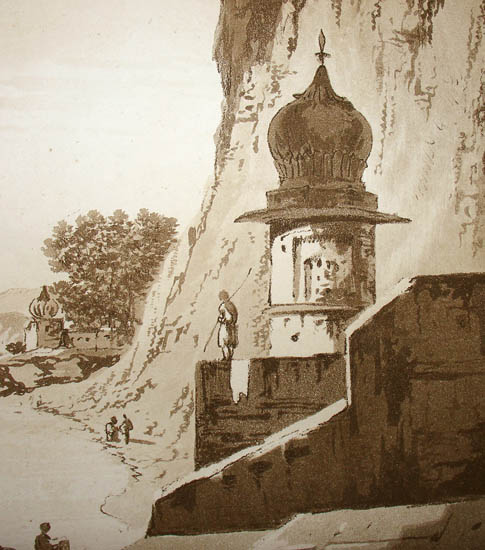

Description
William Hodges was a British artist. The son of a blacksmith, his talent for drawing was recognized by the landscape painter Richard Wilson, who took him on as a pupil and assistant. After gaining some skill, he worked as a scene painter in the theater at Derby and exhibited in 1770 and 1772 at the Spring Gardens Rooms. In 1772 he was appointed the draftsman to Captain Cook’s second expedition. After returning three years later, he completed his drawings and supervised their engraving under the auspices of the Admiralty. He first exhibited at the Royal Academy in 1776. Hodges’ major opus is his collection of views made during a three-year journey through India. He travelled there in 1780 and received patronage from the Governor General Warren Hastings, who also got him a subsidy from the East India Company. Hastings collected his work, some of which are now in the collection of the Yale University Center for British Art. After Hodges returned to England in 1783, he began turning 48 of his sketches into a series of aquatints, which he engraved himself with considerable skill. These were published as the two-volume set Select Views in India (1785-1788). Hodges exhibited his Indian views to an appreciative audience in London and was elected a member of the Royal Academy in 1787 where he was hailed as a very intelligent and ingenious artist. His thoughtful and informative journals from his three-year sojourn were published in 1793. However, sales from subsequent projects were disappointing, and he retired in 1795 and opened a bank at Dartmouth, which failed and brought him financial ruin. Faced with failing health and harassed by financial troubles, he committed suicide in 1797.
Hodges’ legacy remains as an important chronicler of 18th-century India. A reappraisal of his work and his light-filled paintings by some art historians reveals him as an artist who was ahead of his time. In the words of the Indian art and culture historian Pran Nevile, “For Indians, of course, William Hodges was the first artist to portray a true to life picture of the Indian scene. In fact Hodges was the founding father of the great illustrated and colored albums of India in the late 18th and early 19th century and inspired so many other British artists who came later and produced many great works on India.”
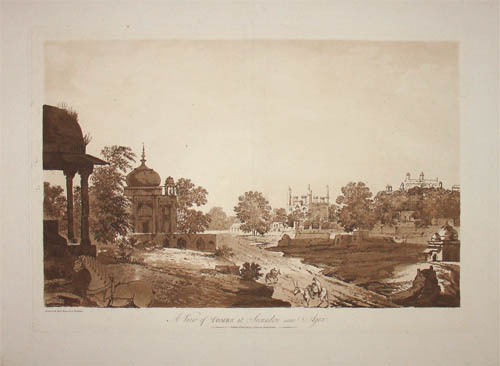
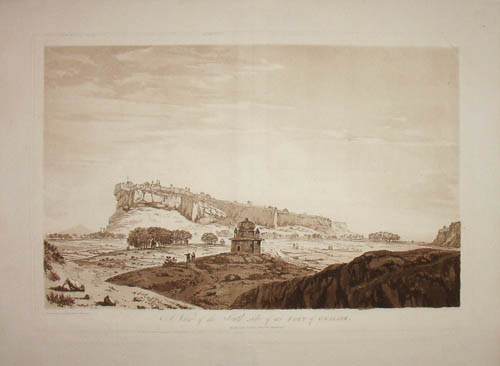
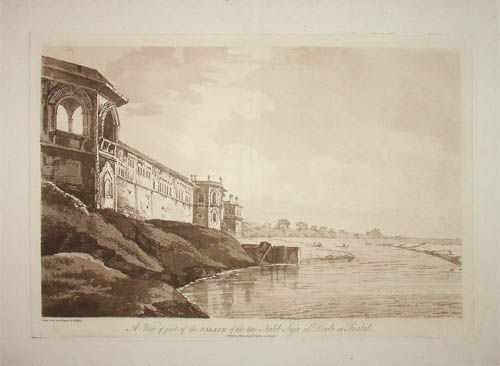
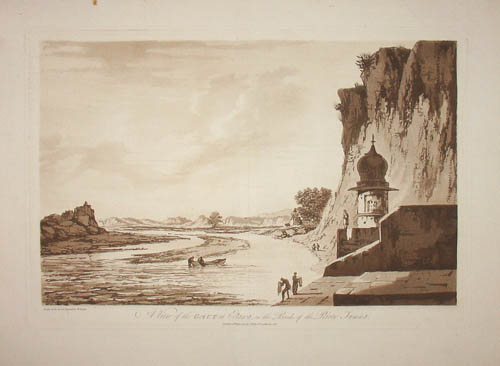
Full publication information: All are “Drawn on the spot and engraved by W. Hodges.” Gaut at Etawa: Published 20th May 1787, by J. Wells, No. 22 Charing Cross. Fort of Gwalior: Published April 1st, 1786, by J. Wells, No. 22 Charing Cross. Palace: Published 14th Dec’r 1787, by J. Grives 103 Strand. Tombs: Published 23d Jan’y 1788, by J. Grives 103 Strand, London.
Condition: Each generally very good, recently professionally cleaned and deacidified, with only minor remaining toning and wear. Original vertical center fold verso professionally flattened and reinforced verso.
References:
Nevile, Pran. “First Views of India.” Khabar. April 2011. http://www.khabar.com/magazine/features/first_views_of_india (30 January 2015).
“Prints & Drawings full record display for shelfmark X744.” British Library: India Office Select Materials. http://www.bl.uk/catalogues/indiaofficeselectpd/FullDisplay.aspx?RecordId=015-000016687 (30 January 2015).
Redgrave, Samuel. A Dictionary of Artists of the English School: Painters, Sculptors, Architects, Engravers and Ornamentists. London: Longmans, Green, and Col., 1874. p. 208.


