
Description
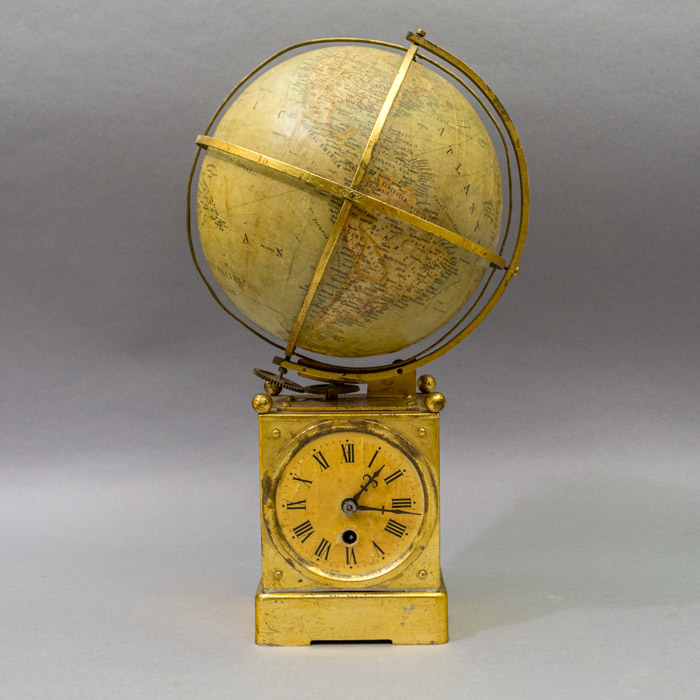
To operate the instrument, the user adjusts the clock hands to local time and rotates the globe until their specific geographic location aligns with the correct time on the equatorial hour circle. Once set, the winding of the clockworks not only powers the traditional clock face but simultaneously turns the globe, completing a full rotation once every twenty four hours. This mechanism allows the user to determine the current local time for any place in the world simply by referencing the equatorial hour circle against the globe’s longitude lines.
Clocks are exceptionally well suited to be combined with globes because world time is inherently based on the full rotation of the Earth every 24 hours. The time of day or night varies with longitudinal location, divided into twenty four standard time zones across the world. Traditionally, globes are divided into twenty four longitudinal lines set fifteen degrees. Because it takes the Earth one hour to turn each fifteen degrees, the continuous rotation of the globe clock provides a perfect mechanical representation of the planet’s daily transit.
Condition: The globe is very good overall with the usual light toning, handling, and wear commensurate with age, with a few minor professionally restored abrasions. The gilt metal case is very good with light surface wear. The clockworks are present and running, though they are not guaranteed to be reliable timekeepers, as is typical for antique globe clocks.
Reference:
“Globe Clocks.” NAWCC Bulletin, June 1999, p. 423.


