

Description
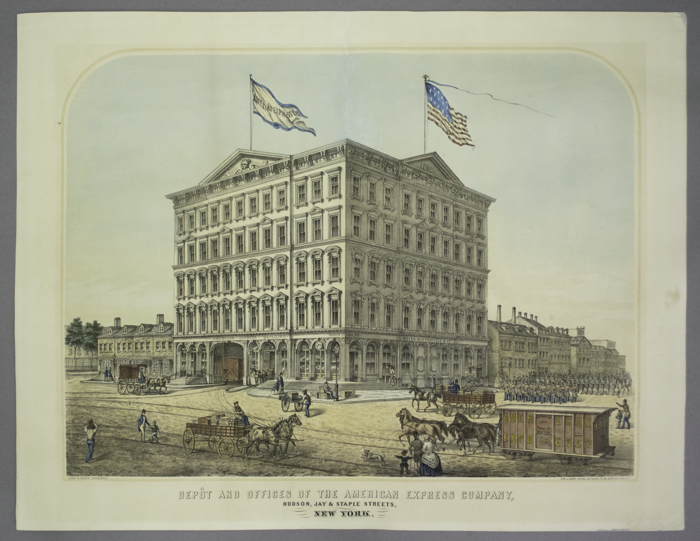
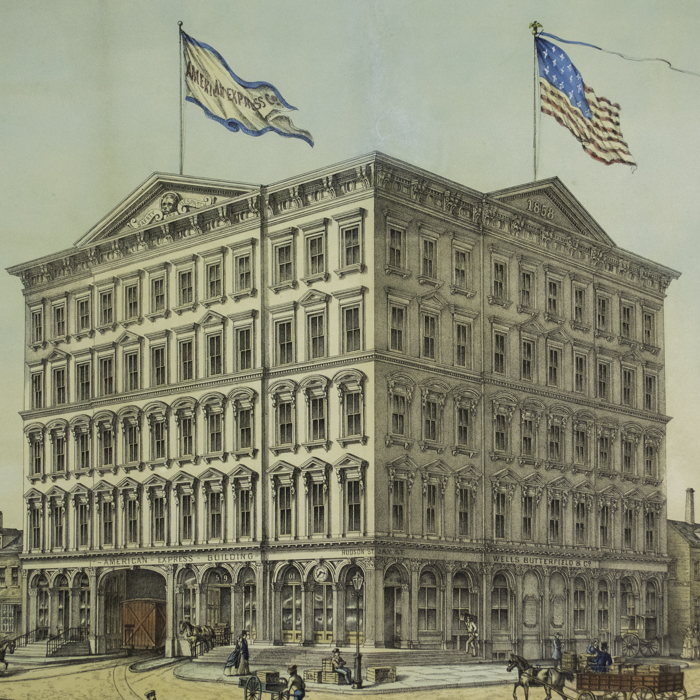
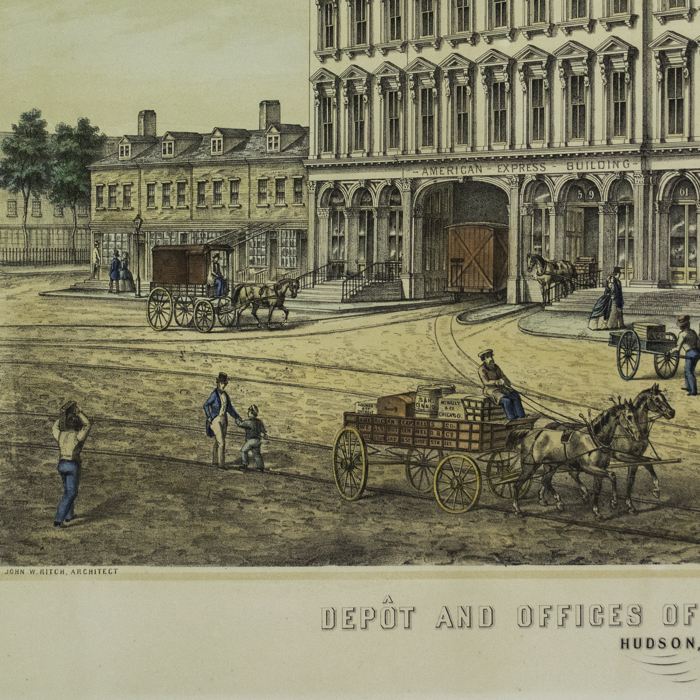
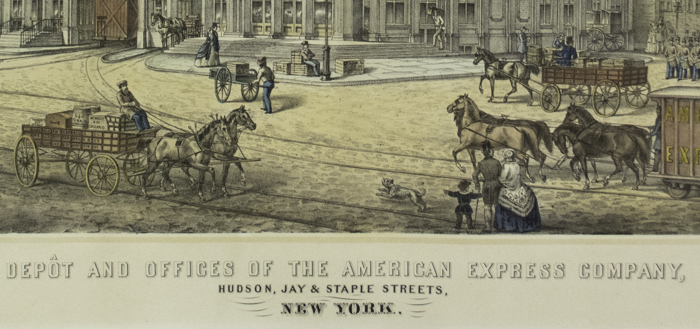
The scene bustles with activity. Horse-drawn carriages, both open and closed, bear the company’s name as they deliver and collect packages at the ground-floor depot. A spur line runs through the facility, linking it to the Hudson River Railroad just one block away. The foreground is alive with pedestrians—families, children, and dogs—pausing to admire the building’s imposing presence. Government officials march in formation nearby. Each facade is crowned by a central triangular pediment: the leftmost features a bold terra cotta relief of a bulldog, American Express’s insignia at the time, while the rightmost displays the building’s completion date, 1858. Above them, the American Express flag and the U.S. flag billow in the wind. Interestingly, the American flag in the print features only 15 stars, despite the official count being 31 in 1858.
The offered print is uniquely rare. The Metropolitan Museum of Art has a copy in their archives. No other can be found online.
The American Express Company, one of the giants in American finance, formed in 1850 after the merger of three competing express firms: Wells & Co., Wasson & Co., and Livingston, Fargo, & Co..
Express companies were established to fill a hole in the market for the transportation of mail, parcels, valuables, goods, etc., that the U.S. Post Office would not accept. Invaluable to the operation of express firms was proximity to a railroad. The Hudson River Railroad, chartered in 1846 to connect Troy to New York City, was built along the east bank of the Hudson River right to the bottom of Manhattan. The American Express Company quickly took advantage of this opportunity and in 1854, built a stable on Vesey Street and later expanded into the location on view in the offered print on 55-61 Hudson Street establishing the company’s first official headquarters in 1958.
John W. Ritch, the esteemed architect behind the Hudson Street headquarters, was a leading figure in New York City’s Italianate architectural movement. His design for the American Express building was one of the most ambitious examples of the style in its time. Ritch was also involved in the construction of the Gilsey Building at 169-171 Broadway, though that structure no longer survives. Ritch’s incredible work gave the American Express Company the structure to monopolize the area for nearly two decades until the company’s rapid expansion led to the establishment of a new headquarters at 63-65 Broadway, relegating the original building to shipping operations.
The American Express Company’s territorial reign came to an end in 1918 after World War I and the establishment of the parcel post system led to the consolidation of competing express companies into the American Railway Express Company. Throughout the 20th century, the building housed various mechanical companies until Tribeca’s renaissance of the 1990s demanded a more exciting use. The former depot stables became home to some of the era’s most legendary nightclubs, including Headley, Vinyl, and Area.
These raucous days ended when developer Peter Moore purchased the building for $18 million in 2004. Collaborating with architect Kevin Kennon, he restored the deteriorating structure, preserving its historic character while adapting it for modern use. Today, the building stands as a 10-story cooperative loft residence, a testament to Hohn W. Ritch’s extraordinary design and its remarkable evolution over more than a century and a half.
Condition:
References:
“Depot and Offices of the American Express Co., Hudson, Jay & Staple Street, New York.” Metropolitan Museum of Art. https://www.metmuseum.org/art/collection/search/821378 (27 February 2025).
“American Architect.” Google Books. https://www.google.com/books/edition/American_Architect/6otMAAAAYAAJ?hl=en&gbpv=1&dq=%22John+W.+Rich%22+architect&pg=PA35&printsec=frontcover (27 February 2025).
“American Express Stables.” Dayton in Manhattan. https://daytoninmanhattan.blogspot.com/2011/12/american-express-stables-no-157-hudson.html (27 February 2025).


