
Description
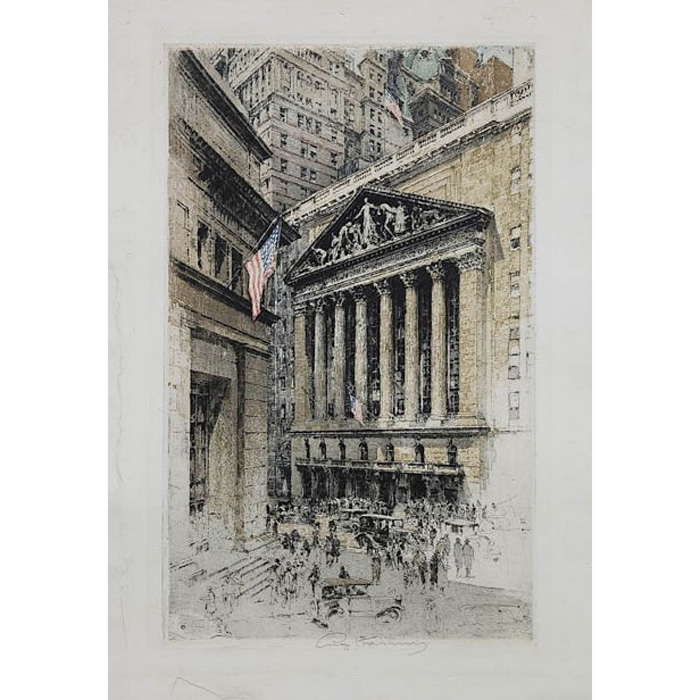
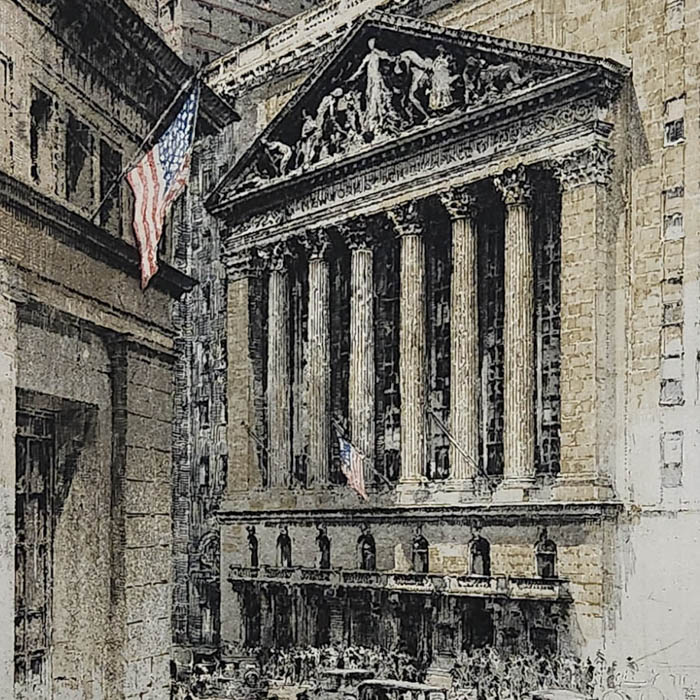
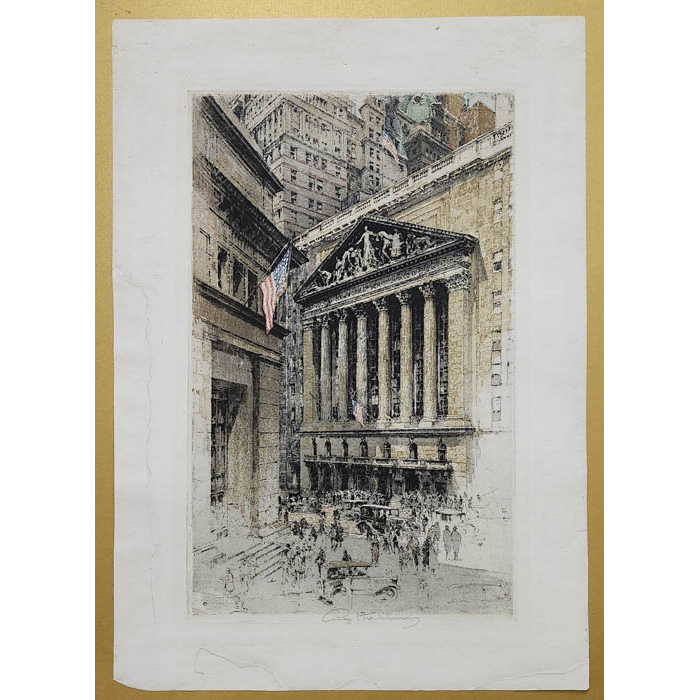
The New York Stock Exchange (NYSE) located at Broad and Wall Street in lower Manhattan, is an iconic financial institution. The current building was completed in 1903 and designed by the prominent architect George B. Post in the Greek Revival Style, with a grand neoclassical façade. The concept of the stock exchange in the United States dates back to 1792 when 24 brokers signed the Buttonwood Agreement under a buttonwood tree in Wall Street. This agreement established rules for trading securities and laid the foundation for the NYSE. By 1865, the Exchange moved into its first major building designed by architect James Renwick, Jr. That building was demolished in 1901 to make way for the current Greek Revival building by Post. It was expanded in 1922, with a a 23-story annex tower added behind it designed by the architects Trowbridge and Livingston.
Luigi Kasimir (1881-1962) was born in present-day Solvenia when it was still part of the Austro-Hungarian Empire. He studied at the Vienna Academy of Art where he learned the fine art of color-printed etching. He is well known for a series of American and European urban landscape city views, often with a focus on architecture. Those of American subjects include prints of the New York Stock Exchange; the Brooklyn Bridge; Columbia University; Park Avenue; the Queensborough Bridge; the Massachusetts State House; and Michigan Boulevard. His wife, Tanna Kasimir-Hoernes (1887-1972) also produced similar prints including New York Trinity Church; the Sub-Treasury (Federal Building); and the Savoy and Sherry Netherland from Central Park. Their son Robert Kasimir (1914-2002) was also an accomplished printmaker in a similar style. The prints of the Kasimir family exemplify Luigi’s pioneering efforts in color printmaking. Unlike the common practice of hand-coloring black-and-white prints, Kasimir used an innovative etching technique in which he etched separate plates for each color and printed them in precise alignment to achieve a vibrant, painterly effect. The Kasimir family’s etchings can be found in numerous major museums, including the Metropolitan Museum of Art, and in numerous fine print collections worldwide.
Condition: Generally very good, recently professionally cleaned and restored with light remaining overall toning, wear, handling. Some minor glue residue, abrasions, and toning in blank margins where formerly matted, can be rematted out.
References:
“History of New NYSE” NYSE. https://www.nyse.com/history-of-nyse. (29 May 2025).
“Luigi Kasimir.” Wikipedia. https://en.wikipedia.org/wiki/Luigi_Kasimir (13 May 2025).
“The Lost New York Stock Exchange Bldg – 10 Broad Street.” Daytonian in Manhattan. https://daytoninmanhattan.blogspot.com/2018/09/the-lost-new-york-stock-exchange-bldg.html. (29 May 2025).


