
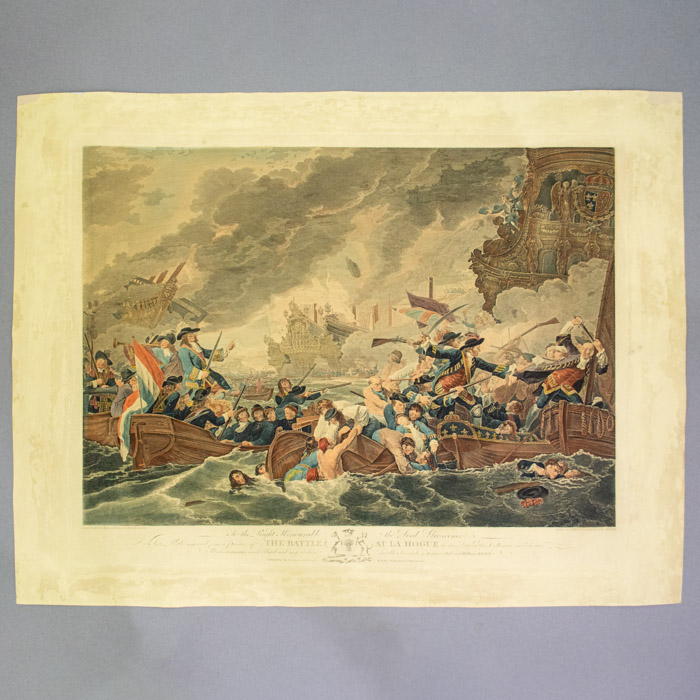
Description
The National Gallery of Art’s website provides the history and context for West’s depiction (see link in References below):
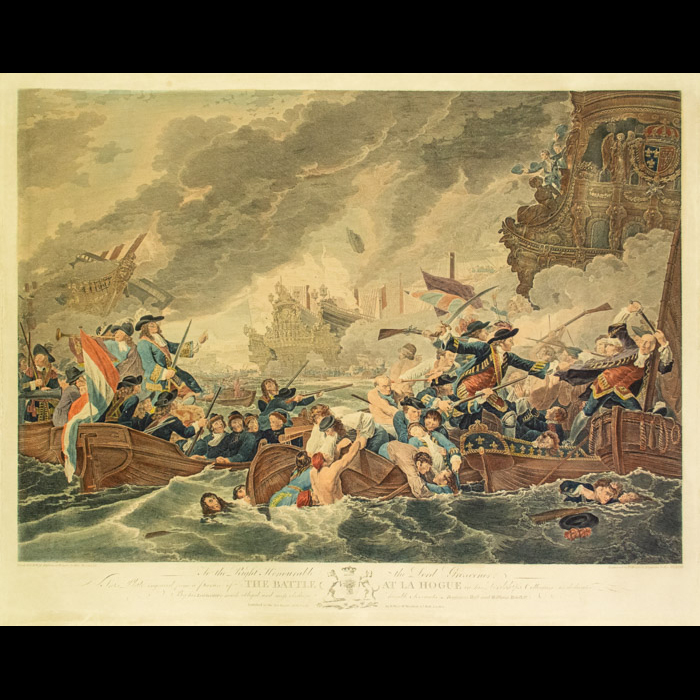
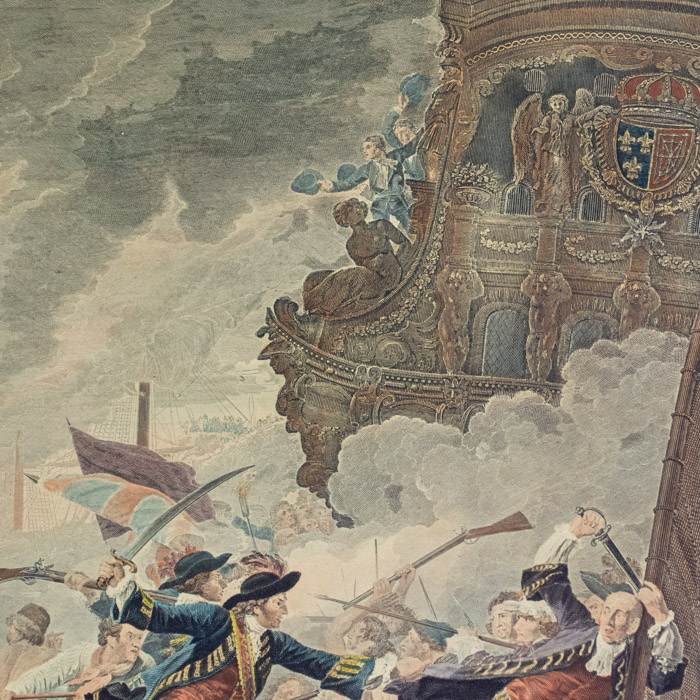
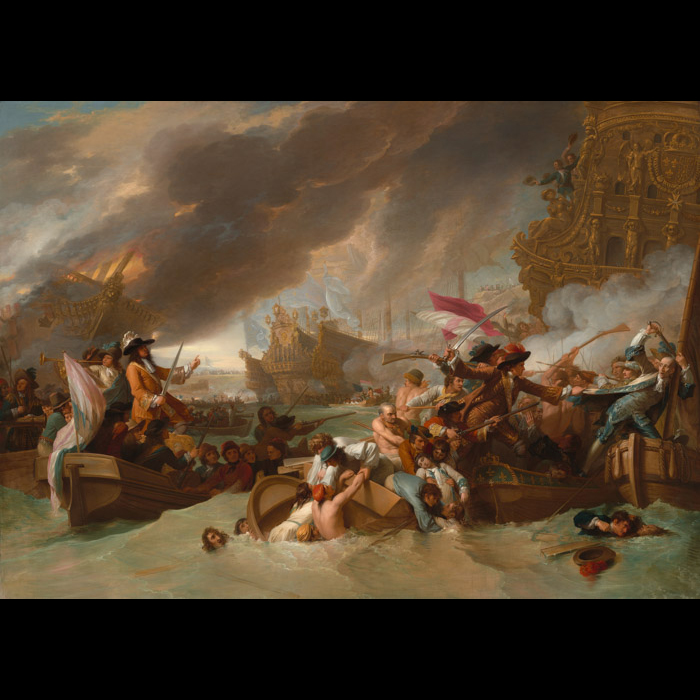
Seventeen years after Benjamin West settled in England, a London newspaper’s review of the 1780 Royal Academy exhibition stated that The Battle of La Hogue “exceeds all that ever came from Mr. West’s pencil.” … Benjamin West condensed the events of the long battle into one dramatic composition that, by employing much artistic or poetic license, is largely propaganda.
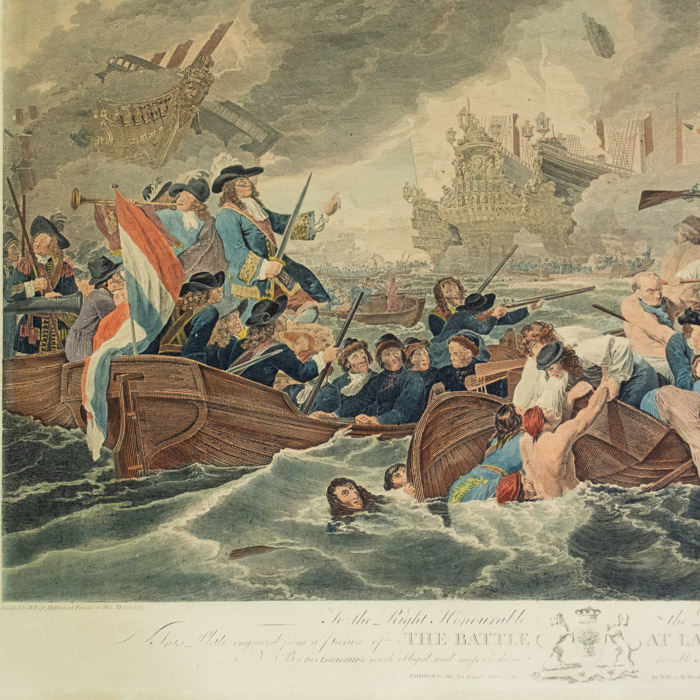
Standing in a boat at the left, for instance, Vice Admiral George Rooke embodies heroic command with his upright posture and raised sword. Yet, in order to survey the maneuvers, he undoubtedly gave orders from a distance. Beached in the center distance is the French flagship, the Royal Sun. Actually burned and sunk a few days before this encounter, the Royal Sun is here deliberately refloated — only to be run against the cliffs so that West might symbolize the French defeat. This complex, multi-figured panorama is an excellent example of West’s influential early style, and of the balanced designs and carefully blended brushwork of eighteenth-century neoclassicism.
The painting, which was exhibited in the 1780 Royal Academy exhibition, was so admired at the time that a faithful oil painting copy of West’s painting was commissioned for the Naval Gallery at Greenwich Hospital in London in 1836; it is now in the collection of the Greenwich Maritime Museum.
Benjamin West (1738-1820) was an American-born painter of historical and religious subjects as well as portraits, esteemed for his complex compositions and sophisticated glazing techniques. He spent most of his career in London, England, where he became one of the most prominent artists of the late-18th-century, painting some 60 pictures for King George III, and serving as president of the Royal Academy from 1792 until his death in 1820. Born in Pennsylvania, he worked as a portrait painter in eastern Pennsylvania and briefly in New York City before leaving for Italy in 1760 to study for three years, where he transcended the provincial style he had begun with and began incorporating the influences of Renaissance and Baroque artists and his contemporaries. He then moved to London, where he remained for the rest of his long life, never returning to the U.S. although he remained loyal to America. West educated a generation of major American-born artists who traveled to England to study with him before, during, and after the Revolution: Charles Wilson Peale, Gilbert Stuart, John Trumbull, Washington Allston, and Thomas Sully. These artists brought his ideas and techniques to the United States, providing a foundation for the development of American art during the Federal period. Benjamin West’s works today are in the collections of major museums around the world.
William Woollett was an engraver working in London, and one of the first English engravers to become well known in Continental Europe. A pupil of John Tinney, he studied at St. Martin’s Lane Academy. His earliest engravings were topographical plates published by Tinney from around 1755 to 1757. He worked for the prominent publisher John Boydell from 1760. He exhibited at the Society of Artists from 1760 to 1777 and became a member in 1766, also serving as secretary for several years. From 1775 to 1785 he served as Historical Engraver to the King. He was buried in Westminster Abbey.
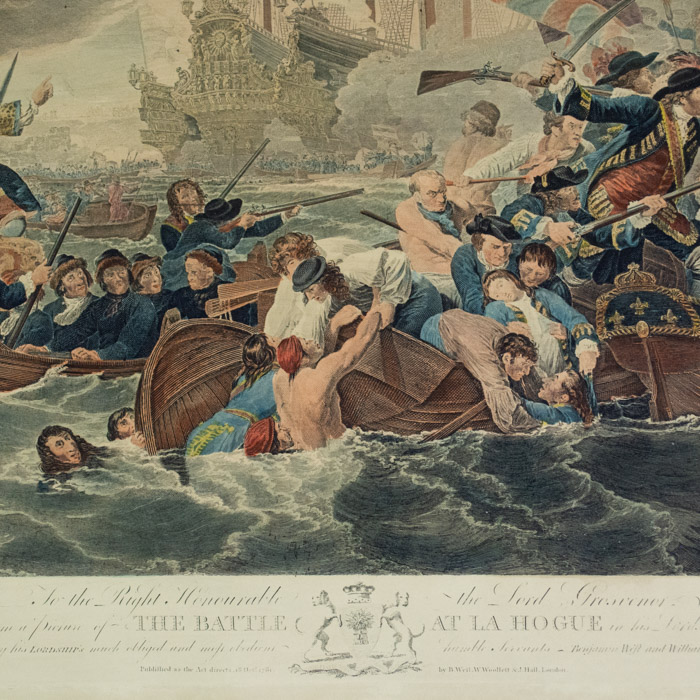
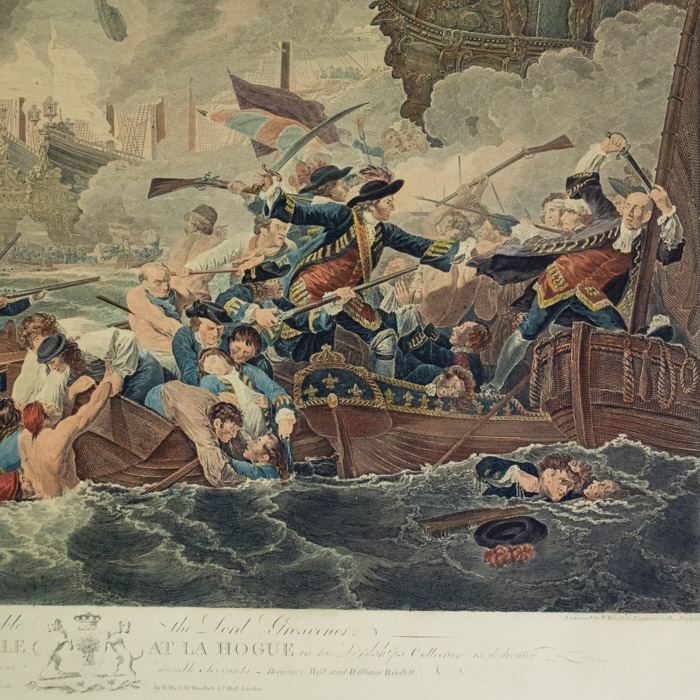
Dedication with title: To the Right Honourable the Lord Grosvenor, … by his Lordship’s much obliged and most obedient humble Servants — Benjamin West and William Woollett.
Condition: A fine example of this print with unusually large margins and vibrant early or original color. Generally very good, recently professionally cleaned and deacidified with light remaining toning, wear, handling, with some greater discoloration in margins where formerly matted.
References:
“Benjamin West.” National Gallery of Art. 2019. https://www.nga.gov/collection/artist-info.1970.html (27 June 2019).
Fagan, Louis. A Catalogue Raisonne of the Engraved Works of William Woollett. London: The Fine Art Society, Ltd., 1885. Items XVIII-XXV. pp. 11-12. Online at Google Books. http://books.google.com/books?id=pTIEAAAAYAAJ (3 June 2009).
Maxted, Ian. “The London book trades 1775-1800: a preliminary checklist of members.” Exeter Working Papers in British Book Trade History. 2001. http://bookhistory.blogspot.com/2007/01/london-1775-1800-w-z.html (3 June 2009).
“The Battle at La Hogue.” Library of Congress. https://www.loc.gov/item/2006676650/ (24 October 2023).
“The Battle of La Hogue, 1778.” National Gallery of Art. 2023. https://www.nga.gov/collection/art-object-page.45885.html (24 October 2023).
“The Battle of La Hogue, 23 May 1692.” Royal Museums Greenwich. https://www.rmg.co.uk/collections/objects/rmgc-object-11831 (24 October 2023).


