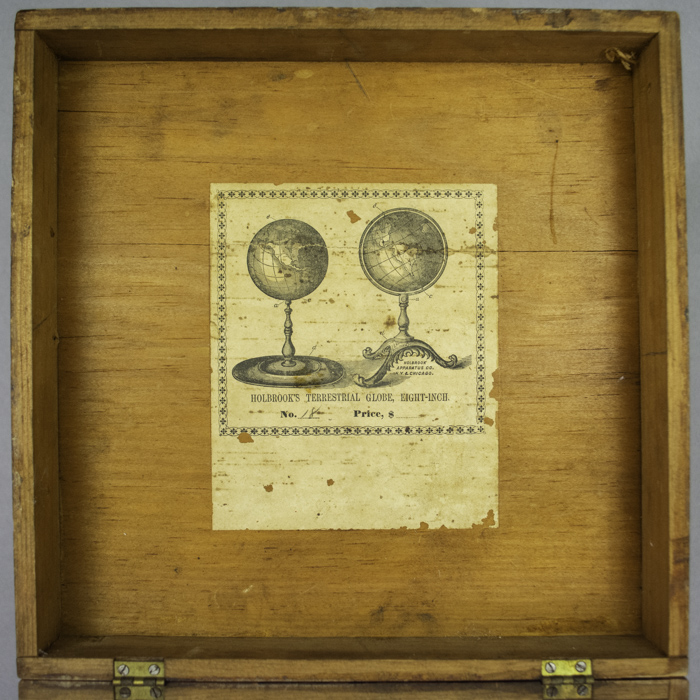
Description
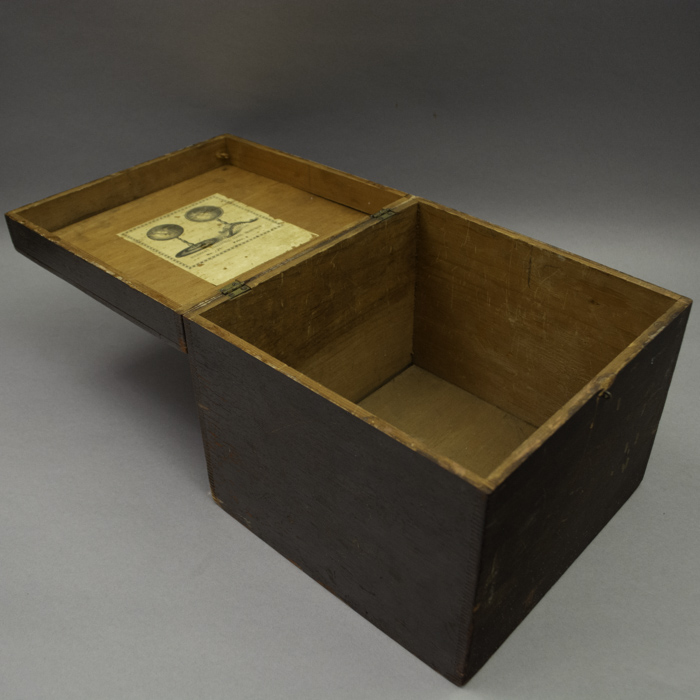
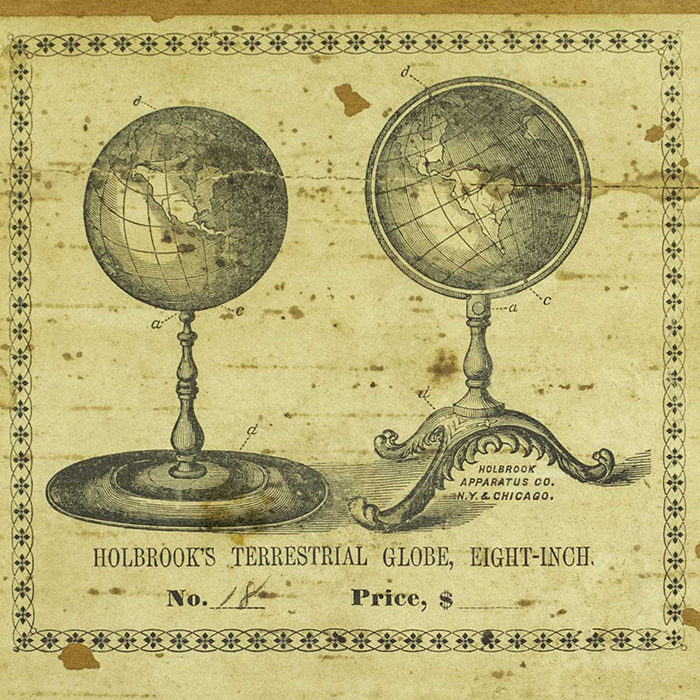
An identical illustration of the two globes side by side to the illustration label on the box appears in the 1858 third edition of The Teacher’s Guide to Illustration: A Manual to Accompany Holbrook’s School Apparatus, published by the Holbrook School Apparatus Company in New York and Chicago. In each illustration the company is referred to as “Holbrook Apparatus Co.” of New York and Chicago, without the word School before Apparatus. Nonetheless, inasmuch as the Guide uses the word School before Apparatus in the publishers name on the title page, the failure to include it that way in the illustration in either the box and Guide can be viewed as n oversight by the artist who drew the illustration.
In the Guide, the two eight-inch globes are described at length specifying the reasons for selecting the 8-inch diameter size, and other aspects of the globes:
NEW EIGHT-INCH TERRESTRIAL GLOBE.
WE would call the attention of Teachers, and others interested in schools, to our new Globe, which will be completed in September, 1858. Comparing it we have endeavored to supply a public want, and have had … to what is desired in public schools and private families.
REMEMBERING,
.1. That the common six-inch globes are too small to satisfy most schools and
families;
2. That the ten-inch ones are too expensive for very many;
3. That no globe made in this country gives any idea of Physical Geography;We decided to make one which should be
1. Large enough for common use in any Grammar or High School;
2. Just the size for the home Library;
3. Cheap enough to be in every school-room, and family;
4. A guide to Physical Geography of the sea, by showing the currents of the
ocean;
5. An ornament for the Teacher’s desk, or the Library;
6. Complete to the present time;In short a globe corresponding with our motto,
“Good enough for the best, and cheap enough for the poorest.”
As such we commend it.
It will be mounted in a style entirely new, and possessing many advantages; and also in the usual way with a horizon, for those in want of a more complete and expensive globe ; as well as on a simple pedestal for schools which wish one cheap and useful. A copy of our Globe Manual will accompany each globe.
Prices,
On simple stand,……………..…$ 8.00
In meridian circle,… ……….….$7.00 to $8.00
With horizon and quadrant…$10.00
Address at 413 Broadway, New York.,
” ” 194 Lake Street, Chicago, Ill.An example of the Holbrook eight-inch terrestrial globe is noted by Warner in the collection of the Kansas Museum of History by the Holbrook School Apparatus company with the following cartouche: “Eight Inch TERRESTRIAL GLOBE with latest discoveries and Oceanic currents. New York & Chicago Holbrook School Apparatus Co.” That example has a horizon band that is inscribed “Dwight Holbrook, Designer and Manufacturer.”
The Holbrook globe making family traces its origins to Josiah Holbrook (1788–1854), founder of the American Lyceum movement and a pioneer of object-based pedagogy, who began producing educational apparatus in Connecticut in the 1830s and subsequently relocated his business to New York City. His sons Alfred and Dwight established a “Lyceum Village in Berea, Ohio in 1840, operating the family enterprise as Holbrook & Co. Dwight returned to Connecticut in about 1854, opening a manufacturing company in Wethersfield, Connecticut, notably making use of contract labor from the Wethersfield State Prison. In 1855, Dwight opened a salesroom in Hartford under the name Holbrook School Apparatus Co., trading under the motto “Good enough for the best, and cheap enough for the poorest.” Dwight and Alfred Holbrook discontinued direct retail in about 1860 and transitioned to distribution through school suppliers including A.H. Andrews of Chicago and James W. Queen of Philadelphia. Dwight’s son Charles succeeded to the business in the 1870s, locating in Chicago as it emerged as a major railroad hub and center of map and globe production.
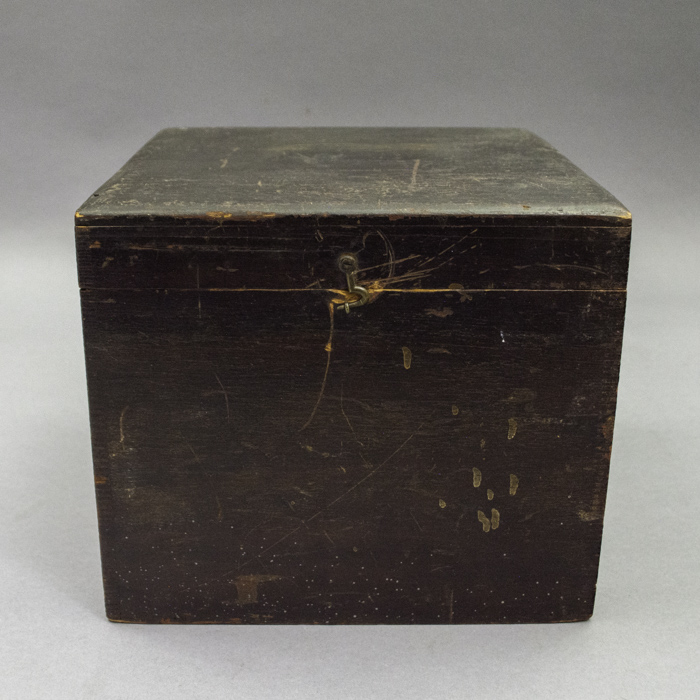
American globe-maker catalogs of the period document that certain globes were shipped from the company to the purchaser (generally a school) in plain utilitarian boxes of this type for storage and transit. A few larger Holbrook boxes survive containing other apparatus: orreries, tellurians, and geometric teaching blocks. Slightly more elaborate globe boxes by competitors such as A.H. Andrews in the later 19th century opened to form a hanging shelf for display. Surviving examples of American globes retained in their original boxes are quite rare, and as indicated above, the present example is of documentary interest for its label, with illustrations identical to the aforementioned catalog entry of 1858.
Condition: Generally very good, with considerable wear, abrasions, and light indentations to the surface commensurate with use as a utilitarian shipping box.
References:
Brownell, F.C.. The Teacher’s Guide to Illustration: A Manual to Accompany Holbrook’s School Apparatus, 3rd ed. (New York and Chicago: Holbrook School Apparatus Company, 1858).
Dekker, Elly and van der Krogt, Peter. Globes from the Western World. London: Zwemmer, 1993. p. 175.
Sumira, Sylvia. Globes: 400 Years of Exploration, Navigation and Power. Chicago: University of Chicago Press, 2014. p. 31.
Warner, Deborah Jean. “The Geography of Heaven and Earth.” Rittenhouse Journal of the American Scientific Instrument Enterprise, Vol. 2, No. 3. 1987. pp. 94–98.
Yonge, Ena L. A Catalogue of Early Globes, Library Series No. 6. American Geographical Society, 1968.