
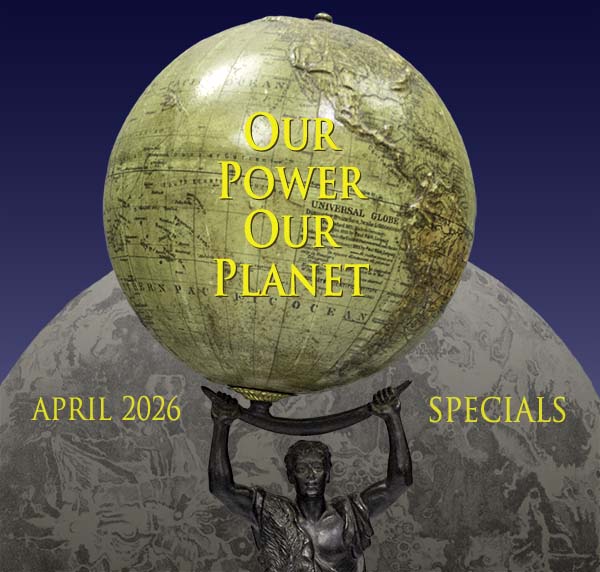
In this issue: Our April Enewsletter celebrates Earth Day and its 2026 globe theme “Our Power, Our Planet.” This slogan reflects this special selection of globes, maps, and natural history prints.
Contact us for further assistance and gift selection ideas relating to any profession or pastime. Availability of items below subject to prior sale. You can also view them on our website.
Each item is also specially curated for perfect gift giving for the early Holiday shopper.
Contact us for further assistance and gift selection ideas.
As featured in our latest eNewsletters — subscribe now.
Availability of items below subject to prior sale.
Sale prices in effect through May 20, 2026.
GLOBAL REACH
POWER TO THE PEOPLE
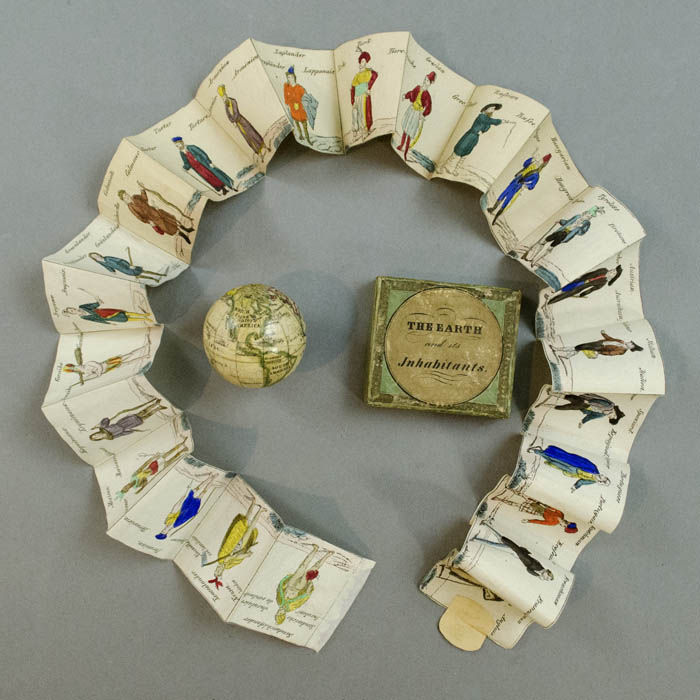
In The Earth and its Inhabitants, the peoples of the world accompany a miniature globe and are connected as a leporello — their printed images in a single strip, folded back-and-forth like an accordion. Produced in Germany, the world globe is in English for the export market. Regularly $7,500, reduced for Earth Day to $6,750. More information.

CARRYING THE WEIGHT OF THE WORLD
In ancient Greek mythology carrying the Earth represented taking on the burdens of the world. A fine figural example is this 8-inch terrestrial raised relief physical globe dated 1921, held aloft by Hercules, who wears the pelt of the defeated Nemean lion. The globe was produced by Paul Rath of Leipzig, Germany with place names in English. Regularly $6,800, sale price $5,500. More information.

ON TOP OF THE WORLD WITH TOPONOMY
Because antique globes often feature outdated place names and borders, they serve as a metaphor reminding us that our current world is just a snapshot in time. On this Rand McNally 12-inch globe, Istanbul is shown with the toponymic notation “Constantinople” in parentheses, indicating a date soon after 1930 when the name change occurred. For more superseded geographical names one can consult the atlas book contained in the wooden globe stand. Regularly $1,650, in this enews $1,400. Priced at $900, discounted to $800. More information.
THE LITTLE THINGS THAT RUN THE WORLD
Biodiversity pioneer Edward O. Wilson famously coined this phrase to describe insects and other invertebrates, highlighting that although small, they anchor natural systems.

STIR UP A HORNET'S NEST
Plate 6 of E.A. Séguy's famous 1924 portfolio Insectes [Insects] features illustrations of wasps and other similar winged insects. In keeping with the style of the first 16 plates in the series, it showcases five enlarged specimens arranged in a vibrant composition designed to highlight their natural patterns, colors, and the intricate details of their wings and veins. On sale for $1,200. Please inquire as to other Seguy insects and butterflies we have for sale as well. More information.

TURN AND FACE THE STRANGE CH-CH-CHANGES
The metamorphosis from caterpillar to moth or butterfly are explored in prints from The Aurelian by Moses Harris, a highly regarded late 18th century Enlightenment Era natural history work on varieties found in England. Drawn after live specimens, each print depicts their life cycle stages with plants on which they feed. They are displayed in elaborate gold leaf frames with custom foliate corners. Regularly $3,600, the set of four; sale price $3,200. More information.
COME RAIN OR SHINE
YOU'VE GOT MAELSTROM
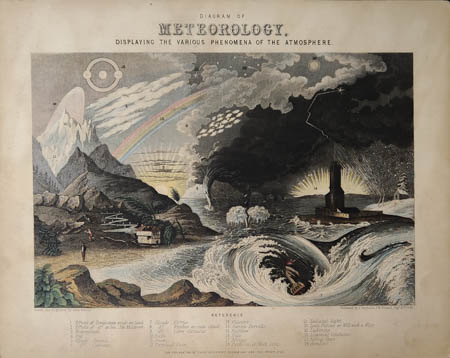
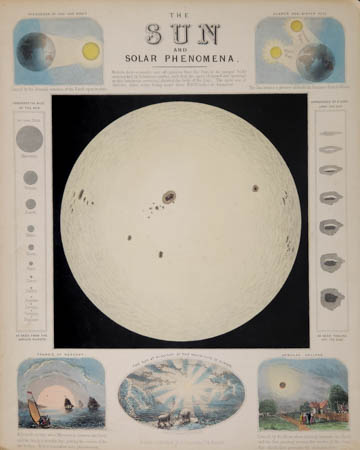
The powerful swirling currents of a maelstrom are just one of many weather-related phenomena combined into a single scene In James Reynolds' Diagram of Meteorology, London 1846 (above). Though based in science, this illustration prioritizes the drama and sublime power of nature. Another visually compelling Reynolds print shows The Sun and Solar Phenomena (left). Each now $375. More information.
SOLAR POWER
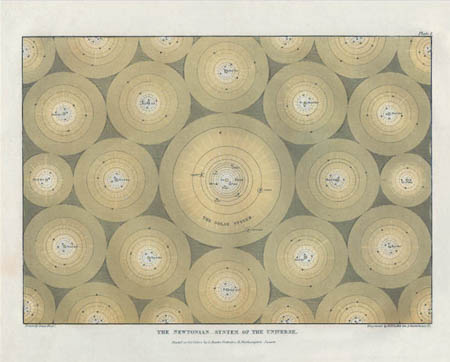
A different representation of the sun from the same period is Isaac Frost’s Plate 1, The Newtonian System of the Universe. In this diagram the universe is shown as a series of independent solar systems of various sizes. For each, a central bright yellow sun emanates white and yellow rays, and is surrounded by concentric circles representing the orbits of planets. This print is one of a series of six astronomical engravings based on beliefs associated with a Victorian sect known as the Muggletonians, who believed that Newton was wrong and the Earth is the center of the universe. Despite the pseudoscientific content, these prints are admired today for their luminousity, produced by an innovative oil color technique. $375 as a single print. The set of six from this series is on sale for $2,000. More information.
THE HORSE RULES THE EARTH, THE EAGLE RULES THE SKY
HORSE POWER
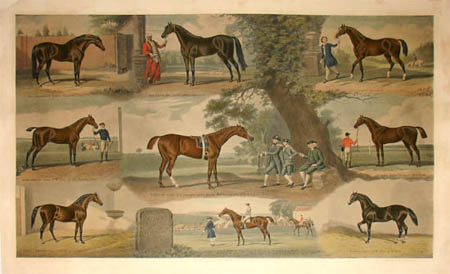
It has been said that power requires both a grounded, energetic force (the horse) and a high, spiritual perspective (the eagle). Powerful thoroughbred stallions are illustrated in Fathers of the Turf 1683-1822, a large colorful print incorporating nine equine portraits. At the center is the exceptional racehorse Eclipse. Regularly $1,800; for enews subscribers $1,575. More information.
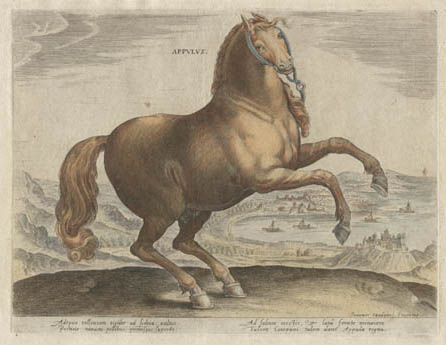
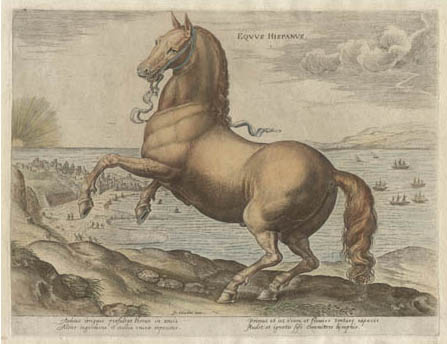
In a pair of Old Master horse portraits, an Apulian horse and a Spanish horse are among prize breeds from the stables of John of Austria (1547-1578), son of Emperor Charles V. They were engraved after works by Flemish painter and draftsman Jan van der Straet, known as Stradanus (1523-1605). Regularly $1,100, the pair, sale price $950. More information.
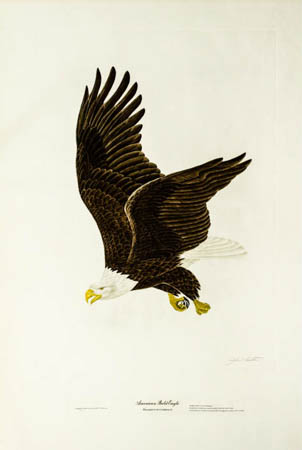
The American Bald Eagle in flight makes a striking silhouette, with wings overhead, claws curled, and tail feathers spread. This aquatint was produced by the prolific ornithological artist John Ruthven to commemorate the United States Bicentennial in 1976. Like many of Ruthven’s bird paintings, it presents a species that has either disappeared or been threatened with extinction by human activity. Thanks to conservation efforts, the bald eagle population has made a dramatic recovery — a positive note on which to conclude our Earth Day enews. Regularly $675; sale price $575. More information.