Description
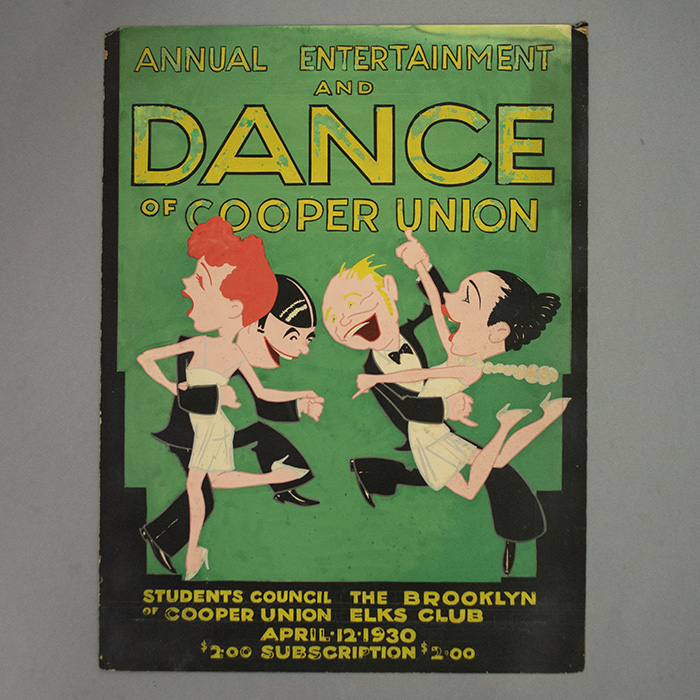
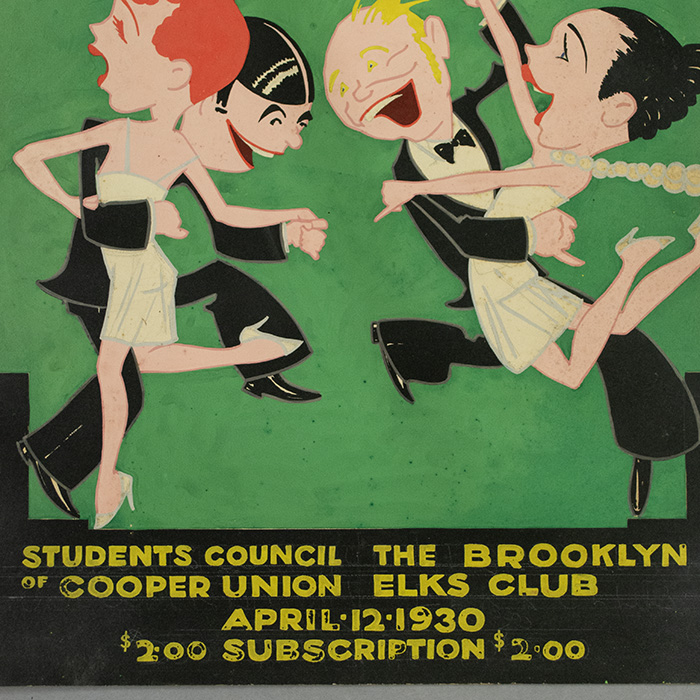
The Cooper Union. Founded in 1859 by industrialist Peter Cooper, The Cooper Union for the Advancement of Science and Art is one of the most prestigious institutions in the United States, historically known for providing full-tuition scholarships to all students. During the early 20th century, the student body was largely comprised of working-class commuters. The “Students Council,” mentioned on the poster, played a critical role in fostering a cohesive campus life for students who otherwise had little opportunity for socializing. In 1930, the school established a “Joint Student Council” to better unify the Day and Night schools; this dance was likely a major effort by that body to build school spirit and “good-fellowship” among the engineering and art students.
The Brooklyn Elks Club. The venue listed, the Brooklyn Elks Lodge No. 22, was located at 110 Livingston Street in Downtown Brooklyn. The building, a massive Renaissance Revival structure designed by the renowned architectural firm McKim, Mead & White, opened in 1926. It was a premier social hub in the borough, featuring a banquet hall, bowling alleys, and suites, and frequently hosted high-society dances, civic gatherings, and boxing matches. Hosting the Cooper Union annual dance at such a lavish, recently built venue underscores the importance of the event in the school’s social calendar.
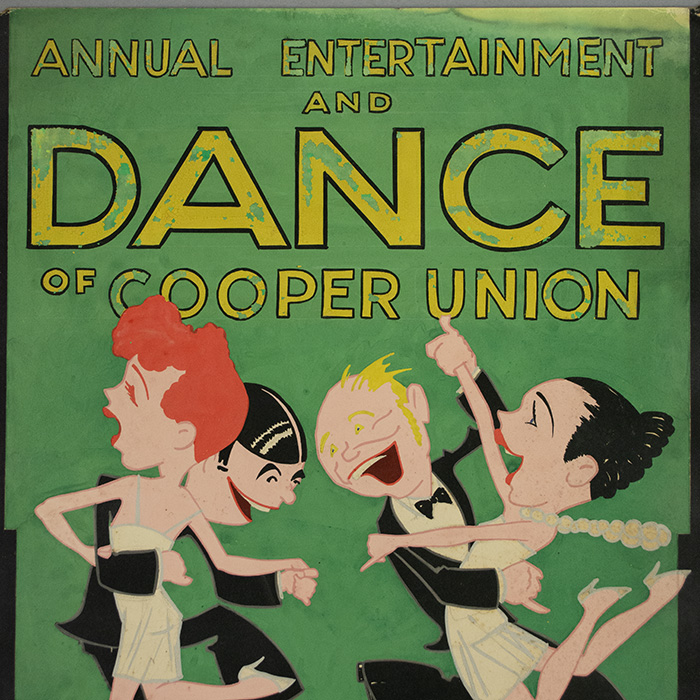
John Held Jr. (1889–1958) Influence. This work is rendered in the spirited, caricature style popularized by the renowned illustration artist John Held, Jr. His work often included college subjects and themes, thus making it appropriate for inspiration by Cooper Union college students at this time. Held was the preeminent illustrator of the Jazz Age, whose art defined the visual spirit of the “Roaring Twenties.” Born in Salt Lake City, he sold his first cartoon at age 15 and eventually moved to New York, where his sharp, satirical drawings became ubiquitous in magazines like Life, The New Yorker, and Vanity Fair. Held is best known for creating the quintessential flapper archetype—characters he named “Betty Co-ed” and her escort “Joe College”. His illustrations featured thin, flat-chested women with short “shingle bob” hair, rolled-down stockings, and long cigarette holders. He captured the era’s “Flaming Youth” engaged in the Charleston, driving fast cars, and attending rowdy parties. While sometimes debated by historians, Held’s work is deeply associated with the Art Deco movement due to its specific visual hallmarks. Following the 1929 stock market crash, the demand for Held’s carefree “college-age” imagery declined. He spent his later years focusing on more serious fine art, including watercolor landscapes, animal sculptures, and teaching as an artist-in-residence at Harvard and the University of Georgia.
Condition
Generally very good, with the usual overall light toning, wear, handling, and soft creases, including professional restoration to some of the corners, expected for working art/signage of this period. Minor dampstain upper right margin. Some flaking, including minor losses of paint, particularly the bold yellow lettering.
References
Armitage, Shelley. John Held, Jr.: Illustrator of the Jazz Age. Syracuse: Syracuse University Press, 1987.
Cooper Union Student Council. The Cable. New York: Cooper Union, 1930.
Gray, Christopher. “Streetscapes: The Elks Lodge; A Renaissance Palace for Brooklyn’s ‘Best People’.” The New York Times 23 Apr. 2000. https://www.nytimes.com/2000/04/23/realestate/streetscapes-the-elks-lodge-a-renaissance-palace-for-brooklyn-s-best-people.html (9 Feb. 2026).
“History of the Cooper Union.” The Cooper Union. 2024. https://cooper.edu/about/history (9 Feb. 2026).
White, Norval, and Elliot Willensky. AIA Guide to New York City. 4th ed. New York: Crown Publishers, 2000.