
Description
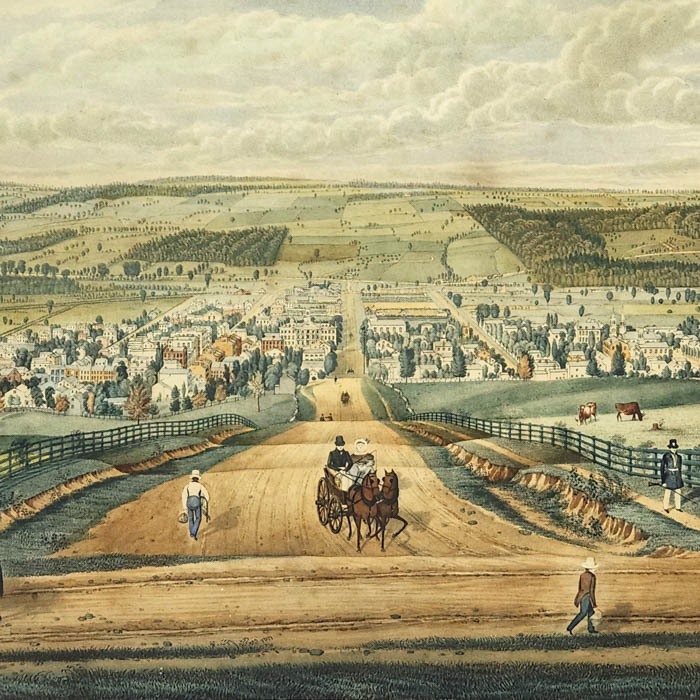
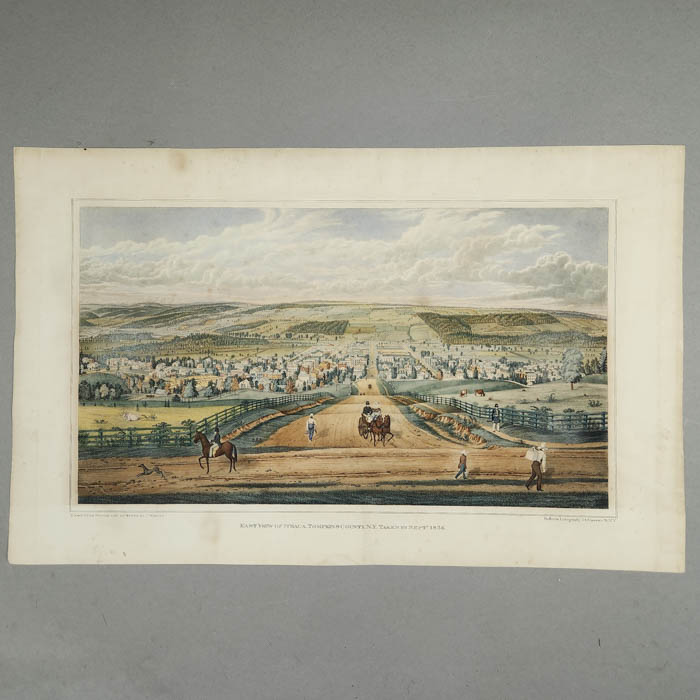
Gloria Gilda Deák describes this striking lithograph in her book Picturing America, a compendium of important American 19th Century views in the New York Public Library collection:
Precise architectural and topographic renderings are typical of the town views of Henry Walton, whose work contains a strong blend of artistic sophistication and naiveté. Few details are lost in his somewhat ambitious panorama of Ithaca taken from East, or College, Hill, looking west down Seneca Street.
Deák includes an analysis by John W. Reps, one of the foremost scholars on American views:
In his depictions of towns Walton relied on what he could see from vantage points on nearby elevations. Because the region where he worked is hilly, his views resemble the later views of others who selected imaginary viewpoints and showed their subjects as if seen from the air. Walton probably did make close-up sketches of prominent buildings so that he could render their details accurately in smaller size, but he was essentially an easel artist.
Henry Walton was an American painter, draftsman, and lithographer known for his highly detailed town views and portraiture. His work is characterized by a refined balance between artistic interpretation and cartography. A resident of upstate New York, Walton was drawn to the landscape and created a series of town views documenting the changing American scenery at the time. Walton is best known for his lithographs of New York towns. He later transitioned into portrait painting.
John Henry Bufford (1810-1870) was an influential lithographer of the 19th century. Bufford helped refine the American lithographic process and introduced new shading and color techniques to the industry. His firm, Bufford’s Lithography, produced a wide range of views, portraits, and commercial prints that shaped visual culture in the antebellum United States. Bufford began as an apprentice of William S. Pendleton in Boston, then came to New York and worked for Endicott and for Nathaniel Currier (who soon thereafter founded Currier & Ives). Bufford worked under his own name in New York from 1835 to about 1840, then returned to Boston, where he first worked in association with B.W. Thayer until 1844. From 1845, he was in business as J.H. Bufford & Co., a major lithographic establishment of the period, though he still sometimes co-published works with other companies. Bufford’s work was wide ranging in subject and of high quality, encompassing many important views of Boston, New York, and New England; a major series of whaling subjects; portraits, including an important one of Abraham Lincoln; Civil War scenes; genre prints; and music sheets. Among his apprentices from 1855 to 1857 was the young Winslow Homer, who later became one of America’s greatest artists. Prints from 1865 to 1867 bear the name of J.H. Bufford & Sons. Bufford ran his firm until his death in 1870, after which his sons took over operations for several years. In his classic reference work on American lithography, Harry T. Peters says of Bufford: “His work is almost invariably good, his sense of the essential in the general field seems to have been second only to that of Currier & Ives, his importance can be seen, and his contribution to Americana is in the very first rank” (Peters, 127).
Condition: Generally very good, recently professionally cleaned and deacidified with light remaining toning, wear, handling, soft creases. Occasional remaining scattered light pale foxing and discolorations from former backing, unobtrusive.
References:
Deák, Gloria Gilda. Picturing America. Princeton University Press: 1989. Item 475, pp. 308.
Groce, George C. and Wallace, David H. The New-York Historical Society’s Dictionary of Artists in America 1564-1860. New Haven: Yale University Press, 1969. p. 94 (Bufford).
“Henry Walton.” Wikipedia. https://en.wikipedia.org/wiki/Henry_Walton_%28American_painter%29?utm_source=chatgpt.com (12 March 2025).
“John Henry Bufford.” American Scoop. https://www.america-scoop.com/index.php/en/reporters/painters/1839-storck-william-penniman-19xx-usa-2 (12 March 2025).