Mark Catesby (1683-1749) (artist and etcher)
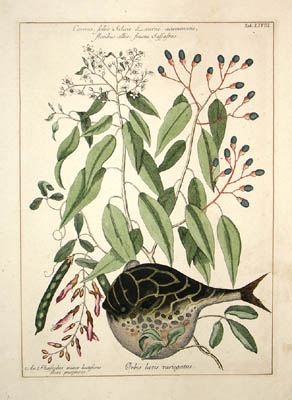
Orbis Laevis Variegatus: The Globe Fish; Cornus, foliis Salicis Laureae acuminatis; floribus albis; fructu Sassafras; An Phaseolus minor lactescens flore purpureo. T. 28
from The Natural History of Carolina, Florida, and the Bahama Islands
London: 1771-75 (third edition)
Hand-colored engraving on wove paper
14.25 x 10.25 inches, plate mark
19 x 12.5 inches, average overall
Sold, please inquire as to the availability of similar items.

Mark Catesby Fish Engravings
Pilchard, Bone Fish, and Globe Fish
Pilchard, Bone Fish, and Globe Fish
This item is sold. It has been placed here in our online archives as a service for researchers and collectors.
- Please inquire as to the availability of similar items currently in stock, or use the navigation bar above to browse our site for currently available items.
- Find guidelines for the use of images from georgeglazer.com.
- To see more archived items, view our directory.
- Find information about selling your art and antiques.
 |
 |
To see other Catesby prints on our site, use our site search engine.
One of a series of natural history prints of fish and plants native to the Bahama Islands, from Volume II of Mark Catesby’s The Natural History of Carolina, Florida and the Bahama Islands. The plates shown here are from the 1771 edition, which added the Linnaean names of the plants and animals depicted. The University of Wisconsin has placed scans of the pages of the 1754 second edition containing these plates and Catesby’s text about them online and the University of Virginia has text transcriptions on their web site (see References below).
Orbis Laevis Variegatus: The Globe Fish... depicts a strikingly patterned spherical fish against the branches of a tree Catesby calls Cornus, shown in different stages of the development of the flowers and fruit, and a bean plant he refers to as "Phaseolus minor lactescens."Catesby wrote the following description of this print (bearing his original punctuation, spelling and capitalization):
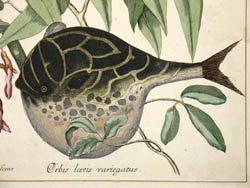
Orbis Laevis Variegatus: The Globe Fish.
This Fish (no doubt of it) has received its Name from the Form, which is almost globular, except that the Tail extends beyond the spherical Form. It has a small Mouth, near which the Eyes are placed, and behind them two small Fins, the Fin of the Tail is forked. The upper part of the body of an Olive Colour, marked with many irregular curved white Stripes; the Belly dusky white. These Fish are found in Virginia and many other Parts of America.
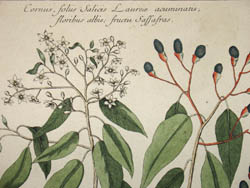
Cornus, foliis Salicis Laureae acuminatis; floribus albis; fructu Sassafras.
This Tree is usually but of small Stature, growing to the Height of about sixteen feet; the Leaves grow alternately on Foot-stalks of about an Inch long, they resemble somewhat those of the common Bay, but are more taper and pointing at the End; they are light green, smooth and shining: on the Tops of the Branches are placed many small white hexapetalous flowers, which are succeeded by green Berries in a reddish Calix, growing to red Foot-stalks of an Inch long, resembling much the Berries of Sassafras.
An Phaseolus minor lactescens flore purpureo.
This Plant creeps up, and is supported by Trees and Shrubs near which it grows, the Leaves are trifoliate, the Flowers papilionaceous, and of a purple Colour, succeeded by Pods, like those of our common Pease, but thicker, more rounding, and somewhat less; these Pods contain usually seven or eight small round brown Pease.
This Fish (no doubt of it) has received its Name from the Form, which is almost globular, except that the Tail extends beyond the spherical Form. It has a small Mouth, near which the Eyes are placed, and behind them two small Fins, the Fin of the Tail is forked. The upper part of the body of an Olive Colour, marked with many irregular curved white Stripes; the Belly dusky white. These Fish are found in Virginia and many other Parts of America.
Cornus, foliis Salicis Laureae acuminatis; floribus albis; fructu Sassafras.
This Tree is usually but of small Stature, growing to the Height of about sixteen feet; the Leaves grow alternately on Foot-stalks of about an Inch long, they resemble somewhat those of the common Bay, but are more taper and pointing at the End; they are light green, smooth and shining: on the Tops of the Branches are placed many small white hexapetalous flowers, which are succeeded by green Berries in a reddish Calix, growing to red Foot-stalks of an Inch long, resembling much the Berries of Sassafras.
An Phaseolus minor lactescens flore purpureo.
This Plant creeps up, and is supported by Trees and Shrubs near which it grows, the Leaves are trifoliate, the Flowers papilionaceous, and of a purple Colour, succeeded by Pods, like those of our common Pease, but thicker, more rounding, and somewhat less; these Pods contain usually seven or eight small round brown Pease.
Catesby’s important work was the first comprehensive publication on the natural history of the New World, and it influenced Audubon and Linnaeus among others. The original work contained 220 fine hand-colored, folio size plates after his natural history paintings, many of which he etched himself, together with descriptions in English and French. Almost half the pictures depicted birds, the rest portrayed various animals and plants. In 1754, George Edwards (1694-1773) revised and reissued both volumes (the second edition) and in 1771 the publisher Benjamin White reissued Edward's edition, adding Linnaean names to all Catesby's plants and animals (the third edition).
Mark Catesby, a British scientist and illustrator, trained as a botanist. Beginning in 1712, he spent seven years in Virginia, amassing collections of plant and animal specimens which he shipped back to wealthy patrons in England. With their encouragement, he undertook his Natural History, returning to North America for an extended stay in 1722 as well as learning etching so he could control the quality of the final product. His depictions of birds, which comprise 109 of the 220 illustrations, contributed to the development of ornithological illustration due to several innovative qualities: their naturalism, the use of foliage backgrounds and the folio format. For decades Catesby’s books remained the definitive source for information about New World birds, consulted by the likes of Linnaeus, Thomas Jefferson and Lewis and Clark.
References:
Amacker, Kristy. “Mark Catesby’s Natural History.” Mark Catesby’s Natural History: American Studies at the University of Virginia. http://xroads.virginia.edu/~ma02/amacker/etext/pre_4.htm (16 August 2004).
Amacker, Kristy. “Volume II Contents.” Mark Catesby’s Natural History: American Studies at the University of Virginia. http://xroads.virginia.edu/~ma02/amacker/etext/vol_II_cont.htm (21 June 2005).
Stewart, Doug. “Abstract of an Article on Mark Catesby” Smithsonian Magazine. September 1997. http://www.smithsonianmag.si.edu/smithsonian/issues97/sep97/catesby.html (25 June 2004).
The Library of H. Bradley Martin: Magnificent Color-Plate Ornithology. New York: Sotheby’s, 1989. pl. 65.
“The Natural History of Carolina, Florida and the Bahama Islands...” Digital Library for Decorative arts and Material Culture, University of Wisconsin. http://digital.library.wisc.edu/1711.dl/DLDecArts.CateNatHisV2 (21 June 2005).