Mark Catesby (1683-1749) (artist and etcher)
Harengus Minor, Bahamensis: The Pilchard; Arbor Populi nigrae foliis, fructu reni-formi mono-spermo. T. 24.
from The Natural History of Carolina, Florida, and the Bahama Islands
London: 1771-75 (third edition)
Hand-colored engraving on wove paper
14.25 x 10.25 inches, plate mark
19 x 12.5 inches, average overall
Sold, please inquire as to the availability of similar items.

Mark Catesby Fish Engravings
Pilchard, Bone Fish, and Globe Fish
Pilchard, Bone Fish, and Globe Fish

 |
 |
To see other Catesby prints on our site, use our site search engine.
One of a series of natural history prints of fish and plants native to the Bahama Islands, from Volume II of Mark Catesby’s The Natural History of Carolina, Florida and the Bahama Islands. The plates shown here are from the 1771 edition, which added the Linnaean names of the plants and animals depicted. The University of Wisconsin has placed scans of the pages of the 1754 second edition containing these plates and Catesby’s text about them online and the University of Virginia has text transcriptions on their web site (see References below).
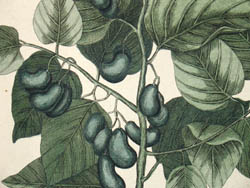
Harengus Minor, Bahamensis: The Pilchard... presents a still life of Bahamanian flora and fauna consisting of a pilchard, a small silver-scaled fish, resting at the base of a tree with broad green leaves and black kidney-shaped fruit, called Populi nigra foliis.
Catesby wrote the following description of this print (bearing his original punctuation, spelling and capitalization):
Harengus Minor, Bahamensis: The Pilchard.
These Fish are very numerous in the Shallows near the low and flat Parts of the Bahama Islands, they are carried through small Channels a little Way within Land, where vast Quantities of them are taken at the ebbing of the Tide, by the Inhabitants stopping up the Channels they came in at; They are small silver-scaled Fish, resembling somewhat a Herring, but smaller and tolerable good Food.
Arbor, Populi nigra foliis; fructu reni-formi mono-spermo.
This large Shrub or small Tree, was of the Height of about twelve Feet with Leaves, resembling those of the black Popler, set alternatly, The Fruit are somewhat of the Form of a Kidney, tho' more resembling the Nut or Seed of the Accajou, but not so big; The Fruit, though not mature, seemed to be at full Bigness and was single dividing in the middle like a Bean, and that enclosed in a Film or thin Skin, three or four hanging in a Cluster on Footstalks about an Inch long. The Flowers I never saw: It grows near the Sea.
These Fish are very numerous in the Shallows near the low and flat Parts of the Bahama Islands, they are carried through small Channels a little Way within Land, where vast Quantities of them are taken at the ebbing of the Tide, by the Inhabitants stopping up the Channels they came in at; They are small silver-scaled Fish, resembling somewhat a Herring, but smaller and tolerable good Food.
Arbor, Populi nigra foliis; fructu reni-formi mono-spermo.
This large Shrub or small Tree, was of the Height of about twelve Feet with Leaves, resembling those of the black Popler, set alternatly, The Fruit are somewhat of the Form of a Kidney, tho' more resembling the Nut or Seed of the Accajou, but not so big; The Fruit, though not mature, seemed to be at full Bigness and was single dividing in the middle like a Bean, and that enclosed in a Film or thin Skin, three or four hanging in a Cluster on Footstalks about an Inch long. The Flowers I never saw: It grows near the Sea.
Catesby’s important work was the first comprehensive publication on the natural history of the New World, and it influenced Audubon and Linnaeus among others. The original work contained 220 fine hand-colored, folio size plates after his natural history paintings, many of which he etched himself, together with descriptions in English and French. Almost half the pictures depicted birds, the rest portrayed various animals and plants. In 1754, George Edwards (1694-1773) revised and reissued both volumes (the second edition) and in 1771 the publisher Benjamin White reissued Edward's edition, adding Linnaean names to all Catesby's plants and animals (the third edition).
Mark Catesby, a British scientist and illustrator, trained as a botanist. Beginning in 1712, he spent seven years in Virginia, amassing collections of plant and animal specimens which he shipped back to wealthy patrons in England. With their encouragement, he undertook his Natural History, returning to North America for an extended stay in 1722 as well as learning etching so he could control the quality of the final product. His depictions of birds, which comprise 109 of the 220 illustrations, contributed to the development of ornithological illustration due to several innovative qualities: their naturalism, the use of foliage backgrounds and the folio format. For decades Catesby’s books remained the definitive source for information about New World birds, consulted by the likes of Linnaeus, Thomas Jefferson and Lewis and Clark.
References:
Amacker, Kristy. “Mark Catesby’s Natural History.” Mark Catesby’s Natural History: American Studies at the University of Virginia. http://xroads.virginia.edu/~ma02/amacker/etext/pre_4.htm (16 August 2004).
Amacker, Kristy. “Volume II Contents.” Mark Catesby’s Natural History: American Studies at the University of Virginia. http://xroads.virginia.edu/~ma02/amacker/etext/vol_II_cont.htm (21 June 2005).
Stewart, Doug. “Abstract of an Article on Mark Catesby” Smithsonian Magazine. September 1997. http://www.smithsonianmag.si.edu/smithsonian/issues97/sep97/catesby.html (25 June 2004).
The Library of H. Bradley Martin: Magnificent Color-Plate Ornithology. New York: Sotheby’s, 1989. pl. 65.
“The Natural History of Carolina, Florida and the Bahama Islands...” Digital Library for Decorative arts and Material Culture, University of Wisconsin. http://digital.library.wisc.edu/1711.dl/DLDecArts.CateNatHisV2 (21 June 2005).