Mark Catesby (1683-1749) (artist and etcher)
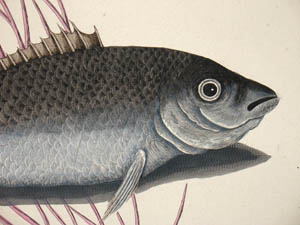
Mormyrus ex cinereo nigricans; The Bone-Fish; Corallina fruticosa elatior ramis quaqua-versum expansis teretibus; The Sea-Feather. T. 13.
from The Natural History of Carolina, Florida, and the Bahama Islands
London: 1771-75 (third edition)
Hand-colored engraving on wove paper
14.25 x 10.25 inches, plate mark
19 x 12.5 inches, average overall
Sold, please inquire as to the availability of similar items.

Mark Catesby Fish Engravings
Pilchard, Bone Fish, and Globe Fish
Pilchard, Bone Fish, and Globe Fish
This item is sold. It has been placed here in our online archives as a service for researchers and collectors.
- Please inquire as to the availability of similar items currently in stock, or use the navigation bar above to browse our site for currently available items.
- Find guidelines for the use of images from georgeglazer.com.
- To see more archived items, view our directory.
- Find information about selling your art and antiques.

To see other Catesby prints on our site, use our site search engine.
One of a series of natural history prints of fish and plants native to the Bahama Islands, from Volume II of Mark Catesby’s The Natural History of Carolina, Florida and the Bahama Islands. The plates shown here are from the 1771 edition, which added the Linnaean names of the plants and animals depicted. The University of Wisconsin has placed scans of the pages of the 1754 second edition containing these plates and Catesby’s text about them online and the University of Virginia has text transcriptions on their web site (see References below).
Mormyrus ex cinereo nigricans: The Bone-Fish... shows a fish identified by Catesby as a bonefish, casting a shadow on a spiky ocean plant identified as the Sea-Feather. Catesby notes that the Bone-Fish is common in the Bahamas, while the Sea-Feather grows underwater from Virginia to the Bahamas.Catesby wrote the following description of this print (bearing his original punctuation, spelling and capitalization):
Mormyrus ex cinereo nigricans: The Bone-Fish.
The Back of this Fish was dark-brown, the Belly white, the Iris of the Eye white; On the Back was one long spiny Finn: Behind the Gills were two more, and one behind the Anus; the Tail black and large, making a very wide Fork. They are in Plenty on the Coasts of the Bahama-Islands; and as I remember are called there Bone-Fish.
Corallina fruticosa elatior ramis quaqua-versum expansis teretibus: The Sea-Feather.
The Size of these Plants is various some growing to the Height of three Feet, tho' usually a Foot, and a Foot and half spreading into long Slender pliant, stalks of an Horny transparent Substance of a light brown Colour; but incrusted over with a purple or reddish coralline Coat or Bark. The horny Part diverted of the coralline burns and stinks like common Horn. They grow in the Sea usually in five, or ten and fifteen Fathom Water, and are frequently found on the Shores of Virginia, Carolina, and sometimes on the Bahama Islands. These Plants do not grow horizontally, but upright as most Land-Plants doe, as doth also the great Sea-Fan; which is usually thought to grow horizontally. This Mistake I conceive [sic.] proceeds from the Structure of that Plant, judging it from its flat and close Contexture not able to withstand the Impetuosity of the Waves but in that Position.
The Back of this Fish was dark-brown, the Belly white, the Iris of the Eye white; On the Back was one long spiny Finn: Behind the Gills were two more, and one behind the Anus; the Tail black and large, making a very wide Fork. They are in Plenty on the Coasts of the Bahama-Islands; and as I remember are called there Bone-Fish.
Corallina fruticosa elatior ramis quaqua-versum expansis teretibus: The Sea-Feather.
The Size of these Plants is various some growing to the Height of three Feet, tho' usually a Foot, and a Foot and half spreading into long Slender pliant, stalks of an Horny transparent Substance of a light brown Colour; but incrusted over with a purple or reddish coralline Coat or Bark. The horny Part diverted of the coralline burns and stinks like common Horn. They grow in the Sea usually in five, or ten and fifteen Fathom Water, and are frequently found on the Shores of Virginia, Carolina, and sometimes on the Bahama Islands. These Plants do not grow horizontally, but upright as most Land-Plants doe, as doth also the great Sea-Fan; which is usually thought to grow horizontally. This Mistake I conceive [sic.] proceeds from the Structure of that Plant, judging it from its flat and close Contexture not able to withstand the Impetuosity of the Waves but in that Position.
Catesby’s important work was the first comprehensive publication on the natural history of the New World, and it influenced Audubon and Linnaeus among others. The original work contained 220 fine hand-colored, folio size plates after his natural history paintings, many of which he etched himself, together with descriptions in English and French. Almost half the pictures depicted birds, the rest portrayed various animals and plants. In 1754, George Edwards (1694-1773) revised and reissued both volumes (the second edition) and in 1771 the publisher Benjamin White reissued Edward's edition, adding Linnaean names to all Catesby's plants and animals (the third edition).
Mark Catesby, a British scientist and illustrator, trained as a botanist. Beginning in 1712, he spent seven years in Virginia, amassing collections of plant and animal specimens which he shipped back to wealthy patrons in England. With their encouragement, he undertook his Natural History, returning to North America for an extended stay in 1722 as well as learning etching so he could control the quality of the final product. His depictions of birds, which comprise 109 of the 220 illustrations, contributed to the development of ornithological illustration due to several innovative qualities: their naturalism, the use of foliage backgrounds and the folio format. For decades Catesby’s books remained the definitive source for information about New World birds, consulted by the likes of Linnaeus, Thomas Jefferson and Lewis and Clark.
References:
Amacker, Kristy. “Mark Catesby’s Natural History.” Mark Catesby’s Natural History: American Studies at the University of Virginia. http://xroads.virginia.edu/~ma02/amacker/etext/pre_4.htm (16 August 2004).
Amacker, Kristy. “Volume II Contents.” Mark Catesby’s Natural History: American Studies at the University of Virginia. http://xroads.virginia.edu/~ma02/amacker/etext/vol_II_cont.htm (21 June 2005).
Stewart, Doug. “Abstract of an Article on Mark Catesby” Smithsonian Magazine. September 1997. http://www.smithsonianmag.si.edu/smithsonian/issues97/sep97/catesby.html (25 June 2004).
The Library of H. Bradley Martin: Magnificent Color-Plate Ornithology. New York: Sotheby’s, 1989. pl. 65.
“The Natural History of Carolina, Florida and the Bahama Islands...” Digital Library for Decorative arts and Material Culture, University of Wisconsin. http://digital.library.wisc.edu/1711.dl/DLDecArts.CateNatHisV2 (21 June 2005).