
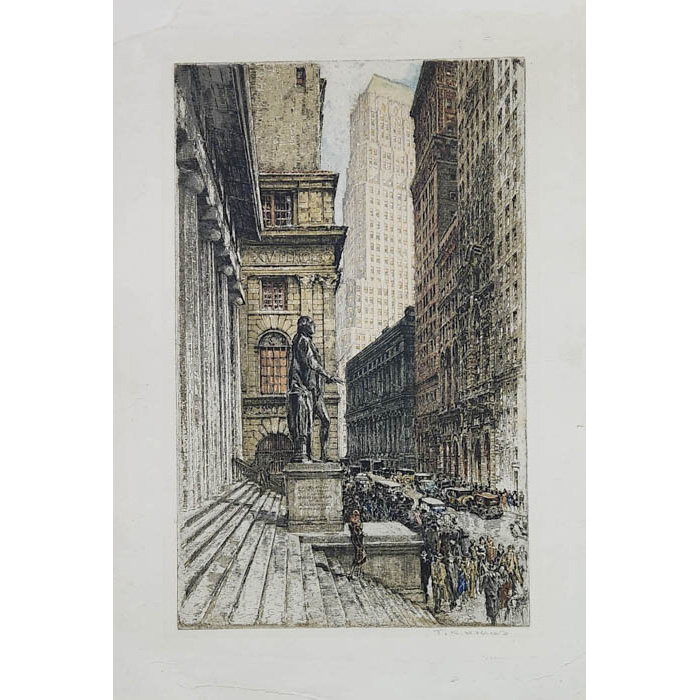
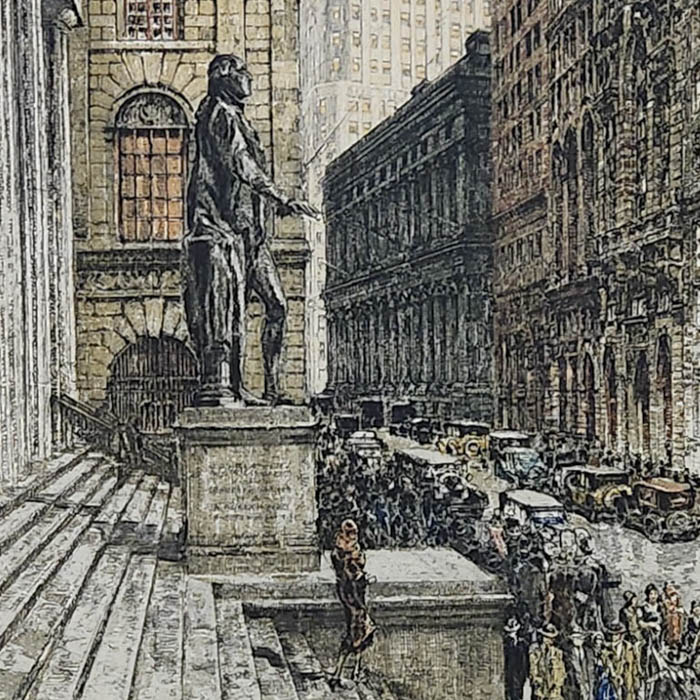
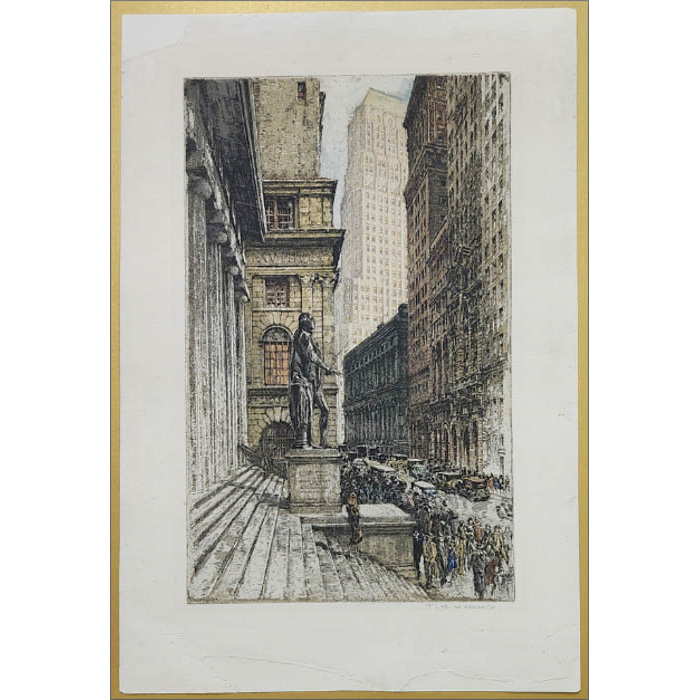
Description
Located at the intersection of Wall and Nassau Streets, directly across from the New York Stock Exchange, the building now known as Federal Hall National Memorial or the Federal Building is one of the most architecturally and historically significant structures in Lower Manhattan. Completed in 1842, it was originally constructed to house the U.S. Custom House, serving as a central point for federal customs collection in New York, then the nation’s busiest port. In 1862, it was repurposed as the New York Sub-Treasury, where millions of dollars in federal funds, including gold and silver reserves, were stored and managed.
Painter, etcher, and graphic designer Johanna (Tanna) Hoernes was born in Graz, Austria. She studied at the School for Women and Girls with Ludwig Michalek and at the Vienna Academy of Art with Wilhelm Unger, where she met her future husband, the renowned print artist Luigi Kasimir. They were married in 1911 and worked collaboratively to develop the revolutionary technique of color etching. Each produced a substantial body of work, consisting largely of views based on their worldwide travels. Her work is highly prized for its exacting detail and realistic depiction of both the notable architectural subjects and natural landscapes that she and her husband observed in their travels. Both husband and wife were prolific producers of color and black-and-white etchings of European and American urban landscapes and architecture. Their prints bear many similarities, but Tanna’s style was somewhat more painterly.
Luigi Kasimir (1881-1962) was born in present-day Solvenia when it was still part of the Austro-Hungarian Empire. He studied at the Vienna Academy of Art where he learned the fine art of color-printed etching. He is well known for a series of American and European urban landscape city views, often with a focus on architecture. Those of American subjects include prints of the New York Stock Exchange; the Brooklyn Bridge; Columbia University; Park Avenue; the Queensborough Bridge; the Massachusetts State House; and Michigan Boulevard. His wife, Tanna Kasimir-Hoernes (1887-1972) also produced similar prints including New York Trinity Church; the Sub-Treasury (Federal Building); and the Savoy and Sherry Netherland from Central Park. Their son Robert Kasimir (1914-2002) was also an accomplished printmaker in a similar style. The prints of the Kasimir family exemplify Luigi’s pioneering efforts in color printmaking. Unlike the common practice of hand-coloring black-and-white prints, Kasimir used an innovative etching technique in which he etched separate plates for each color and printed them in precise alignment to achieve a vibrant, painterly effect. The Kasimir family’s etchings can be found in numerous major museums, including the Metropolitan Museum of Art, and in numerous fine print collections worldwide.
Condition: Generally very good, recently professionally cleaned and restored with light remaining overall toning, wear, handling. Some minor glue residue, abrasions, and toning in blank margins where formerly matted, can be rematted out.
References:
“Federal Building.” Wikipedia. https://en.wikipedia.org/wiki/Federal_Hall#:~:text=After%20the%20relocation%20of%20the,the%20rotunda%2C%20toward%20Pine%20Street. (29 May 2025).


