

Description
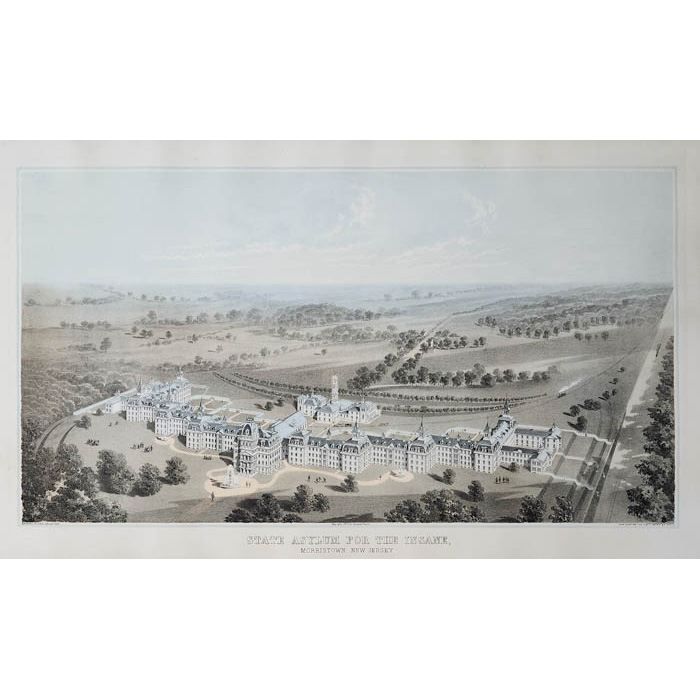
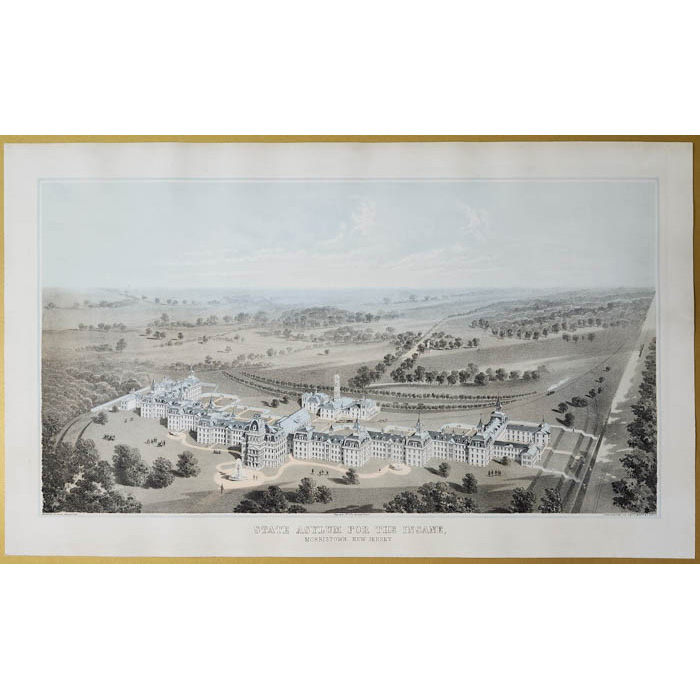
The Asylum was built at a time when New Jersey’s first state hospital in Trenton had become overcrowded, and a second facility was urgently needed to serve the northern part of the state. The institution’s name has changed over the years: State Asylum for the Insane at Morristown (1876-1893); New Jersey State Hospital at Morris Plains (1894-1924); and New Jersey State Hospital at Greystone Park (1925-2008). It was also known as Greystone Park Psychiatric Hospital. This print is at once a record of fine Victorian architecture and of a cultural moment when major buildings were custom designed for medical psychiatric care.
The Kirkbride style for psychiatric institutions in the mid 19th century emphasized light, air, order, and separation, intended to calm and stabilize patients. It reflected a shift in thinking that mental illness wasn’t a moral failure but a medical condition that could respond to structured, humane care. The Kirkbride movement was also fueled by reformers such as Dorothea Dix, who championed state-funded institutions as a more dignified alternative to prisons and almshouses. Sloan, a follower of Kirkbride’s theories, worked these ideas directly into the design of the State Asylum For The Insane at Morristown. Architecture wasn’t just a backdrop; it was a tool for social well-being, and a way to embody new ideals of care and public responsibility.
Samuel Sloan was a self-taught architect and prolific designer whose work ranged from modest suburban homes to massive state institutions. He became widely known through his popular pattern books, which helped spread styles like Italianate and Gothic Revival across 19th-century America. Though not limited to hospitals, Sloan was one of the architects who embraced and helped realize the Kirkbride vision for asylum design. His work on the State Asylum For The Insane at Morristown was both ambitious and deeply rooted in the therapeutic theories of his time. It demonstrates how architecture was used in the mid 19th century for public benefit and reflects changing values around mental health and institutional care.
Thomas Hunter (1827 – 1898) was an Irish-American publisher and lithographer active in Philadelphia in the second half of the 19th Century. He immigrated to the United States as a child. In the 1860s he worked with the Stephen C. Duval in the publishing firm of Duval and Hunter. Stephen Duval was prior a member of P. S. Duval & Son, a major Philadelphia publishing family venture. Thomas Hunter succeeded to sole ownership of Duval and Hunter in the 1870s and was among numerous publishers of prints of the Philadelphia 1876 Centennial Exhibition. In the 1880s, after some financial difficulties, management of the business was turned over to William H. Butler, and the firm ended in the 1890s.
Condition: Generally very good, recently professionally cleaned and deacidified, and a few short small marginal tears closed with mulberry paper backing, now with light remaining overall light toning, wear, handling.
References
“Greystone Park Psychiatric Hospital.” Wikipedia. https://en.wikipedia.org/wiki/Greystone_Park_Psychiatric_Hospital. (22 May 2025).
“State Asylum For The Insane.” Library of Congress. https://www.loc.gov/item/2004670355/. (22 May 2025).
“State Asylum For The Insane.” University of Michigan. https://quod.lib.umich.edu/w/wcl1ic/x-6708/wcl006774 (22 May 2025).
“When Looking Insane Got You Committed.” The Atlantic. https://www.theatlantic.com/health/archive/2013/03/when-looking-insane-got-you-committed/273999/. (22 May 2025).


