


Description
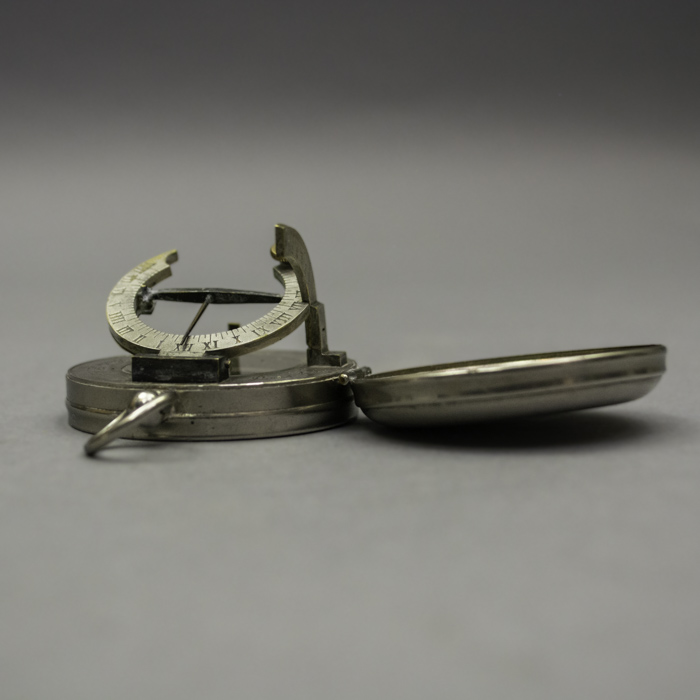
On this particular dial, the inclusion of French spellings for cities like London and Vienna, combined with German cardinal point abbreviation on the compass rose (‘O’ for “Ost” or “Osten” for East) suggests it was manufactured in Germany for an affluent international traveler from France. The specific inclusion of New York alongside major European capitals reflects the increasing frequency of transatlantic travel and trade during the latter half of the 19th century.
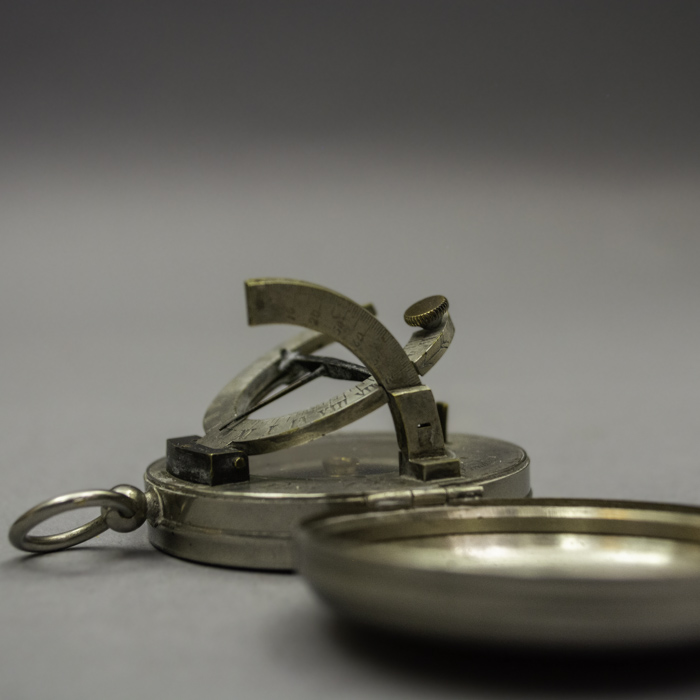
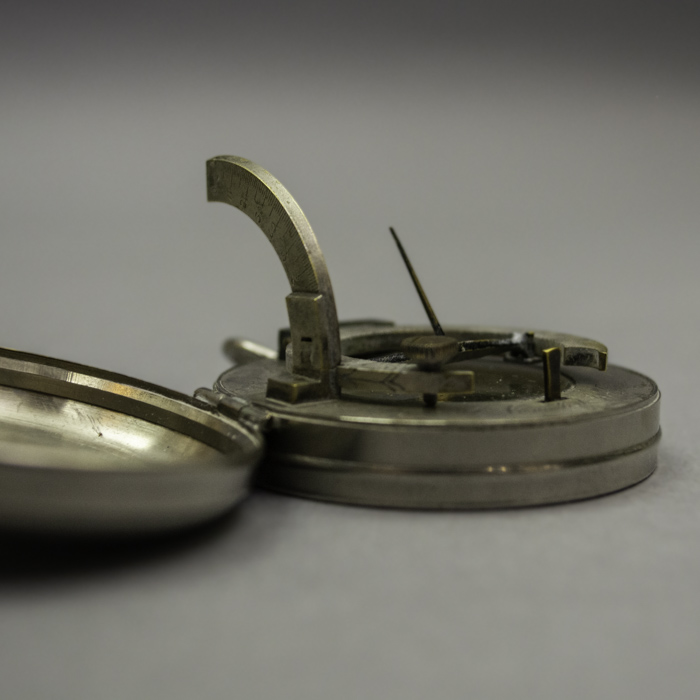
A portable equinoctial dial is a highly adaptable scientific instrument designed to read the correct solar time regardless of the user’s location, providing that the latitude is known. To operate the dial, the user consults the engraved list of cities to find the local latitude at the time of use, raises the latitude arc to that specific degree, and tilts the hour ring accordingly. The compass is then used to align the instrument to true magnetic north. Once properly oriented, the shadow cast by the folding central gnomon onto the hour ring accurately indicates the local solar time. Travelers converted solar time (apparent time) from an equinoctial pocket sundial into mean time (standard clock time) primarily by using the Equation of Time, a correction factor that accounts for the Earth’s elliptical orbit and axial tilt.
Historically, portable sundials of this type were essential tools for merchants, navigators, and wealthy gentlemen during the 18th and 19th centuries. Before the advent of standardized railway time and the widespread affordability of highly accurate mechanical watches, travelers relied on solar time to set their personal pocket watches upon arriving in a new city or otherwise directly to tell time. Many pocket sundials were made of brass, sometimes silver or nickel plated, and sometimes within a hunters pocket watch case or with a separate hardshell case. Others were inset in wooden cases. The craftsmanship and accuracy of a pocket sundials manufactured in this period made them both a functional tool and a symbol of status and intellect.
Condition: Very good antique condition. The metal exhibits a handsome, slightly oxidized patina and minor surface wear to nickel and silver plating commensurate with age and normal use. The hinges for the hour ring, gnomon, and latitude arc remain fully functional and articulate smoothly. The compass needle is intact and responsive, and the glass crystal is free of cracks.
Reference:
Turner, Gerard L’E. Antique Scientific Instruments. Blandford Press, 1980. [Standard reference detailing the function and history of portable equinoctial dials].


