
![Simia Satyrus [Orangutan]](https://www.georgeglazer.com/wpmain/wp-content/uploads/2022/10/simia-satyrus.jpg)
![Simia Satyrus [Orangutan]](https://www.georgeglazer.com/wpmain/wp-content/uploads/2022/10/simia-satyrus-det-1.jpg)
![Simia Satyrus [Orangutan], detail](https://www.georgeglazer.com/wpmain/wp-content/uploads/2022/10/simia-satyrus-det-2.jpg)
![Simia Satyrus [Orangutan], detail](https://www.georgeglazer.com/wpmain/wp-content/uploads/2022/10/simia-satyrus-det-3.jpg)
![Simia Satyrus [Orangutan], detail](https://www.georgeglazer.com/wpmain/wp-content/uploads/2022/10/simia-satyrus-det-4.jpg)
![Simia Satyrus [Orangutan] Plate 1 in Temminck's book, scan from the Biodiversity Heritage Library website.](https://www.georgeglazer.com/wpmain/wp-content/uploads/2022/10/simia-satyrus-det-5.jpg)

Description
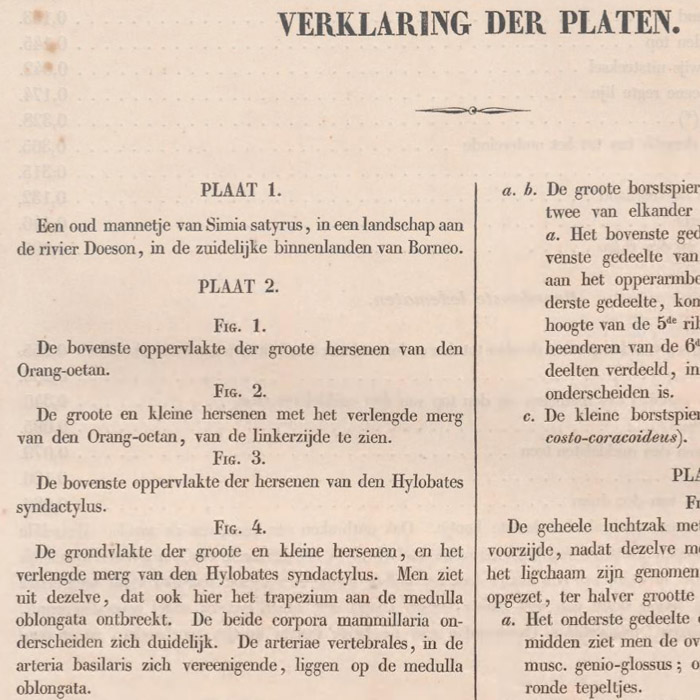
The original print (as a plate in a book) that this painting is based on accompanies the monograph of the orangutan within that volume. The list of plates describes it as depicting an old male in a landscape at the river Doeson, in the southern interior of Borneo. The monograph was the earliest trustworthy scientific account of the orangutan and the plate is probably one of the earliest naturalistic portrayals of a great ape; in the late 18th and early 19th centuries primates were typically depicted standing upright in an anthropomorphic posture, often holding a branch or walking stick in one hand. Orangutans spend most of their times in trees, although they do occasionally come to the ground for specific foods or traveling. It may be surmised that the more accurate portrayal in this illustration was the result of input from Salomon Müller, one of the monograph’s co-authors, who spent extensive time studying the animals in the field. The scans from that volume that we show here are on the Biodiversity Heritage Library website (see References below). A researcher associated with the George Glazer Gallery also had the opportunity to view the book in person in the collection of the George Peabody Library in Baltimore, Maryland.
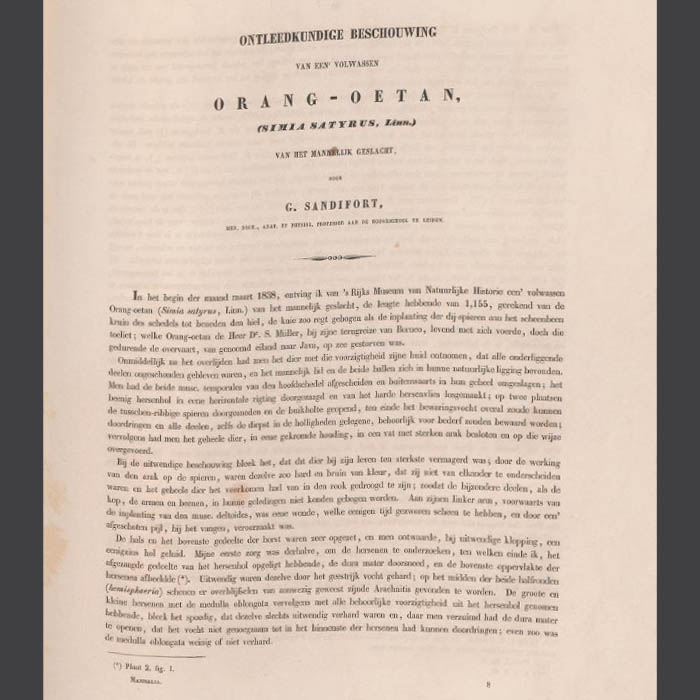
Verhandelingen over de natuurlijke geschiedenis der Nederlandsche overzeesche bezittingen, de Leden der Natuurkundige commissie in Indië en andere Schrijvers was edited by Coenrad Jacob Temminck, director of the Rijksmuseum of Natural History in Leiden, Holland, and sponsored by the state and published in 29 parts, with lithographed plates drawn by a variety of artists. In addition to the zoology volumes, there were volumes on botany and the land and peoples. Zoologie contains a series of monographs on animals of the region and was chiefly written by Hermann Schlegel (1804-1884) and Salomon Müller (1804-1864). Schlegel was a German ornithologist and herpetologist who joined the staff of the Leiden museum in 1825 and was director from 1858 until his death. Müller was a German naturalist sent by Temminck on an expedition to collect specimens in the East Indies. Müller visited Indonesia in 1826, New Guinea and Timor in 1828, Java in 1831, and Sumatra from 1833 and 1835. Zoologie begins with the monograph on the orangutan, a two part text: Bijdragen tot de Natuurlijke Historie van den Orang-Oetan [Contributions to the Natural History of the Orangutan] by Schlegel and Müller, and Ontleedkundige Beschowing van een Volwassen Orang-Oetan Van Het Mannelijk Geslacht, an analysis of the anatomy of the adult male orangutan by G. Sandifort, identified as a medical doctor and professor of anatomy and physiology in Leiden, who dissected a specimen of an adult male orangutan brought from Borneo by Müller to the Rijksmuseum in March 1838.
The lithographed plate of the orangutan in the Borneo landscape is one of seven accompanying the monograph; the other six illustrate Sandifort’s essay, showing anatomical drawings of the brain and other organs. The inscription on Plate I says it was “in lap. del.” (drawn on the lithographic stone) by Dr. A.S. Mulder and W. Groenewoud and printed by J.M. Kierdorff. Mulder and Groenewoud are also credited with making the lithographic drawings for other plates in the series; some of the other prints also bear the name of the artist who “in nat. pinx.” or painted it from life, but this one does not.
Orangutans are found in the Southeast Asian countries of Indonesia and Malaysia, and on the islands of Sumatra and Borneo. The largest arboreal animal in the world, its long arms suit a life spent mainly traveling through the forest canopy. Europeans first encountered the species in the 1600s, and brought back strange stories of wild red-haired “forest people.” It was not until 1782 that the first scholarly account of the animal’s anatomy was published in Europe, by the German scientist Pieter Camper (1722-1789), who may have been working from a specimen killed in Borneo and shipped to Bavaria in 1780.
Information about Plate I in the Zoologie volume of Verhandlingen:
Dimensions: 11.5 x 17 inches, overall; 9 x 13.5 inches, image
Inscribed lower left: Dr. A.S. Mulder & Groenewoud in lap. del. [drawn on stone]
Inscribed lower center: SIMIA SATYRUS.
Inscribed lower right: J.M. Kierdorff, impr. [printer]
Inscribed upper left: MAMMALIA
Inscribed upper right: TAB. I.
Condition: Generally good with the usual overall toning and scattered small marginal tears and soiling at edges. Few scattered faint stains. Brown paper tape in margins verso where previously mounted. Minor mat impression in margins, now rematted out as st in a gold leaf frame with rosette custom corners, and a French mat.
References:
“Herman Schlegel.” Wikipedia. 11 January 2022. https://en.wikipedia.org/wiki/Hermann_Schlegel (6 October 2022).
“Orangutan Facts.” Orangutan Foundation. 2022. https://www.orangutan.org.uk/orangutans (6 October 2022).
“Salomon Müller.” Wikipedia. 9 November 2021. https://en.wikipedia.org/wiki/Salomon_Müller (6 October 2022).
Temminck, Coenrad Jacob, ed. Verhandelingen over de natuurlijke geschiedenis der Nederlandsche Overzeesche Bezittingen / door de Leden der Natuurkundige Commissie in Indië en andere schrijvers ; uitgegeven … door C.J. Temminck. Leiden : In commissie bij. S. en J. Luchtmans en C.C. van der Hoek, 1839-1844. Vol. 1, plate 1. Online at: Biodiversity Heritage Library: https://www.biodiversitylibrary.org/item/212259#page/261/mode/1up (6 October 2022).


