Description
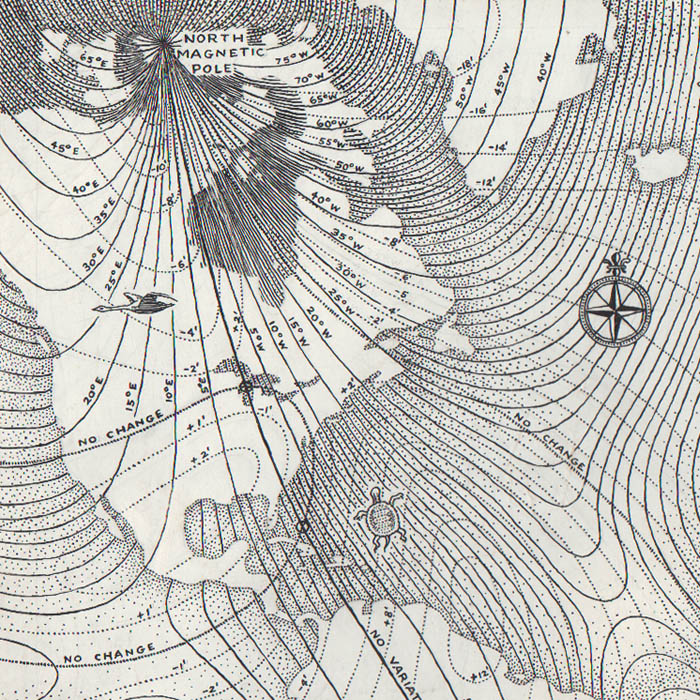
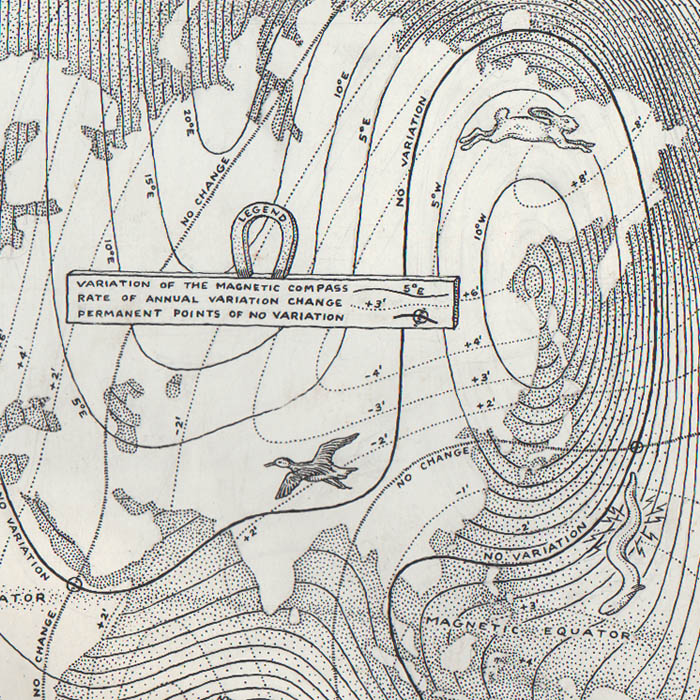
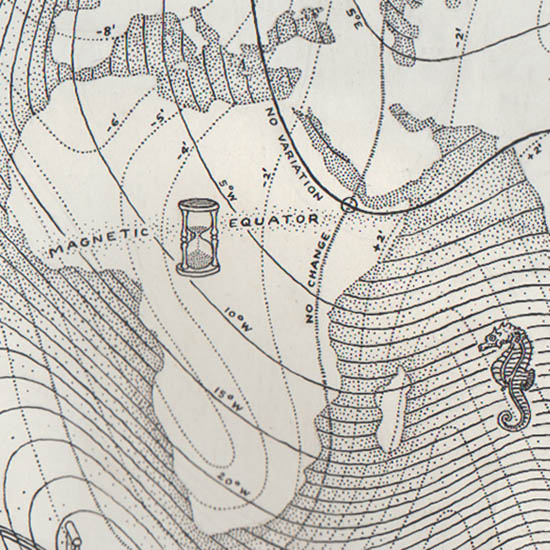
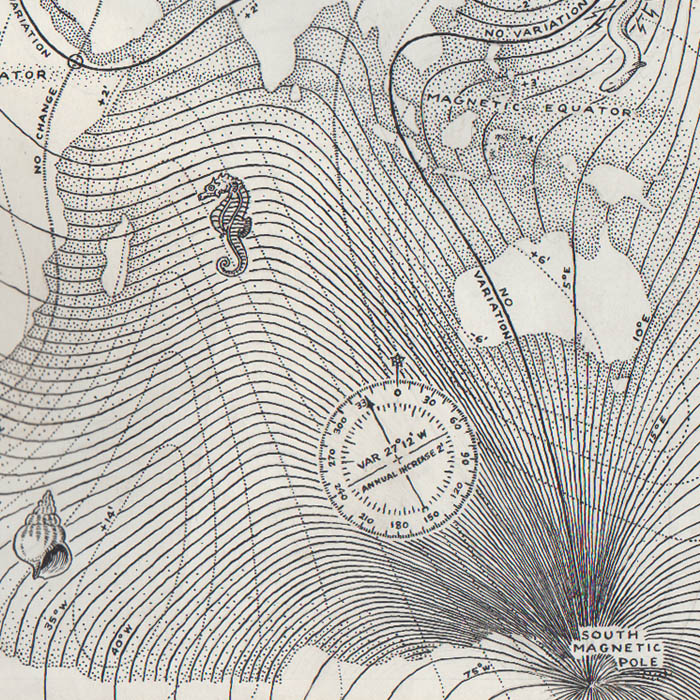
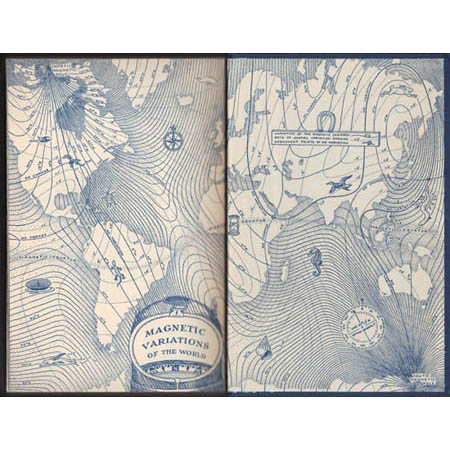
A “Legend” in the form of a magnet attached to a bar on the map indicates that solid lines show variation of the magnetic compass, dotted lines show the rate of annual variation change, and circles show permanent points of no variation. The magnetic equator is also indicated by a line shaded with dots.
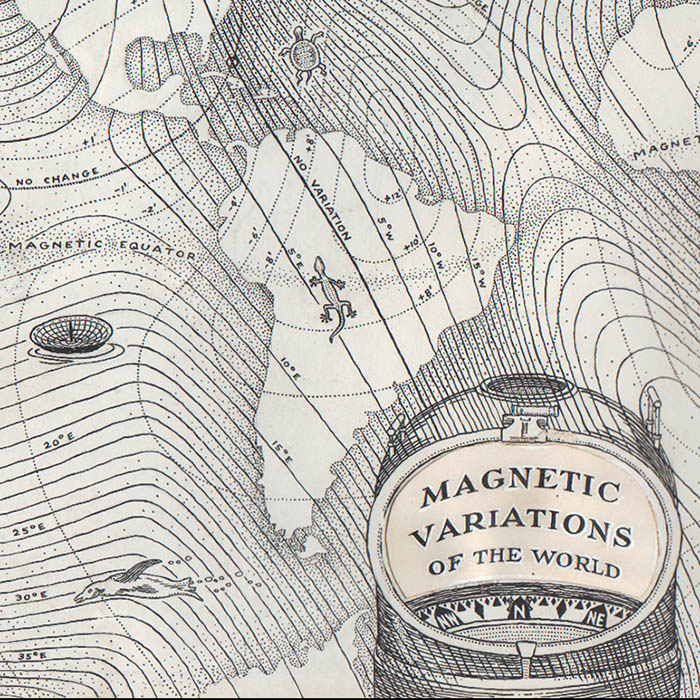
A cartouche lower center shows the title within an illustration of a maritime binnacle compass. There is a small compass rose in the North Atlantic. The map is decorated with small illustrations, including marine creatures in the oceans, a Canada goose in North America, a lizard in South America, an hourglass filled with sand above the Sahara, a bird over Asia, and an Arctic hare over northern Siberia.
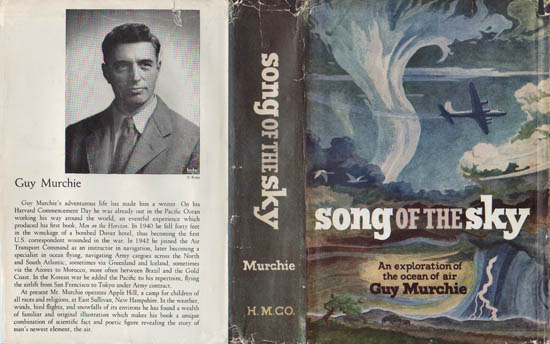
The lower margin of the map contains pencil notations related to its preparation for publication. It is mounted in its original window mat, which is titled and signed in pencil — presumably by the author. The illustration is offered with a copy of Song of the Sky. This book of popular science was described on the dust jacket as “a unique combination of scientific fact and poetic figure revealing the story of … the air” at a period in the mid 20th century when aviation was still only a few decades old. It was a Book of the Month Club selection.
Guy Murchie was an author, artist and aviator. Educated at Harvard, after graduation in 1929 he set off on a round the world trip, which became the basis of his first book, Men on the Horizon (1932). Murchie joined the staff of the Chicago Tribune in 1934 as a photographer, staff artist and reporter, serving as a war correspondent from 1940 to 1942. In 1940, he fell from the wreckage of a bombed English hotel, becoming the first U.S. correspondent wounded in World War II. In 1942 he joined the Air Transport Command as a navigation instructor and later became a specialist in ocean flying, navigating Army cargoes along various Atlantic routes. He also worked under contract for the Army during the Korean War, flying the airlift from San Francisco to Tokyo. Murchie was the author of three bestselling books explaining scientific concepts to the layperson: Song of the Sky (1954), Music of the Spheres (1961) and The Seven Mysteries of Life (1978. All were Book of the Month Club selections. By 1954 he was operating the Apple Hill summer camp in East Sullivan, New Hampshire, “for children of all races and religions,” which he ran for 11 years. At the time of his death he was living in Anaheim, California.
References:
“Guy Murchie, Author and Aviator, 90.” New York Times. 13 July 1997. Online at http://www.nytimes.com/1997/07/13/nyregion/guy-murchie-author-and-aviator-90.html (5 December 2014).
Heise, Kenan. “Guy Murchie, WWII Correspondent.” Chicago Tribune. 11 July 1997. Online at http://articles.chicagotribune.com/1997-07-11/news/9707110119_1_illustrations-spheres-nontechnical-language (5 December 2014).
“Magnetic Declination.” National Geophysical Data Center. http://www.ngdc.noaa.gov/geomag/declination.shtml (9 December 2014).
Murchie, Guy. Song of the Sky. Boston: Houghton Mifflin, 1954.