
Description
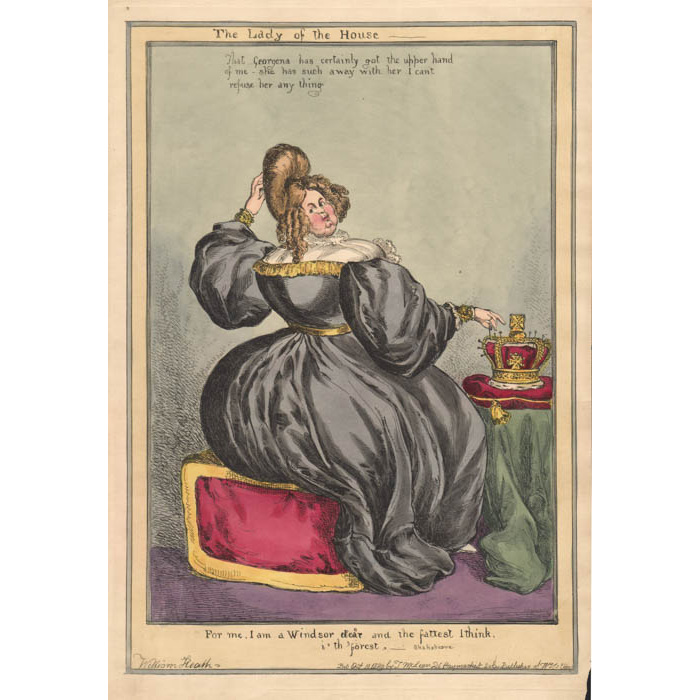
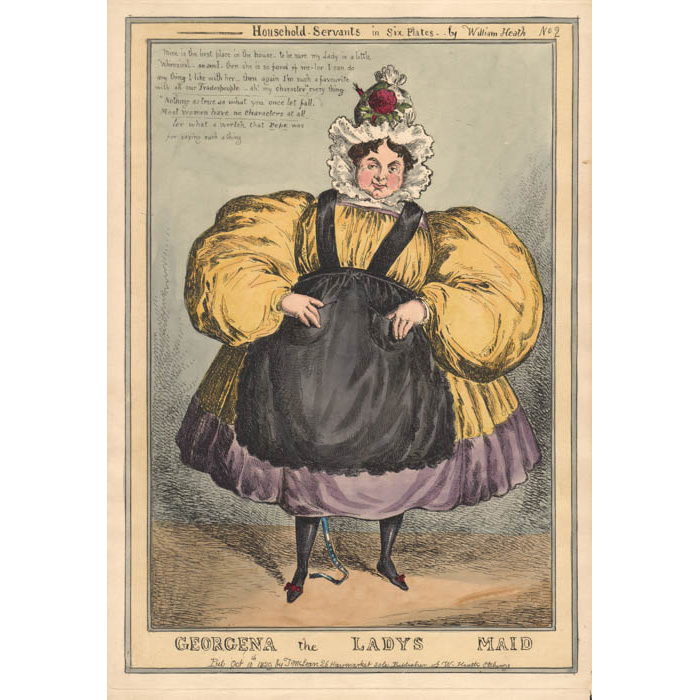
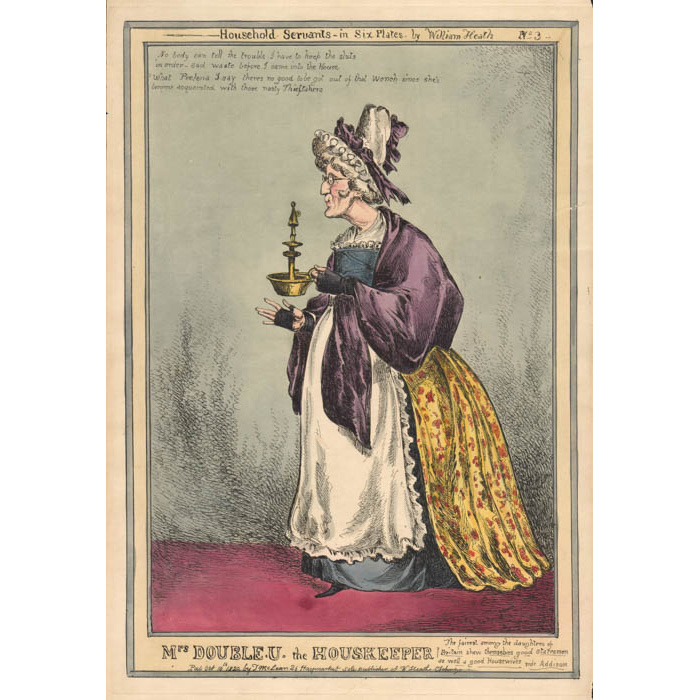
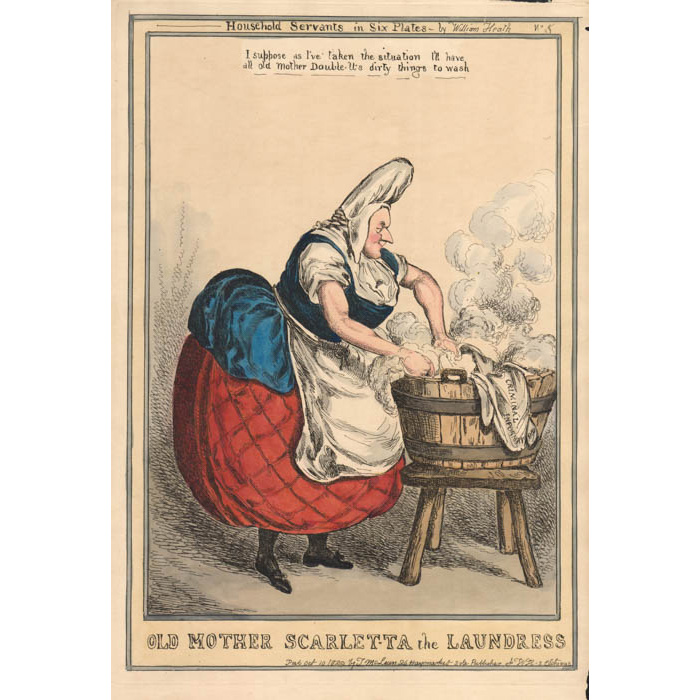
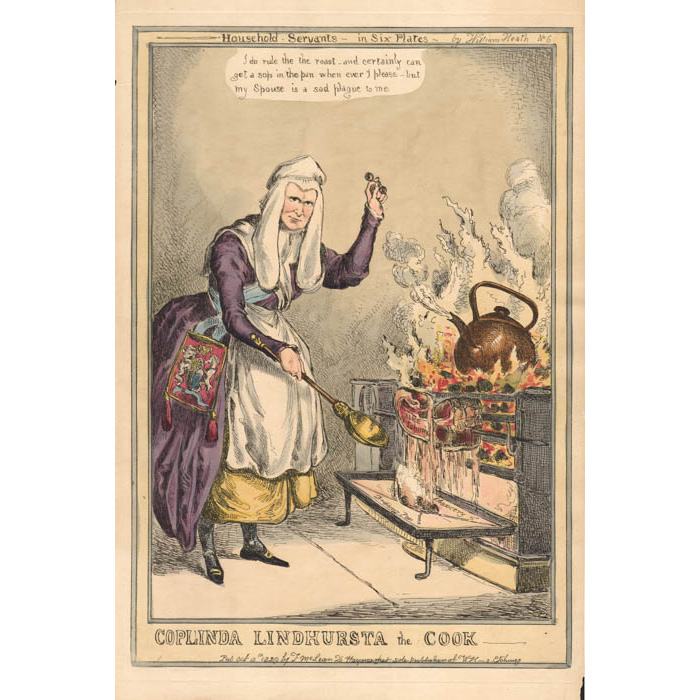
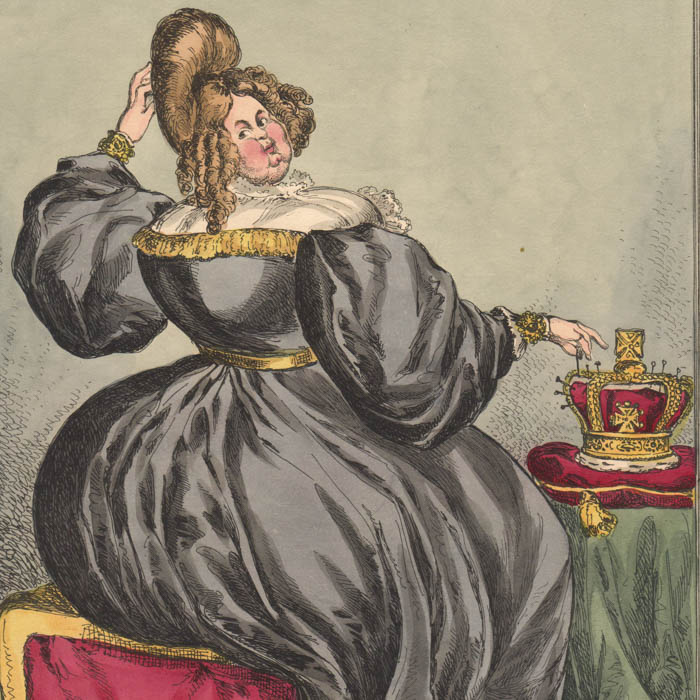
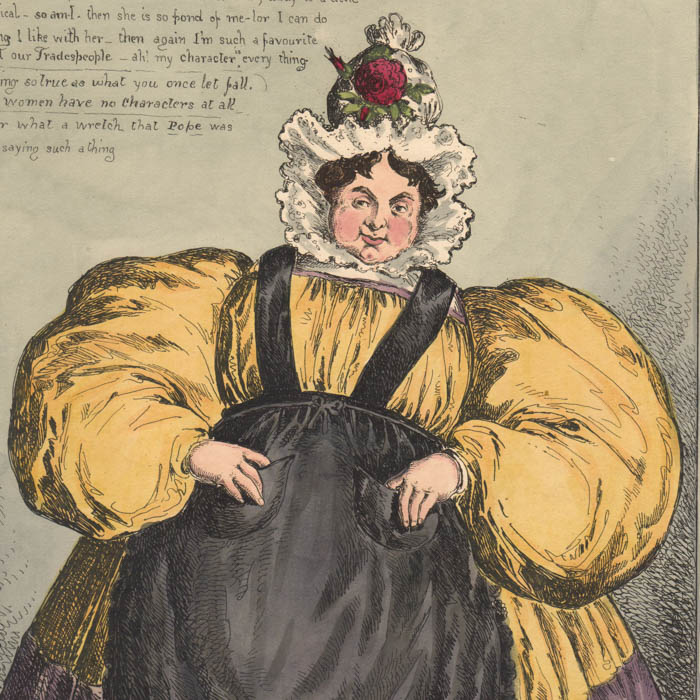
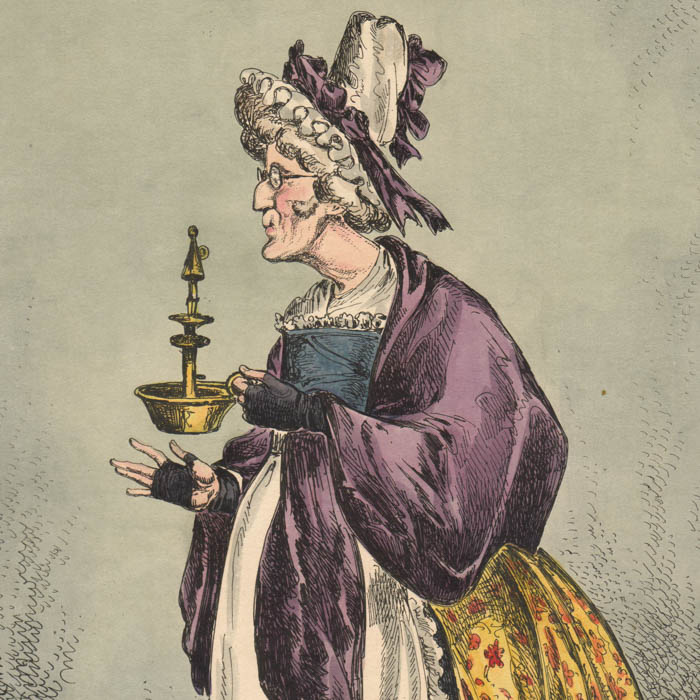
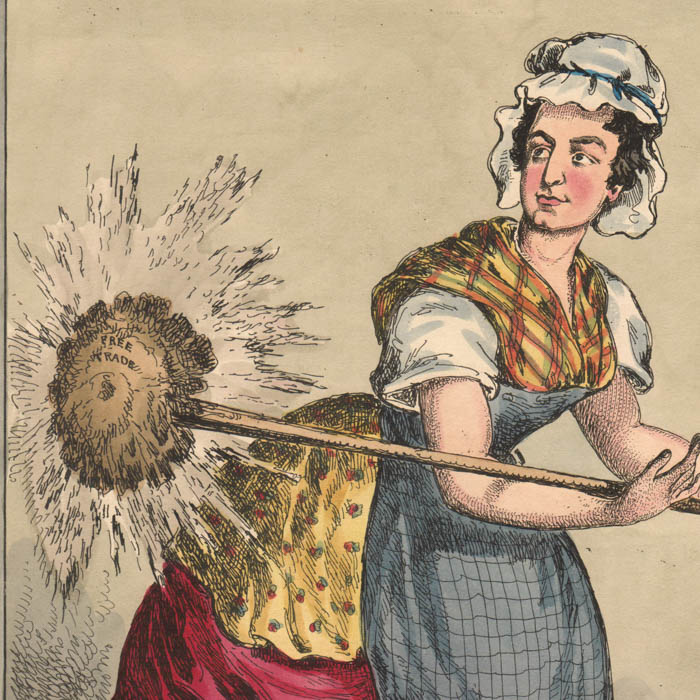
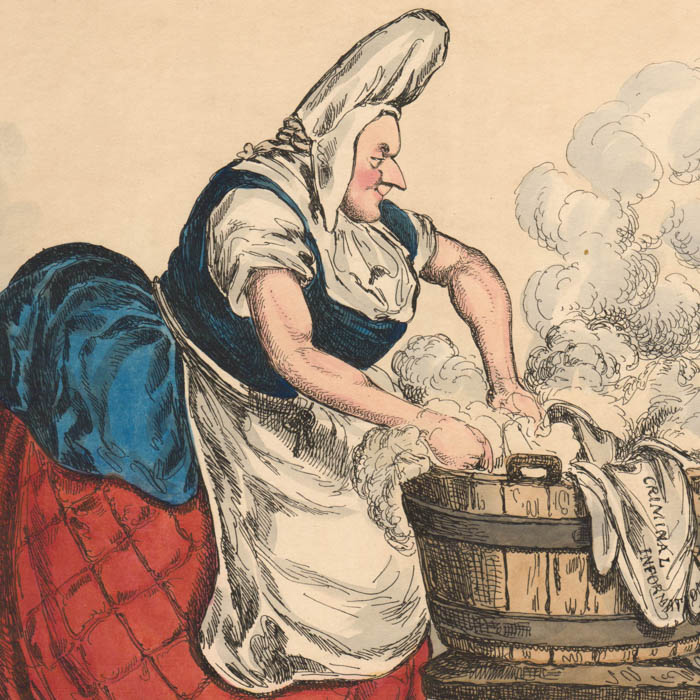
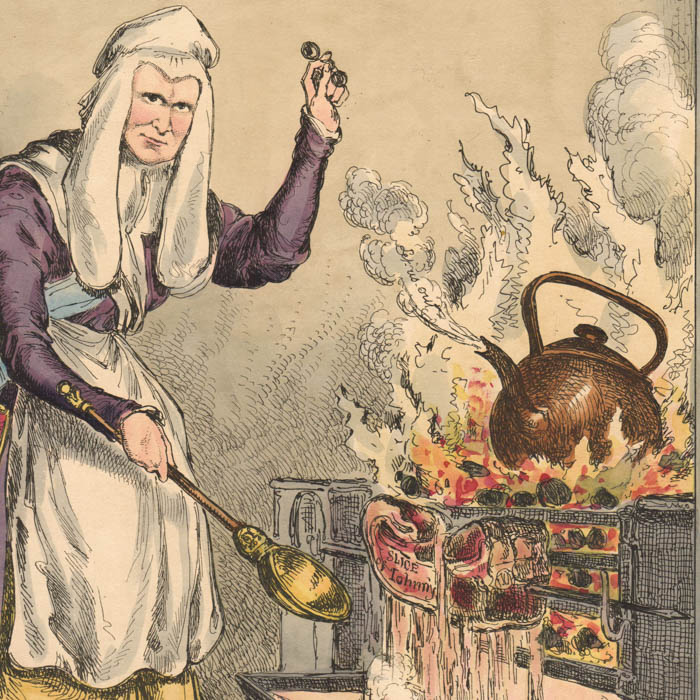
The people in the six prints, published in 1829, are recast as a dysfunctional aristocrat wife and her domestic staff, through thinly veiled alternate names and textual captions, as well as visual caricature. In Plate No. 1, Lady Conyngham, mistress to King George IV, appears as the “Lady of the House,” seated on a red throne and picking bobby pins from the King’s crown and placing them in her own hair. This is a direct reference to Elizabeth Conyngham (1770–1861), an English courtier and noblewoman. In Plate No. 2, the King is portrayed as “Georgena the Lady’s Maid,” simpering and subservient. Here, the feminization of George IV underscores his perceived moral corruption and subjugation to Lady Conyngham’s influence. In Plate No. 3, the Duke of Wellington, then Prime Minister, is shown as “Mrs. Double. U. the Housekeeper,” bemoaning the difficulty of managing unruly servants that she refers to in the caption as “sluts.” This is in reference to the Duke’s aristocratic and out-of-touch attitude and his struggles leading a fractious cabinet. Plate No. 4 shows Sir Robert Peel as “Robertena Peelena the Maid of All Work,” scrubbing the floor with a mop labeled “Free Trade.” Peelena defends an alliance with a “thief-taker,” referencing Peel’s role in founding the Metropolitan Police, who were widely assumed to spy on the public and be corrupt and violent. In Plate No. 5, “Old Mother Scarletta the Laundress” is seen boiling scandalous “criminal information” in a wash tub. The text indicates that she is cleaning the dirty laundry of the Duke of Wellington. In this context, “Scarletta” might be another reference to George IV, or the royals in general, inasmuch as the king was often depicted in portraits in a vibrant scarlet field marshal’s uniform. In Plate No. 6, Lord Lyndhurst, the Lord Chancellor, appears as “Coplinda Lindhursta the Cook.” Lyndhurst is shown aggressively tending to a roast labeled “Loe Johnny,” likely mocking the Whig politician Lord John Russell. Further elucidation of the meaning of each caricature can be discerned from the original text, shown in full below.
Each print is set in a theatrical, farcical domestic setting, underscoring the chaos and absurdity Heath saw in contemporary British politics. Indeed, in 1829, British politics were in a state of crisis. The Catholic Emancipation Act — championed by Peel and Wellington — split the Tory party in two. In addition, London’s first police force sparked fears of government overreach, working-class unrest was on the rise, and George IV — near the end of his reign — was seen as a fat, bloated weak link manipulated by his actress mistress. In this climate of instability, Heath’s use of feminized servants to represent male leaders would have resonated deeply with viewers, playing on cultural anxieties about declining masculinity, failed leadership, and social disorder. Heath’s satire critiques these failing elites, who he saw as acting like squabbling female servants rather than than serious leaders.
William Heath was a British caricaturist and illustrator. His illustrated books include his own Life of a Soldier (1823) and Sir John Bowring’s Minor Morals (1834). In the 1820s, he established himself as a leading caricaturist, first in Scotland for The Glasgow Looking Glass, and after 1827 in London, where he began signing his social and political satires “Paul Pry,” named after a busybody character from playwright John Poole’s 1825 comedy of the same name, so-called because he liked to pry into other people’s business. Heath also included a tiny sketch of Pry offering commentary from the lower margin of his prints. The Paul Pry device became so popular it was soon forged by other artists; within a few years, Heath abandoned it. He worked for the prolific publisher Thomas McLean, who published his fashion and society satires as Modern Oddities, and included his work in other collections and his monthly caricature magazine Looking Glass.
Thomas McLean (1788–1875) owned a printing firm in London publishing a wide range of works during the mid-19th century, especially humor, satire, and political caricatures, both as separately issued prints and in periodicals such as the Monthly Sheet of Caricatures. McLean published and sold collections of humorous illustrations by Henry Alken, George Cruikshank, Edward Lear, and William Heath, as well as portraits and collections of landscape prints such as J.D. Harding’s The Park and the Forest (1841). Britain’s National Portrait Gallery holds at least 195 portrait prints published by McLean.
Full transcription of each print:
The Lady of the House, Plate No. 1: “That Georgena has certainly got the upper hand of me – she has such a way with her I can’t refuse her anything. The bottom caption reading – for me I am a Windsor dear, and certainly the fattest I think. I’th’forest, – Shakespeare”
Georgena the Ladys Maid, Plate No. 2: “Mine is the best place in the house – to be sure my lady is a little whimsical – so am I. Then she is so fond of me – lor I can do anything I like with her – then again I’m such a favorite with all tradespeople – ah my character is everything- ‘Nothing so true as what you once let fall. Most women have no character at all.’ For what a wretch that Pope was for saying such a thing.”
Mrs. Double. U. the Housekeeper, Plate No. 3: “Nobody can tell the trouble I have to keep the sluts in order – sad waste before I came into the House. What Peelena I say there’s no good to be got out of that wench since she’s acquainted with those nasty thief takers. – The fairest among the daughters of Britain show themselves good statesmom as well a good Housewives.”
Robertena Peelena the Maid of All Work, Plate No. 4: “What if I am wedded to a thief taker. I’ve often done worse, besides I shall get something by it.”
Old Mother Scarletta the Laundress, Plate No. 5: “I suppose I’ve taken the situation. I’ll have all old mother Double U’s dirty things to wash.”
Coplinda Lindhursta the Cook, Plate No. 6: I do rule the the roast – and certainly can get a sop in the pan whenever I please – but my spouse is a sad plague to me
Condition: Generally very good with the usual overall light toning, wear, handling. Fine likely original color. Paper slightly brittle. A few small chips in some outer margins, easily can be restored by professional paper conservator at expense of Seller.
References:
Gertz, Stephen J. “William Heath On Womens Hats and Fashion Madness, Part I.” Booktryst. 12 September 2012. http://www.booktryst.com/2012/09/william-heath-on-womens-hats-and.html (21 September 2017).
“Robertena Peelena the Maid of All Work.” British Museum. https://www.britishmuseum.org/collection/object/P_1868-0808-9077. (6 June 2025).
“Thomas McLean.” National Portrait Gallery. 21 April 2005. http://www.npg.org.uk/live/search/person.asp?LinkID=mp62465&role=art (18 November 2010).
Williamson, George C., ed. Bryan’s Dictionary of Painters and Engravers. London: G. Bell and Sons: 1930. Vol. 3, p. 25.