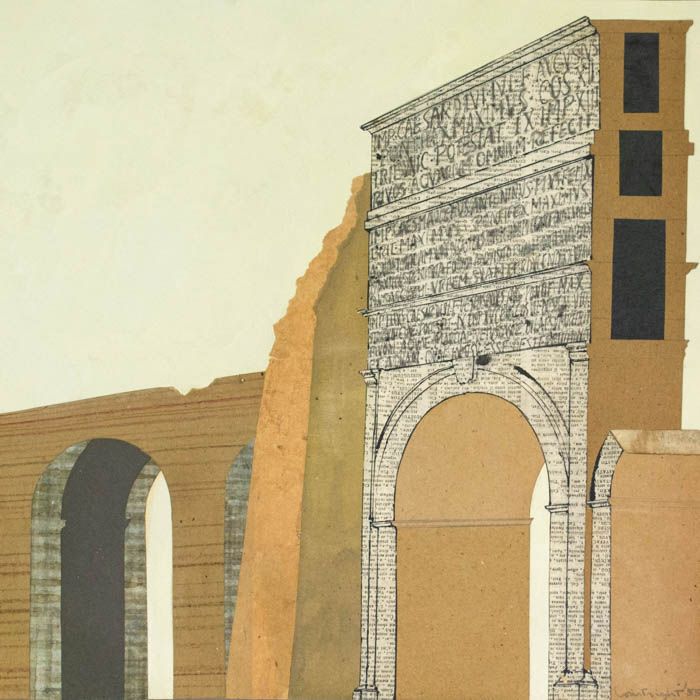
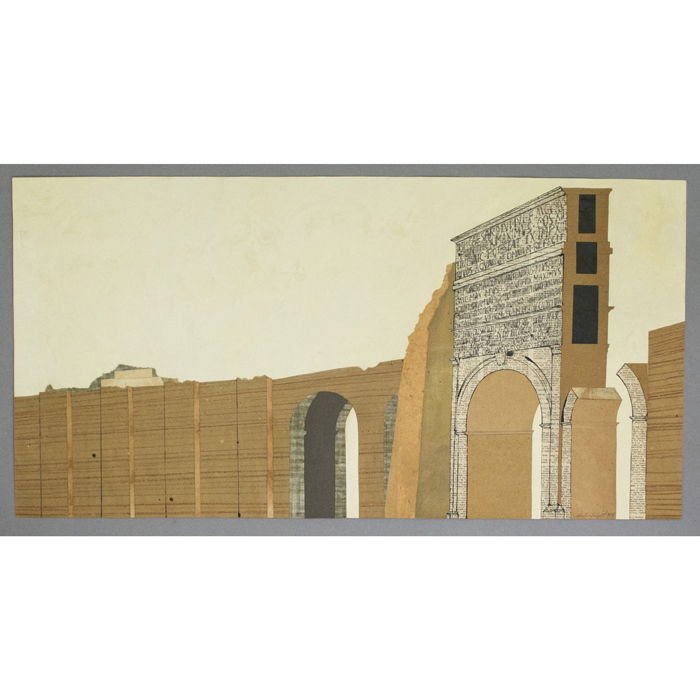
Description
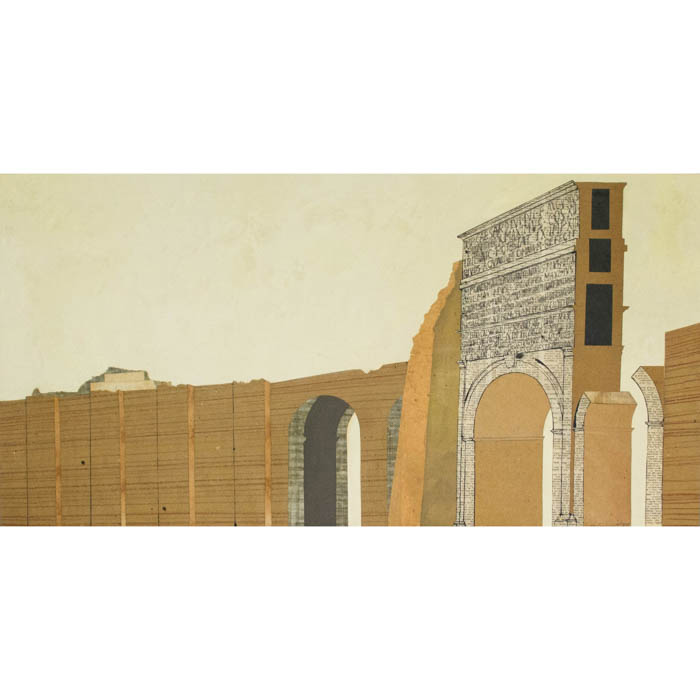
The Porta San Lorenzo, also known as Porta Tiburtina, was an aqueduct constructed by the emperor Augustus in 5 BC, and later incorporated into the Aurelian walls, which were built in the 3rd century AD to protect the city. This is stated in an inscription above the gate, which also mentions restoriations carried out by emperor Honorius in the early 5th century. The name of this gate, as well as the name of the neighborhood, comes from the basilica of San Lorenzo Outside the Walls, located about a half mile further down the road Via Tiburtina.
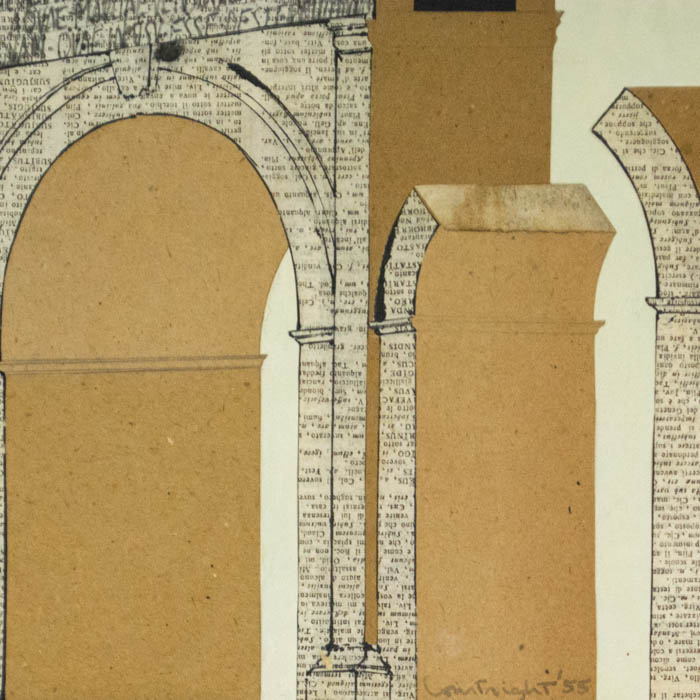
Robert Courtright was an American collage artist and painter. He grew up in Sumpter, South Carolina where he developed an interest in historical architecture. He studied at St. John’s College in Annapolis, Maryland and the New School for Social Research. As a student at the Art Students League in New York he was instructed by numerous accomplished artists including Jack Levine and Vaclav Vytlacil. He relocated to Rome in 1953 and began to create collages of local architecture made of various paper materials. He continued this work into the 1960s. Later his work turned to abstract grid collages employing “color and texture in visual patterns using paper and acrylic paint mounted to wood panels.” His work was exhibited widely, and is represented in such collections as the Metropolitan Museum of Art, Carnegie Institute, Aldrich Museum of Contemporary Art, Phillips Collection, and San Francisco Museum of Modern Art and Thyssen-Bornemisza Collection, Lugano, Switzerland.
Condition: Generally very good with the usual over all light toning, wear, handling. Some slight irregularities to white pastel sky. Some masking tape residue verso.
References:
Courtright, Robert (1926-2012), The Johnson Collection, https://thejohnsoncollection.org/robert-courtright/ (8 July 2025).
“The City Walls: Aurelian’s Walls.” DIY Rome.http://www.geocities.com/mp_pollett/walls.htm#hist and http://www.geocities.com/mp_pollett/aurel21.htm (24 March 2003).
Who’s Who in American Art 1989-90. New York: R.R. Bowker, 1989. 18th ed. pp. 220-221.