
  |
|
Click on image to view enlargement. |
|
Photos taken by George during his summer 2003 visit to Swedish country houses,
show natural history themes in wall decoration.
In the European age of exploration of the New World, expeditions to tropical regions and remote locales around the world were documented in books of natural history prints, acquainting Europeans with exotic species of plants and animals. Many of these images caught the imagination of decorative artists, who used them as source material in developing motifs for ceramics, furniture, wall paper, textiles, etc. It is likely that the artists who produced these works in Sweden relied on natural history plates as reference material for the appearance of such exotica as pineapples and monkeys, since they probably had never seen them in person. |
|

|
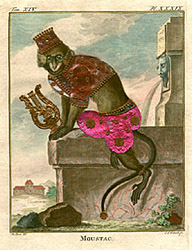
| Above left: A trompe l'oeil mural in a Swedish country house depicts winsome pet monkey seated on a balcony and tethered by a gold chain to a marble post, eating a handful of cherries. Above right: Monkeys were popular subjects of natural history prints, and we have many examples in the Monkeys section of our web site. The print shown here was from a 44-volume encyclopedia published by Georges-Louis M. Leclerc, Comte de Buffon, and later embellished by an anonymous artist with collaged costumes and props. | ||
 |
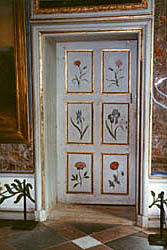 |
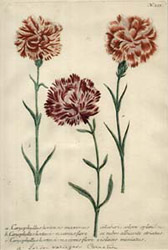
Near left: The painter who provided the wall murals for this room in a Swedish house did not neglect the door, which is decorated with flower studies set within gilded borders. Far left: The paintings on the door relate to the style of botanical studies in books such as
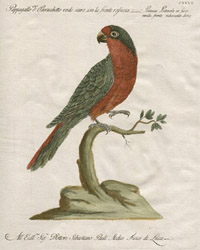
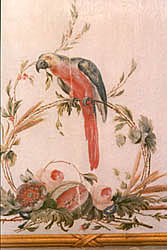
Phytanthoza Iconographia by Johann Wilhelm Weinmann in 1737-45. Below right: A parrot perches in a fanciful still life on the walls of a Swedish home. Below left: Parrot prints by Xavier Manetti, from a series issued from 1767-76, also imbued the birds with personality and character. We always offer a large selection of parrot prints, with additional examples by Greene, Keulemans/Mivart and George Edwards. |
|
Fashionable Fruit
Pineapples were first brought to Europe by Christopher Columbus in 1493, from the island of Guadeloupe and became extremely fashionable in the second half of the 18th century as a rare delicacy, decorative motif and symbol of welcome. A pineapple placed at the entrance to a native Caribbean village denoted hospitality. This caught on with Europeans -- pineapples were carved into the columns at the entrances to colonial plantations and sea captains adopted the custom of setting a fresh pineapple on a post outside their houses to signify they were home from a voyage and receiving visitors. |
|
|
|
|
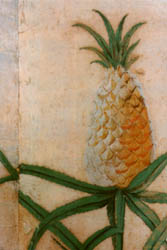
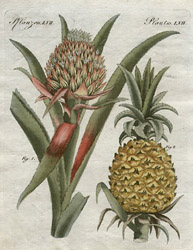
Far left: Swedish artisans decorated the walls of a country house with pineapple motifs. Botanical plates of pineapples were also popular, and frequently featured at George Glazer Gallery. See examples by
Friedrich Justin Bertuch (near left),
Abraham Munting,
Johann Weinmann,
and Johann Volckamer on our site. Bertuch print shown above right.
Reference: Pack, Beverly L. "Symbolism of the Pineapple." 1999. http://www.mindspring.com/ ~sixcatpack/pineappl.htm (5 February 2004). |
| Contents End of Tour |