

 |
|
Click on image to view enlargement. |
|
King Gustav III (1746-1792) was one of the great European sovereigns of the 18th century, both as a political figure and a patron of the arts. A strong and autocratic ruler, he ascended to the throne in 1771, and during his reign was able to stop the factional fighting in Sweden.
He instituted enlightenment-era reforms and successfully repelled an attack by the Russians. He made substantial contributions to Swedish culture as an author and essayist and is credited with the creation of Swedish theater and having written some of the best acting dramas in the literature.
He was also interested in the other arts and amassed a large collection of artwork and classical antiquities, which he willed to the Swedish state after his death. These works became the foundation of the Royal Museum in Stockholm, one of the first public museums in the world, founded in 1792,
and later incorporated into the National Museum in Stockholm, where Gustavus' antiquities are displayed today.
Gustav was among the clients of the Piranesi family, who had a thriving business supplying English nobility and European royalty with marble sculptures and other ancient artifacts. The business was founded by Giovanni Battista Piranesi, who in addition to selling antiquities |
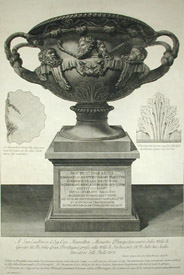 Piranesi Print from the Vasi of the renowned Warwick Vase, from a British art collection.
|
|
|
produced porfolios of etchings of ancient objects and architecture.
much neoclassical as ornamental and informed by a baroque sensibility.
Gustav III purchased his collection from Giovanni's son Francesco,
who succeeded him in the business: marble busts, ornate Roman funerary urns, altars, architectural fragments and a few full-length statues. In many cases these items had been "restored" by Piranesi,
who incorporated pieces of antiquities into his own creations that he claimed better represented the greatness of ancient Rome than imperfect fragments. Piranesi's concoctions were, however, not so
much neoclassical as ornamental and informed by a baroque sensibility.
The antiquities of Gustav III were among those that Piranesi (father and son) illustrated in the set of etchings known as the Vasi. No photography is allowed in the National Museum, however there is a photo of the museum's marble statue gallery on their web site. At our gallery, we offer various of Piranesi's prints from Vasi. |
||
|
References:
"Encyclopedia: Gustav III of Sweden." Nationmaster.com. 20 December 2003. http://www.nationmaster.com/encyclopedia/Gustav-III-of-Sweden (30 January 2004). "History." National Museum. http://www.nationalmuseum.se/NMTemplates/NMPage____2683.aspx (30 January 2004). Touati, Ann-Marie Leander. Hort, Patrick, trans. Gustav III's Museum of Antiquities. Berlings, Arlöv: National Museum, 1993. |
Contents
|