
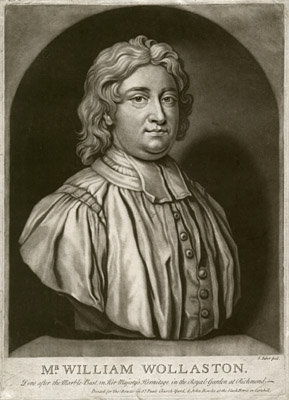
Description
William Wollaston’s views were crystallized in his influential book The Religion of Nature Delineated. First published in 1722, the work was so popular that eight editions had been published by 1750. In it, he sought to answer to two questions: Is there such a thing as natural religion, and, if there is, what is it? Wollaston starts with the assumption that religion and morality are identical, and attempts to demonstrate that religion is “the pursuit of happiness by the practice of truth and reason.” In 1730, Queen Caroline (who was married to King George II) commissioned a garden Hermitage to unite the achievements of the scientists Robert Boyle and Isaac Newton, the philosopher John Locke, and the clergymen Samuel Clarke and William Wollaston. According to Anne Collins: “In a temple-like structure designed by William Kent, these English luminaries were convened as a series of marble busts executed by the English sculptor Michael Rysbrack. Robert Boyle’s portrait received the greatest honor…Each of the remaining portraits occupied a separate niche, appropriate for individual contemplation… Viewers were reminded of philosophical and scientific links between Boyle, Newton, and Locke, and of their support for the tenets of the liberal latitudinarian Anglicanism thought represented by the inclusion of images of Clarke and Wollaston.” William Wollaston was the grandfather of the famous English scientist William Hyde Wollaston.
John Faber was an English engraver who studied mezzotint engraving under his father and became an engraver of portraits. His portraits of members of the Kit-Kat Club (a social and political organization of London’s intelligentsia in the early 18th century) are his best known engravings.
John Bowles (1701-1779) was a printseller located on Black Horse, Cornhill c. 1740-1780. His brother Thomas (1712-67) also had a shop.
Full publication information: Thomas Bowles, St. Paul’s Church Yard, & John Bowles, Black Horse, Cornhill, London.
Condition: Generally very good with the usual toning, wear, soiling, soft creases. A rich impression. Sheet trimmed close to image on sides and top, but outside the plate mark, as is often the case with separately issued 18th-century mezzotint portraits. Rebacked by paper conservator to stabilize and restore minor marginal chips and tears.
References:
Collins, Anne. “Queen Caroline’s Hermitage and Merlin’s Cave: On the Architectural Evocation of the Scientific and Magical Foundations of Political Power.” Abstracts – Section 3F. Enlightenment Cultures of Science. Society for Literature and Science, 1997 Annual Conference. 4 September 1997. http://faculty.la.psu.edu/hquamen/sls/abstract/friday/3f.htm (7 October 2002).
Gratton, Janet. “John Faber.” History, People and Places. http://www.geocities.com/Athens/Ithaca/9286/F.html (7 October 2002).
Maxted, Ian. “The London book trades 1775-1800: a preliminary checklist of members.” Exeter Working Papers in British Book Trade History. U.K.: Devon Library and Information Services. 2001. http://www.devon.gov.uk/library/locstudy/bookhist/lonb.html (7 October 2002).
“William Wollaston.” The 1911 Edition Encyclopedia. PageWise, Inc. 2002. http://56.1911encyclopedia.org/W/WO/WOLLASTON_WILLIAM.htm (7 October 2002).

![[Lucrezia Borgia]](https://www.georgeglazer.com/wpmain/wp-content/uploads/2017/02/borgia-300x300.jpg)
