
Description
The State Historical Society of Missouri has an example of this print in their collection that they describe well online as follows:
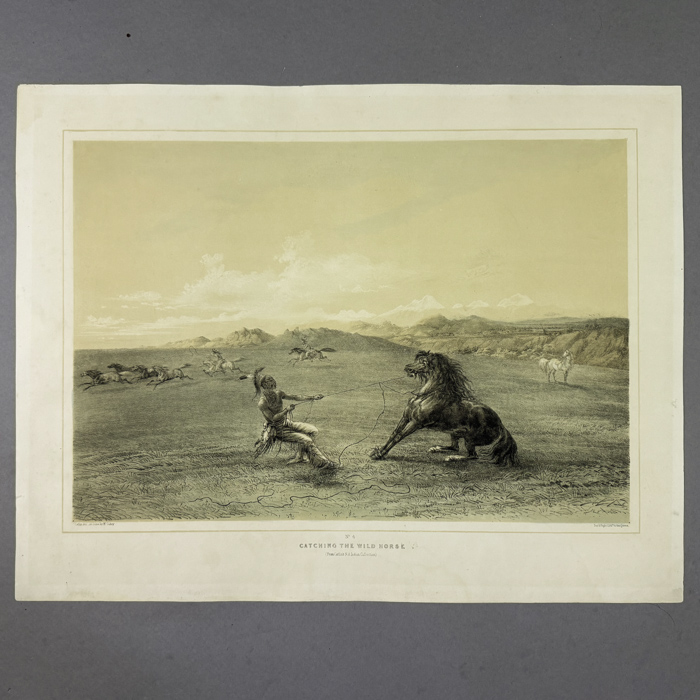
In “Catching the Wild Horse,” Catlin represents the method by which certain Indigenous people captured wild horses for domestication. He pictures the initial pursuit of the horses in the background, showing two riders attempting to lasso a group of fleeing equines. In the foreground the artist depicts a Native American man trying to control a lassoed horse after having dismounted from an already domesticated steed. Catlin describes the process as “breaking down” the untamed horse.
Since Catlin would have been unable to copy the fast-moving action represented directly from life, he likely created this image in the studio from sketches, memories, and well-known prototypes. The image of the horse has some similarities to an engraved and often-copied eighteenth-century composition by George Stubbs, “A Horse Frightened by a Lion.” A version of the Catlin’s 1832 composition “Breaking the Wild Horse” survives at the Smithsonian American Art Museum in Washington, D. C., accession number 1985.66.501. A line engraving of the composition appears as plate 162 in Catlin’s 1841 book, “Letters and Notes on the Manners, Customs, and Condition of the North American Indians.
The following biography of Catlin appears on the website of the Smithsonian Museum, which holds a major collection of his original works:
A self-taught artist, George Catlin is best remembered for his extensive travels across the American West, recording the lives of Native Americans in a collection of images the artist called his Indian Gallery. Early in his career, Catlin practiced law in Connecticut and Pennsylvania, having passed the bar exam in 1818. He abandoned his practice in 1821 to pursue painting. Catlin enjoyed modest success painting portraits and miniatures, but found both inadequate to his ambition of becoming a history painter. In 1828, after seeing a delegation of western Indians in the east, he had found a subject, as he later wrote, “on which to devote a whole life-time of enthusiasm.” Catlin traveled the frontier from 1830 to 1836, visiting fifty tribes west of the Mississippi, from present-day North Dakota to Oklahoma, and creating an astonishing visual record of Native American life. Catlin’s Indian Gallery was donated to the Smithsonian Institution in 1879 …. Several hundred of Catlin’s Indian portraits now hang in the Smithsonian American Art Museum.
In addition to producing original paintings, Catlin self-published a set of 25 hand-colored lithographs in London in 1844, in his North American Indian Portfolio. The preface stated: “The history and customs of such a people, preserved by pictorial illustrations, are themes worthy of the lifetime of one man, and nothing short of the loss of my life shall prevent me from visiting their country and becoming their historian.” Although Catlin planned on producing a series of additional prints from his Indian Gallery paintings, the initial portfolio proved too great an expense, so it was the only he published. Nonetheless, a so-called pirated, albeit much sought-after high-quality version of this work was published in New York in 1845, with the prints relithographed, under the direction of British publisher Rudloph Ackermann.
Condition: Generally very good, recently professionally cleaned and deacidified, with light remaining toning, handling, wear, soft creases. Minor faded toning mark in margins, can be rematted out.
References:
Catlin, George Letters and Notes on the Manners, Customs, and Condition of the North American Indian, London: Geo. Catlin, 1841.
Howes, Wright. U.S.-Iana (1650-1950). R.R. Bowker, 1978. C243.
Reese, “The Production of Catlin’s North American Indian Portfolio, 1844-1876,” unpublished
Sabin, Joseph, Wilberforce Eames and R.W.G. Vail. Dictionary of Books Relating to America: From Its Discovery to the Present Time, Volumes I and II. Mansfield Center, CT: Martino, 1998 (reprint of 1868 ed.). 11532.
Wagner, Henry R., and Charles L. Camp. The Plains and the Rockies: A Bibliography of Original Narratives of Travel and Adventure, 1800-1865. 4th ed., University of Nebraska Press, 1982. Entry 105a:3.


