by George Glazer and Helen Glazer © 2007-2022
The George Glazer Gallery offers a choice selection of American, English and Continental vintage and antique gavels, in various well-patinated woods such as mahogany, walnut, rosewood, and oak. In their variety they demonstrate the numerous design possibilities for the woodworker of the basic configuration of mallet head and handle.
Gavels symbolize authority, prestige, power, control, and order, and make a great gift for the chairman of the board, president, lawyer, judge, scholar or auctioneer. Besides, they're fun to hold and hammer!
George Glazer is the leading worldwide antique dealer specializing in gavels. His collection of over 100 gavels was featured in the article "Vintage Gavels" in the October 2000 issue of Country Living Magazine, and he continues to stock a wide selection today in our Gavels section.
How did the gavel evolve its symbolic meanings and ceremonial functions from its origin as a utilitarian stonemason's tool? Read on to learn more about the history of gavels.

Vintage Gavels magazine page
The Origin of the Gavel
The origin of the gavel is obscure, and the historical derivation of the word unknown. In Middle English, gavel was tribute or rent paid by a tenant to a landowner. Gavels in their present form and purpose may have their origins in the Masonic lodges in 18th-century England. The word gavel first appeared in print with its present meaning as either a stone mason's setting maul or a president's mallet or hammer in the United States, in the 1860s. Since the 19th century, gavels have been used widely outside Masonic lodges, by judges, elected officials and presiding officers as a signal to come to order at meetings, as well as by auctioneers, to indicate a sale.
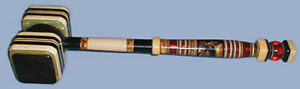
One type of stone mason's tool, having a sharp edge on one side of the head and a hammer end on the other became an emblem of the authority of the master and wardens of the lodge. This instrument resonated symbolically, since its purpose is "to break off the corner of rough stones," and the hammer end functioned nicely to get the attention of a crowd and maintain order in a meeting. The "setting maul," an instrument having a bulbous end with flat bottom and central handle, was used by masons to set stones in mortar. In some Masonic lodges, fancy wooden setting mauls, sometimes called ceremonial stone-laying mallets, were given as presentations. They were not gavels, though sometimes were incorrectly used by the Masonic master as such. They can, however, be considered transitional gavels, having a handle with a big head that eventually yielded to the more popular streamlined heads that we currently associate with gavels.

Masonic chisel mallet: Another Masonic mallet based on a stonecutter's chisel.

Emblem of authority: Present-day gavels may have their origins in the Masonic setting maul, like this one from c. 1900.
Gavel Manufacture, Materials and Craftsmanship
Most gavels are of anonymous manufacture. Some were mass-produced in a factory, while others are unique handmade objects. Some American manufactured gavels bear the union decal label of the Amalgamated Woodworkers. The most frequently used material in making gavels is hardwood, typically mahogany, walnut, ebony, rosewood, or maple. Exotic woods such as patterned zebra wood are sometimes used to give the gavel a decorative flair. Ivory or bone has been used to make expensive gavels, sometimes in combination with wood. The head and handle of wooden and ivory gavels are generally turned on a lathe, then fitted together.
The handle is threaded into the head or fitted in a socket and glued. These gavels sometimes are handcarved, handpainted, or inlaid with other woods or decorative materials. Often the head of the gavel is fitted with a sterling silver or gold band inscribed with a dedication.
Other materials that have been commonly used for gavels include brass, nickel-plated brass, and glass. In the mid 20th century, bakelite, an early plastic widely used for colorful decorative objects and jewelry, was frequently formed into gavels, sometimes as faux ivory — also referred to as "butterscotch."
Gavels sometimes come as a set with a round or rectangular sound block on which to pound the gavel. More elaborate presentation gavels are frequently stored in a custom made box.

An extremely fine carved gavel presented to the chairman of the board of the Supervisors of Westchester County, New York, by the board in 1872.
The jewel-like colors of bakelite made the material a popular choice for decorative objects during the 1930s.

Detail of brass plate on a White House wood relic gavel.
Relic Gavels
Relic woods were made into a variety of souvenirs in the 19th and 20th centuries, from picture frames and cups to gavels. Gavels were made from White House wood salvaged during renovations in 1927 and 1948-52 when the early 19th-century pine timbers were replaced. Gavels were also produced from the timbers of famous ships such as the U.S.S. Constitution (also known as Old Ironsides). Homely wooden articles belonging to famous people went under the lathe to be made into gavels — even President Ulysses S. Grant's work bench. Fallen trees on historical sites, such as Round Hill or Devil's Grove at Gettysburg Civil War battle fields, have also been turned into gavel-formed relics.

American Bar Association 1963 Silver Gavel Award presented to NBC for the contribution of NBC’s drama "The Judge “to public understanding of the legal system.
Long-Life Gavels was a 20th-century U.S. manufacturer whose mottos were "The Jewel of Gavels and Sound Blocks" and "Give Honor Where Honor is Due." The original instructions of this company promote the use of gavels as presentations: "Long-Life Gavels are treasured by their recipients and usually are well displayed at home on the mantelpiece, bookcase, or in a prominent place at the office where all can see that an 'honor' has been bestowed on the individual." The instructions also explain "The Ceremony of 'Passing the Gavel'...It is also a practice in many organizations to present the outgoing President with the Gavel he has wielded during his term of office, mounted with a Silver Band engraved with his or her name, — the name of the organization, — the period of service; and to present the incoming President with a similar Gavel. This Gavel in turn will be presented to him at the expiration of his term of office."
Ceremonial Gavels
Ceremonial gavels are presented to recognize a person or commemorate an event. These typically have an inscription attached to the gavel on a metal band, or lettered in paint directly in the wood. As collectibles, they are worth more if the recipient was a famous person or if they commemorate a significant historical event.
Lodges and fraternal organizations such as the Masons frequently recognized their members with ceremonial gavels. Gavels are often given to president or officer of a fraternal, business, or political organization, when elected or retiring. A gavel might also be given as a presentation to commemorate the launching of a ship.

Ceremonial gavel produced on the occasion of the launching of the SS Chiapas, a ship launched in Glasgow, Scotland, 1882. Alas, the ship sunk later the same year.
Mounting & Display
For desk or shelf display, we offer custom display stands like the one shown here. The gavel is held at an angle above a round disk simulating a pounding block, giving it the dynamic appearance of being in mid-motion. The gavel rests on two wire rods, and can easily be removed for use. The stands shown here also have hand-stamped metal label plates.

Photograph by Andrew Kelly, Reuters.
Prop Rentals
George Glazer Gallery also rents gavels to productions and photo shoots. Shown here, one of the photographs of a gavel and block taken at the gallery in 2020 by photojournalist Andrew Kelly for Reuters. Those photographs have since been licensed to numerous publications around the world to illustrate stories about legal decisions. Learn more about prop rentals.
