


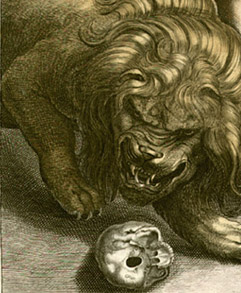
Description
Peter Paul Rubens was a Flemish artist and diplomat. An educated man from Antwerp, he was employed by the rulers of the southern Netherlands as their ambassador. This gave him access to the courts of Europe, who became his patrons. He was the most versatile and influential Baroque artist of northern Europe in the 17th century, and there was a huge demand for his paintings, altarpieces and tapestry designs. Rubens is notable for his vivid, sensual style, which brought to life the allegorical and narrative themes at which he excelled.
Abraham Blooteling was a Dutch engraver, draftsman and printseller, producing portraits, landscapes after van Ruidael, biblical, mythological and genre subjects. He began as a line engraver, then went to England in 1672 to study mezzotint engraving. In collaboration with his brother-in-law Gerard Valck, he significantly advanced mezzotint technique by developing a means of produced controlled and intense contrasts, and the resulting work was a major influence on English printmakers. He returned to Amsterdam in 1678, where he continued engraving, as well as publishing and selling prints and maps by others.
References:
“Abraham Blooteling.” The Grove Dictionary of Art. New York: Macmillan. 2000. Artnet.com. http://www.artnet.com/library/00/0093/T009333.asp (3 October 2002).
“Daniel in the Lions’ Den.” National Gallery of Art. Washington, D.C. 2002. http://www.nga.gov/collection/gallery/gg45/gg45-50016.0.html and http://www.nga.gov/cgi-bin/pimage?50016+0+0+gg45 (3 October 2002).
“Peter Paul Rubens.” The Grove Dictionary of Art. New York: Macmillan. 2000. Artnet.com. http://www.artnet.com/library/07/0743/T074324.asp (3 October 2002).


