
Description
Continued from above:
According to Glazer, of the eight to 10 American manufacturers whose globes regularly appear on the market, those produced by James Wilson shortly after 1810 are among the most desirable. […] “By the second half of the 19th century, the majority of American globes were being mass-produced for schools,” Glazer explains.
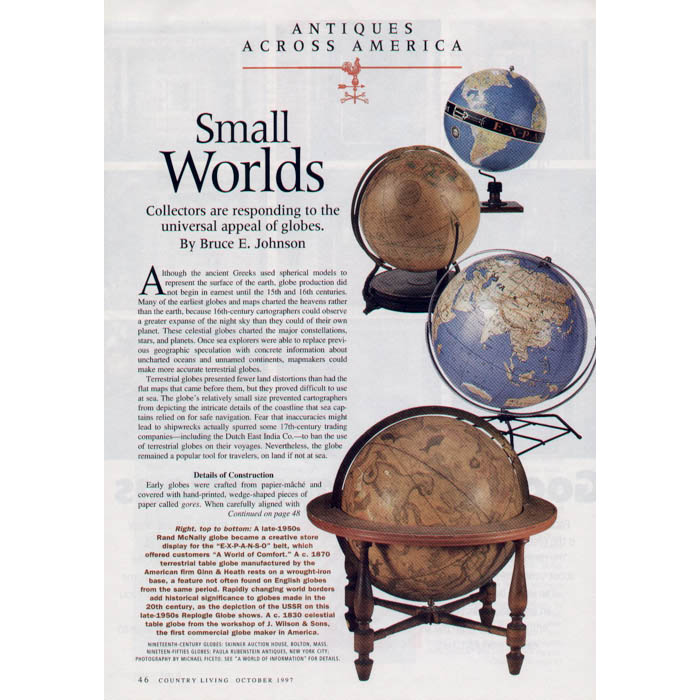
By the 20th century, globes had become educational tools as opposed to practical instruments for astronomers, sea captains, and wealthy merchants. Matched pairs of celestial and terrestrial globes had given way to single terrestrial globes, and table globes were gradually supplanting standing library globes. “Some schools supplied each student with a small globe while the teacher had a larger one at the front of the classroom,” says Glazer. The center for globe production had shifted as well, moving from the East Coast to the Chicago area. The Chicago-based Rand McNally & Co. emerged as the ost popular producer of educational globes, closely followed by the Weber Costello Co., of Chicago, Repogle Globes, Inc. of Broadview, Ill., and A.J. Nystrom & Co., of Chicago.
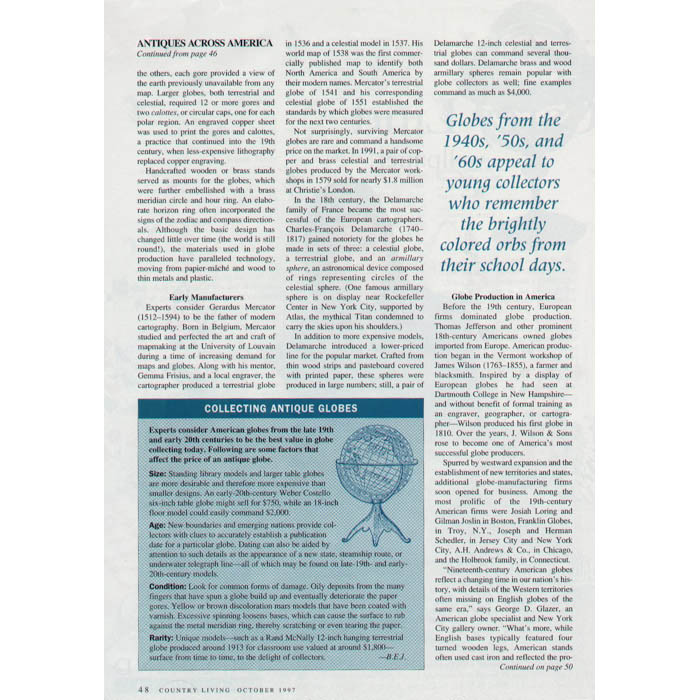
Glazer advises globe collectors and investors to buy the best quality globe for the money. For a collectible antique globe, expect to pay at least $400 to $500. For $2000, you can purchase a significant piece. For a rare globe as much as $8,000. “As with any investment, you should buy in good condition, educate yourself on the subject, price the market and compare the merchandise,” says Glazer.


