Ludwig Julius Heymann
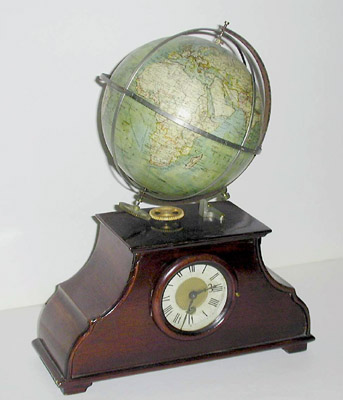
7 1/2-Inch Terrestrial Globe, Clock Mount
Mahogany stand
Germany: c. 1900
16 inches high; 13 x 4 inch base
Working clock turns globe every 24 hours
Sold, please inquire as to the availability of similar items.

Heymann Table Globe with Clock Mount
Germany: c. 1900
Germany: c. 1900
This item is sold. It has been placed here in our online archives as a service for researchers and collectors.
- Please inquire as to the availability of similar items currently in stock, or use the navigation bar above to browse our site for currently available items.
- Find guidelines for the use of images from georgeglazer.com.
- To see more archived items, view our directory.
- Find information about selling your art and antiques.
 |
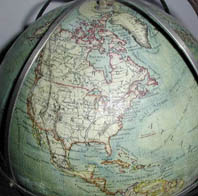  |
The terrestrial globe within plated cast-iron calibrated half meridian, and within nickel-plated metal equatorial horizon band numbered with the hours of day, and solstice and equinox bands, raised on a rectangular mahogany clock base with ogee curved sides, having round mahogany dial and glass bezel. The clock movement one-day spring movement, time only no alarm, unsigned.
Clocks are well suited to be combined with globes because world time is based on the full rotation of the earth once every 24 hours. A number of Continental, English, and American globes were made incorporating a clock mechanism, to not only show relative time around the world, but to keep time for the user of the globe. The time of day or night on the earth varies with longitude location. There are 24 time zones in the world. Generally globes are divided into 24 longitudinal lines, each 15 degrees apart. It takes the earth one hour to turn each 15 degrees, and in 24 hours it has completely turned once.
To use the clock globe set the local time on the dial. Turn the globe so that the place of use corresponds to the correct time on the equatorial hour circle. Local time for any place in the world then can calculated.
The clock movement works. Globe generally good and clean. See generally, Article in NAWCC Bulletin (June 1999, p. 423) showing a related example.
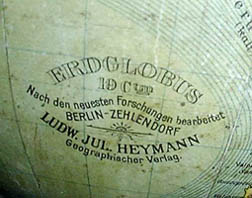
Cartouche: EDRGLOBUS/ 19tm/ Nach den neuesten Forschungen bearbeitet/ LUDW. JUL. HEYMANN/ Geographischer Verlag.