Mornay (after)
John Heaviside Clark (c. 1770-1836) and Matthew Dubourg (act. 1786-1838) (engravers)
J.F. Dove (act. 1813-1833) (printer)
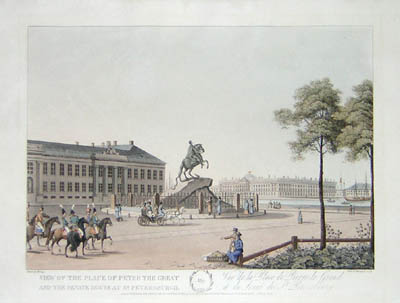
May: View of the Place of Peter the Great and the Senate House at St. Petersburgh / Vue de la Place de Pierre le Grand et du Senat de St. Petérsbourg
from A Picture of St. Petersburgh, Represented in a Collection of Twenty Interesting Views of the City, the Sledges, and the People
Edward Orme, London: April 28, 1815
(publication date on print)
Hand-colored aquatint
Watermark: Whatman Turkey Mill 1829
11.75 x 15.75 inches, platemark
12.75 x 18.5 inches, overall
Sold, please inquire as to the availability of similar items.

View of St. Petersburgh, Russia
British Regency Period Aquatint
British Regency Period Aquatint
This item is sold. It has been placed here in our online archives as a service for researchers and collectors.
- Please inquire as to the availability of similar items currently in stock, or use the navigation bar above to browse our site for currently available items.
- Find guidelines for the use of images from georgeglazer.com.
- To see more archived items, view our directory.
- Find information about selling your art and antiques.
 |
 |
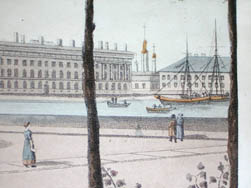 |
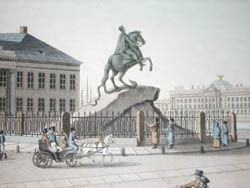
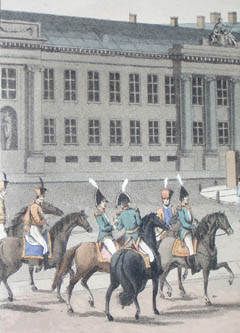
English Regency period view of St. Petersburg in May, centered on the statue of Peter the Great with the Senate House in the near background. The statue of Peter the Great, popularly known as “The Bronze Horseman,” was erected by Catherine the Great in 1782 in the center of the plaza overlooking the waterfront of the Neva river delta. Designed by French sculptor Etienne-Maurice Falconet, she intended it to symbolize Peter’s conquest of an unruly nation, and to legitimate her rule by connecting her regime to his. In the print, the statue is shown with onlookers gazing at it through the metal gate encircling it. Soldiers on horses and strolling pedestrians move through the plaza. The print is titled in English and French, with the word “May” in the center.
This is one of a group of 20 fine aquatints published as A Picture of St. Petersburgh, which includes 12 scenes “taken on the spot at twelve different months of the year” according to the subtitle. The other eight prints in the set illustrate sledges and carriages. The series was republished by Orme in 1833.
Mornay was a painter, probably British, active in the 19th century.
John Heaviside Clark was a British painter of maritime subjects and landscapes, a draftsman, and an aquatint engraver. Born in Scotland, he worked in London for 30 years beginning in 1802, and exhibited regularly at the Royal Academy between 1812 and 1832. He then worked in Edinburgh, where he remained for the rest of his life. Clark's sketches made on site directly after the Battle of Waterloo earned him the nickname "Waterloo Clark." He frequently collaborated with the aquatint engraver Matthew Dubourg and often worked for the London publishers Edward Orme and Thomas McLean. Clark authored and illustrated instructional works on landscape painting in watercolor in 1807 and 1827, aimed at amateur artists seeking to create mementos of their travels. During the 1820s, he also designed entertaining novelties published by Samuel Leigh: the miniature Portable Diorama; two myrioramas, boxed sets of cards each printed with part of a landscape that could arranged in any order to form a continuous panorama; and, according to Redgrave, the celestial card set Urania's Mirror.
Matthew Dubourg (or Dubourgh) was a British aquatint engraver of sporting, military and topographical scenes. Dubourg exhibited several miniature portraits at the Royal Academy in 1786, 1787 and 1808. However he is mainly known for his aquatints. He frequently collaborated with John Heaviside Clark, for example on the views for A Year in St. Petersburgh (1815) and the battle scenes of Historic, Military and Naval Anecdotes (1816). Other works by Dubourg include Views of Rome and Its Vicinity and Its Ruins and in the illustrations for E.W. Brayley’s Illustrations of the Palace of S.M. at Brighton (1838). The Victoria and Albert Museum in London owns two aquatints by Dubourg after Claude Lorrain, several other works are in the collection of Britain’s National Portrait Gallery.
J.F. Dove was a London printer whose works were published and sold by Edward Orme, W.F. Baynes & Son, Saunders & Otley, and under his own imprint between 1813 and 1833.
Edward Orme (b. 1774) was a London artist and printseller, serving as printseller in ordinary and engraver to King George III from 1799 to 1820, and to the Prince of Wales (later King George IV) from 1817 to 1830. He exhibited at the Royal Academy between 1801 and 1803.
References:
Bénézit, E. Dictionnaire critique et documentaire des Peintres, Sculpteurs, Dessinateurs et Graveurs. France: Librairie Gründ, 1966. Vol. 3, p. 358 (Dubourg).
Huhtamo, Erkki. "Peristrephic pleasures: on the origins of the moving panorama." in Fullerton, John and Jan Olsson, eds. Allegories of Communication: Intermedial Concerns from Cinema to the Digital. Indiana University Press, 2004. pp. 216 and 236 (Clark). Online at Google Books: http://books.google.com/books?id=ABf4XCG4Hz0C&pg=PA236 (3 July 2014).
"John Heaviside Clark." British Museum. http://www.britishmuseum.org/research/collection_online/search.aspx?people=129162&peoA=129162-2-60 (3 July 2014).
Maxted, Ian. "The London book trades 1775-1800: a preliminary checklist of members." Exeter Working Papers in British Book Trade History. U.K.: Devon Library and Information Services. 20 June 2001. http://www.devon.gov.uk/library/locstudy/bookhist/lonn.html (6 April 2005).
“Part One: Images of Peter and his City.” Russian 15: Dartmouth College. http://www.dartmouth.edu/~russ15/russia_PI/peter_great_pt1.html (6 April 2005).
Williamson, George C., ed. Bryan's Dictionary of Painters and Engravers. London: G. Bell and Sons: 1930. Vol. I, p. 299 (Clark).