Johann Bernhard Fischer von Erlach (1656-1723)
Mecca and Medina
from Entwurff, Einer Historischen Architectur [Design, A Plan of Civil
and Historial Architecture]
Leipzig: 1721 and 1725
Copper engravings
14.25 x 19 inches, sheet
12 x 16.75 inches, plate mark
Sold, please inquire as to the availability of similar items.

Mecca and Medina
Early 18th Century Views
Early 18th Century Views
This item is sold. It has been placed here in our online archives as a service for researchers and collectors.
- Please inquire as to the availability of similar items currently in stock, or use the navigation bar above to browse our site for currently available items.
- Find guidelines for the use of images from georgeglazer.com.
- To see more archived items, view our directory.
- Find information about selling your art and antiques.

 |
 |
 |

 |
 |
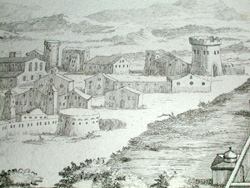 |
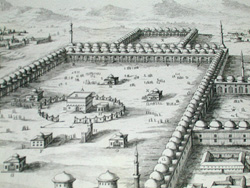
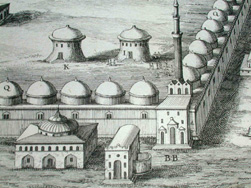
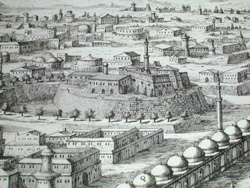
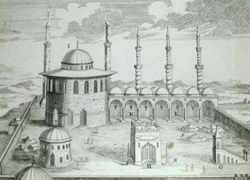
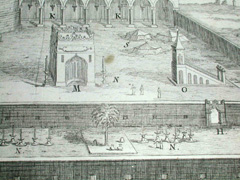
Pair of 18th-century historical and decorative views of Mecca and Medina, important Islamic holy cities. They are shown in landscape, with important landmarks labeled with letters. Beneath each picture is engraved explanatory text in German and French. The title in Arabic is set within a border hung like a sign in trompe l'oeil style from a small chain.
The explanatory texts explain the religious significance of the Islamic holy sites in Mecca and Medina, such as the Sacred Mosque of Mecca, believed by Muslims to be a landmark built by Abraham as a house of God. It sits within a restricted zone within which only Muslims may enter. The text states that this view of Medina was drawn by an Arab engineer, since Christians were forbidden to enter "under pain of being burned alive," and that the drawing eventually made its way via the Ottoman sultan in Constantinople to Vienna, where it was in the possession of a councillor of the Imperial Court of the Electorate of Braunschweig-Lüneburg (a political entity also known as the Kingdom of Hannover).
Text in French on print of Mecca: "Prospect d'une partie de la grande Ville de la Mecque avec cette Place Sainte si celebre, où Suivant l'opinion des Mahometans, subsiste la Maison d'Abraham et la fontaine d'Ismael; enfin où Mahomet écrivit son Alcoran: Ce lieu et visité châque année de Caravanes de Turcs."
[Prospect view of a part of the large city of Mecca with its celebrated holy places, where according to the Mohammedans, was the location of the House of Abraham and the fountain of Ishmael; eventually where Mohammed wrote the Koran: This place is visited each year by caravans of Turks.]
Text in French on print of Medina: "Prospect de la Mosquée où L'on voit le Tombeau de Mahomet auprés de la Ville de Medine; elle êt éloignée de huit jours de la Mecque. Ce lieu appartient à un Prince Arabe nommé Serif il y va tous les ans, aussi bien qu'à la Mecque, deux grandes Caravanes contenant plusieurs milliers d'hommes et de Chamaux, l'une desquelles vient du grand Caire, et l'autre de Damas, mais aprés avoir été auparavant à la Mecque, & bù, Suivant leur opinion de l'eau de la Sacrée fontaine d'Ismaél. Il n'êt permis a aucun Chrétien d'approcher de ce lieu, sous peine d'être brûlé vif, ou de prendre le Turban. Ce dessein fut fait par un certain Ingenieur Arabe aussi bien que celui de la Mecque & transporté à Constantinople au grand Sultan, ensuite à Vienne dont L'original était chez Monsieur der Huldeberg Conseiller & Resident de Son Altesse Electorate de Braunschweig et Lunebourg, à la Cour Imperiale."
[Prospect view of the mosque where the tomb of Mohammed is seen near the city of Medina, eight hours from Mecca. This place belonged to an Arab prince named Serif who went there over the years, as well as to Mecca, two great caravans containing many thousands of men and camels, one of which came from the great Cairo, the other from Damascus, after having first been to Mecca, and drank, what was, in their view, the water of the Sacred Fountain of Ishmael. No Christian is permitted to approach this place, under pain of being burned alive, or to put on a turban. This drawing was made by a certain Arab engineer from Mecca as well and transported to Constantinople to the Great Sultan, then to Vienna where the original is now at the home of Mr. der Hulderberg, Councillor and Resident of the Electorate of Braunschweig-Lüneburg, at the Imperial Court.]
Johann Bernhard Fischer von Erlach was the leading Austrian baroque architect, the last great architect of the Renaissance and Baroque periods. He played a central role in the buildings of the imperial court circle of Vienna and his eclectic approach became the official style of the Hapsburg court. The son of a sculptor and decorator in Graz, he was born Johann Bernhard Fischer and studied in Rome, before going to Vienna. He received his title "von Erlach" in 1696, when he was ennobled by the emperor, and in 1705 he was appointed imperial court architect. His notable works include the mausoleum of Ferdinand II at Graz, the Hercules Fountain in Brünn, the Imperial Library and Imperial Palace Schönbrunn in Vienna, and the Church of the Trinity and University Church of Salzburg. He also wrote Entwurff, Einer Historischen Architectur [Design, A Plan of Civil and Historical Architecture].
References:
"Fischer von Erlach." The Grove Dictionary of Art. New York: Macmillan. 2000. Artnet.com. http://www.artnet.com/library/02/0284/T028425.asp (19 March 2004).
"Johann Bernhard Fischer von Erlach." The Columbia Encyclopedia. 6th Ed. New York: Columbia University Press: 2003. Online at Bartleby.com. http://www.bartleby.com/65/fi/Fischerv.html (19 March 2004).