
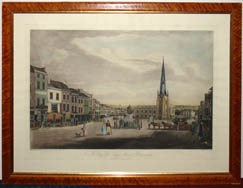
City View, Large Hand-colored Aquatint, 1812
This item is sold. It has been placed here in our online archives as a service for researchers and collectors.
- Please inquire as to the availability of similar items currently in stock, or use the navigation bar above to browse our site for currently available items.
- Find guidelines for the use of images from georgeglazer.com.
- To see more archived items, view our directory.
- Find information about selling your art and antiques.

 |
 |
 |
 |
 |
J. C. Stadler (active 1780-1812) (aquatint etcher)
A View of High Street, Birmingham
T. Hollins, Birmingham: July 1, 1812 [later restrike]
Hand-colored aquatint
26.75 x 35.25 inches, mat opening
31 x 39.25 inches, maple frame
Sold, please inquire as to the availability of similar items.
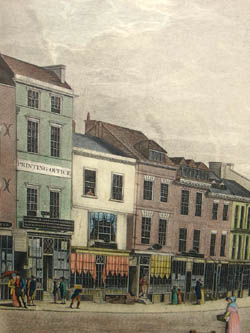
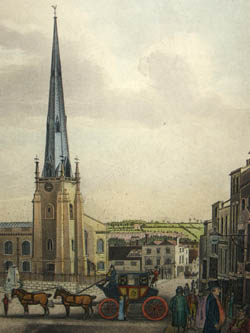
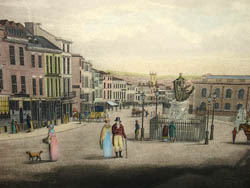
Large Regency period view of High Street in Birmingham, looking toward St. Martins Church across a large triangle of open space known as the Bull Ring. Located at the junction of four major roads, the Bull Ring has served as the major commercial center of the city since the Middle Ages. The print shows horse-drawn carriages and pedestrians strolling past the rows of shops. A few have paused to look at the memorial statue to Admiral Horatio Nelson by Richard Westmacott, erected in 1809. The green countryside beyond the city limits is visible on the right horizon. This print is listed in Mackenzie (see References below). It is matted and mounted in a bird’s-eye maple frame.
Birmingham, England, has long been one of England’s major cities, and today is the second largest metropolitan area, after London. In the late 18th and early 19th century Birmingham became a hub of England’s canal system. The Bull Ring was so called because in the 16th century bull baiting took place there. By the early 19th century, the area had become crowded with old buildings and market stalls. It was decided to raze these structures and open up the area as it appears in this print, and today. In 1809, the citizens erected the first statue in England to honor Admiral Nelson, a hero of the Napoleonic Wars who died at the Battle of Trafalgar in 1805. In 2003, it was cleaned and restored as the focal point of new Bull Ring development, with the iron railings removed. A 360° panoramic view of the Bull Ring, including the statue and church, as they appear today, may be viewed on the BBC’s web site (see References below).
Thomas Hollins was probably related to two other artists from Birmingham, active around the same time period: John Hollins and William Hollins.
Joseph Constantine Stadler, a prolific engraver and aquatint artist, worked in London and created works, chiefly views and landscapes, after some of the leading artists of the day, including J.F.W. Turner, De Loutherbourg, and Farington. He contributed numerous plates to Coombe’s History of the River Thames (1794). Stadler exhibited at the Royal Academy in 1787.
References:
“Birmingham.” Wikipedia. 8 December 2003. http://www.Birminghamuk.com/wikipedia/Birmingham,_England.htm (16 June 2005).
Chinn, Carl. “Bullring memories.” Where I Live: Birmingham. BBC. http://www.bbc.co.uk/Birmingham/your_Birmingham/bullring/bullring_history.shtml (16 June 2005).
Chinn, Carl. “In pictures: 360 views: The Bullring.” Where I Live: Birmingham. BBC. http://www.bbc.co.uk/Birmingham/360/bull/index.shtml (16 June 2005).
Mackenzie, Ian. British Prints: Dictionary and Price Guide. Woodbridge, Suffolk, England: Antique Collectors Club, 1987. p. 163.
“Memorial location: Bull ring, Birmingham, England.” National Maritime Museum. http://www.nmm.ac.uk/memorials/Memorial.cfm?Banner=3&MemorialID=M1353 (16 June 2005).
Redgrave, Samuel. A Dictionary of Artists of the English School: Painters, Sculptors, Architects, Engravers and Ornamentists. London: Longmans, Green, and Col., 1874. p. 389.