Norman Fortier
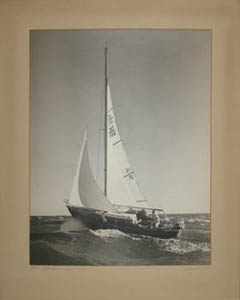
Fall -- Off Soundings, 1961, Sundancer
American: 1961
Black and white photograph
Signed lower right by photographer
Titled in pencil on mat in another hand
20 x 15.75 inches, photograph
19.25 x 15 inches, mat window
24.75 x 20 inches, mat overall
Provenance: Barbara C. & John B. McPherson, Old Lyme, Connecticut
Sold, please inquire as to the availability of similar items.

1961 Off Soundings Club Regatta
Photograph by Norman Fortier of Sundancer Yacht
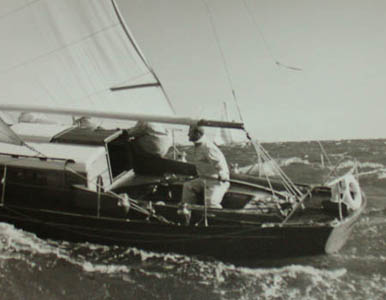
Photograph by Norman Fortier of Sundancer Yacht
This item is sold. It has been placed here in our online archives as a service for researchers and collectors.
- Please inquire as to the availability of similar items currently in stock, or use the navigation bar above to browse our site for currently available items.
- Find guidelines for the use of images from georgeglazer.com.
- To see more archived items, view our directory.
- Find information about selling your art and antiques.

Photograph
In mat |
Detail |
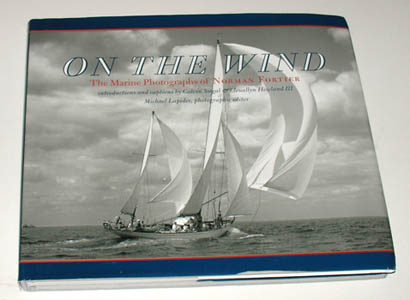
Norman Fortier photography book, On the Wind |
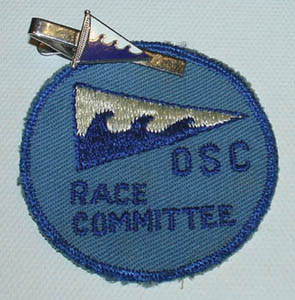
Off Soundings Club cloth patch and tie tack |
Black and white photograph of a yacht called Sundancer by the renowned marine photographer, Norman Fortier. The boat is shown in crisp focus and brilliant contrast sailing over a wave in the Fall 1961 Off Soundings Club regatta.
Sundancer was likely the yacht of John B. McPherson, Old Lyme, Connecticut, an electro-mechanical engineer. McPherson was a committee member of the Off Soundings Club (OSC), a yacht racing organization founded in 1933 and based in Southern New England and New York State, that runs weekend races for its members. The title of the print refers to the Fall Series of races held by OSC in mid-September. McPherson’s OSC Race Committee cloth blazer patch and OSC logo tie bar are included with the photograph, and perhaps could be incorporated in the framed presentation.
Norman Fortier was a photographer based in his native New Bedford, Massachusetts, a city with a tradition of whaling and fishing on the Atlantic Coast. He began as an avid amateur photographer and during World War II served as a U.S. Navy photographer. After the war he opened a commercial studio in New Bedford, doing advertising, portrait, and aerial photography. His commercial clients included Hathaway Manufacturing Company, Revere Copper and Brass, and Wamsutta Mills. Yachting and marine subjects were his passion.
Fortier was the subject of a 2006 retrospective at the New Bedford Whaling Museum and of the book On the Wind: The Marine Photographs of Norman Fortier (2007). A copy of the book is included with the purchase of this photograph. In this book, author Calvin Siegal describes Fortier’s craft: (p.xii).
Early in his career Norman had mastered the technique and art of taking excellent photographs in extremely difficult conditions. From his small, rolling vessel, tossed by waves and wind and exposed to damaging salt spray, in lighting conditions that could vary from second to second, he obtained exciting images of fast-moving subjects. He often had to tell those subjects to trim sails, tighten halyards, head up a bit and more. Yet invariably he achieved a class Fortier shot: well framed, properly focused, and with due attention to the surface of the water, the shape of the clouds and sky overhead.
References:
“A Storied Lens: The Photographic World of Norman Fortier.” New BedfordWhalingMuseum. 2006. http://www.whalingmuseum.org/exhibits/fortier.html (12 June 2009).
“Frequently Asked Questions. (FAQ.pdf)” Off Soundings Club. 2009. http://offsoundings.org/index.html (12 June 2009).
Siegal, Calvin and Llewellyn Howland III. On the Wind: The Marine Photographs of Norman Fortier. Boston, David R. Godine, 2007.