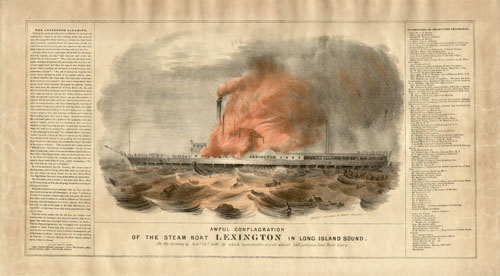
Awful Conflagration of the Steam Boat Lexington in Long Island Sound
Benjamin W. Thayer, Boston: 1840
Hand-colored lithograph
9.5 x 18 inches, printed text and image
11.5 x 20 inches, overall
9.5 x 17.75 inches, printed border
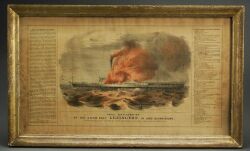
13 x 21.5 inches, framed
Sold, please inquire as to the availability of similar items.

Lexington Steamboat Fire
Long Island Sound, 1840
Long Island Sound, 1840
This item is sold. It has been placed here in our online archives as a service for researchers and collectors.
- Please inquire as to the availability of similar items currently in stock, or use the navigation bar above to browse our site for currently available items.
- Find guidelines for the use of images from georgeglazer.com.
- To see more archived items, view our directory.
- Find information about selling your art and antiques.
 |
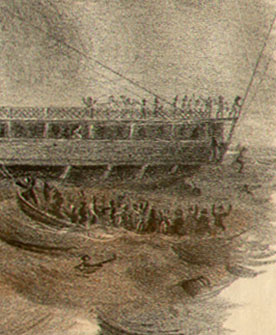 |

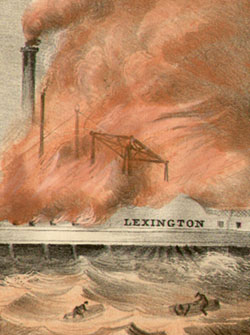
Illustrated broadside of a calamitous fire aboard the Lexington steamboat in Long Island Sound on January 13, 1840. The dramatic scene shows billowing red flames reflected in the choppy water, while people leap off the boat, clutch floating planks, bales of cotton, or escape in lifeboats. A column of text on the left, entitled "The Lexington Calamity," gives a sensationalistic account of the event along with the names of the four survivors. The righthand column lists those who perished. It is one of a number of such broadsides rapidly produced by a variety of printers in response to public interest in this major news event, including three versions printed by Currier & Ives.
The print is subtitled: On the evening of Jany 13 th 1840, by which lamentable event about 140 persons lost their lives. The text on the left includes the eyewitness account of David Crowley, the second mate, who managed to survive for 48 hours on a bale of cotton, which helped him stay warm as well as afloat, landing 50 miles away at New Gully, opposite River Head, Long Island . The broadside states that Crowley recalled watching the burning boat drift in the waters "lighting the whole sound, and then dying away in darkness."
The paddlewheel steamship Lexington was built by Cornelius Vanderbilt and began service as a day boat between New York City and Providence, Rhode Island in 1834, providing the fastest travel available at the time. The venture was a great success. On January 13, 1840, the boat left New York with about 115 passengers and 150 cotton bales. Some of the bales, however, had been loaded too close to the smokestack casing and within an hour and a half caught fire. The captain tried in vain to steer the boat to shore, and although the flames could be seen from both Long Island and Connecticut, would-be rescuers were hindered by the icy and choppy waters. Most of those who escaped the fire succumbed to the freezing water.
Benjamin W. Thayer was a Boston lithographic printer operating from 1840 to 1851, the successor of Thomas Moore. He frequently collaborated with John H. Bufford, another lithographer. Thayer also issued a related print drawn by Benjamin Champney (b. 1817) called "Maritime Disasters in the Winter of 1839 & 40" with the Lexington in the center, surrounded by eight vignettes of other calamities. In addition, he published sheet music, views, clerical portraits, pew plans, certificates and fancy prints, as well as historical prints, especially of military encampments.
References:
"Long Island Shipwrecks." Long Island Genealogy. http://longislandgenealogy.com/shipwrecks.html (9 April 2004).
Peters, Harry T. America on Stone. U.S.: Doubleday, Doran, 1931. pp. 133-134. pp. 382-383. (Thayer).