Sir Joshua Reynolds (1723-1792) (after)
William Dickinson (1746-1823) (engraver)
Sir Joseph Banks
W. Dickinson, No. 180, Near Norfolk Street, Strand, London: January 30, 1774
Mezzotint on chine appliqué, on laid paper, as issued
19.5 x 14 inches, sheet
9.5 x 14 inches, image
Sold, please inquire as to the availability of similar items.

Sir Joseph Banks with Globe
Portrait by Sir Joshua Reynolds
Portrait by Sir Joshua Reynolds
This item is sold. It has been placed here in our online archives as a service for researchers and collectors.
- Please inquire as to the availability of similar items currently in stock, or use the navigation bar above to browse our site for currently available items.
- Find guidelines for the use of images from georgeglazer.com.
- To see more archived items, view our directory.
- Find information about selling your art and antiques.

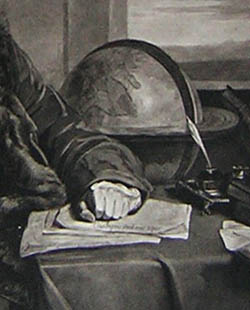
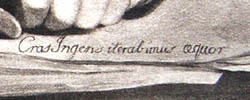
Portrait of the British explorer and naturalist Sir Joseph Banks, seated at a desk before a window, with a globe behind him as a symbol of his travels. According to the British National Portrait Gallery, which has the original oil portrait on display, Banks sat for Reynolds in 1772 and again in 1773, after his voyage to Iceland. On the desk are papers, one inscribed,"Cras ingens itera aequor,” which means "Tomorrow we shall resume our voyage over the mighty sea."
This print is accompanied by a title card suggesting it was at one point part of an exhibition or sold by a German dealer: “Tafel III/ William Dickinson nach Sir Joshua Reynolds/ Sir Joseph Banks/ (Verzeichnis Nr. 56).” [Plate III/ William Dickinson after Sir Joshua Reynolds/ Sir Joseph Banks/ Catalogue Number 56.] It is listed in Charles E. Russell’s English Mezzotint Portraits and Their States. Dickinson’s print is in the collection of the British National Portrait Gallery and the National Library of Australia. That print, and the original Reynolds portrait, can be viewed online (see references below). Reynolds also painted a famous group portrait of Banks with Daniel Charles Solander, a botanist, and Omai, a Polynesian brought to England by Captain Cook.
Sir Joseph Banks (1743-1820) came from a wealthy British family and developed a passion for botany. He went on to become a key figure in British science and government and in the development of the British colony in New South Wales. He accompanied James Cook's first great voyage of discovery in 1768-71, thus beginning his lifelong role participating in the advocacy and governance of the British settlement in New South Wales. In 1776, he acquired a London home in addition to his family estates in Lincolnshire. He kept his natural history collections there and made them freely available to both British and foreign scientists and researchers, and it became a center for the wider scientific community. Terrestrial globes by W. & T.M. Bardin are often dedicated to Banks.
Banks had a role in choosing the governors of the New South Wales settlement, founded in January 1788, and they unofficially reported to him. "Practically anyone who wanted to travel to New South Wales, in almost any capacity, consulted Sir Joseph Banks. He was the one constant throughout the first 30 years of white settlement in Australia, through changes of ministers, government and policy." (New South Wales Library web site) In 1778, he was elected President of the Royal Society, a position he held with varying degrees of support, until his death in 1820. He remains the longest serving President in the history of the Royal Society, founded almost 350 years ago.
Banks sent botanists to all parts of the world, including New South Wales, Australia, Africa, India and South America, often at his own expense. Their collections were added to both Kew Gardens, where he had been appointed adviser to the Royal Botanic Gardens by King George III, and to Banks' own collections in London. His informal role as governmental adviser on a range of issues was recognized in 1797 with his appointment to the Privy Council. He had a number of government roles, for instance serving on committees established by the House of Commons. He was also a Trustee of the British Museum. Banks was created a baronet in 1781 and invested Knight Commander of the Order of the Bath in 1795.
Sir Joshua Reynolds was the foremost portrait painter in England in the 18th century, and was extremely influential on later generations of artists. His poses were intended to invoke classical values and to enhance the dignity of his sitters. His style incorporated strong lighting, rich color and bravura paint handling. He also made history and "fancy pictures." As first president of the Royal Academy in London, he significantly raised the profile of art and artists in Britain. Reynolds is also known for his eloquent Discourses on Art, delivered to the students and members of the Academy between 1769 and 1790.
William Dickinson was a printseller and engraver in London, trading alone in business, mainly as a sole proprietor from 1773 to 1802. He was associated with Thomas Watson from 1776, and they traded as Watson and Dickinson from 1778 until Watson’s death in 1781. In the early 19th century he moved to Paris, although he still supplied the London market from there. He died in Paris in 1823. Dickinson exhibited at the Society of Artists from 1768 to 1776. One of the finest mezzotint engravers of his time, he engraved portraits after Sir Joshua Reynolds and others.
References:
Maxted, Ian. "The London book trades 1775-1800: a preliminary checklist of members." Exeter Working Papers in British Book Trade History. U.K.: Devon Library and Information Services. 24 July 2001. http://www.devon.gov.uk/library/locstudy/bookhist/loni.htmlhttp://www.devon.gov.uk/library/locstudy/bookhist/lond.html (5 November 2004).
Russell, Charles. English Mezzotint Portraits and Their States: Catalogue of Corrections of and Additions to Chaloner Smith’s “British Mezzotinto Portraits.” Vol. 2. New York: Minton, Balch & Co., 1926.
"Sir Joseph Banks." Sydney, Australia: State Library of New South Wales. June 2002. http://www.slnsw.gov.au/Banks/intro/biognote.htm (3 June 2002).
“Sir Joseph Banks.” National Portrait Gallery, UK. http://www.npg.org.uk/live/search/portrait.asp?LinkID=mp00240&rNo=0&role=sit (5 November 2004).
"Sir Joshua Reynolds." The Grove Dictionary of Art. New York: Macmillan. 2000. Artnet.com.http://www.artnet.com/library/07/0717/T071710.asp (15 April 2002).
“William Dickinson.” National Library of Australia. 17 June 2004. http://nla.gov.au/nla.pic-an9283218-1 (5 November 2004).