Forward March: Uncle Sam’s Old Hens Covering Their Chickens On The Way To Richmond
Kellogg, Hartford, Connecticut; Phelps & Watson, New York;
F.P. Whiting, New York: c. 1862
Hand-colored lithograph
8.5 x 13 inches, image
10 x 14 inches, overall
Sold, please inquire as to the availability of similar items.

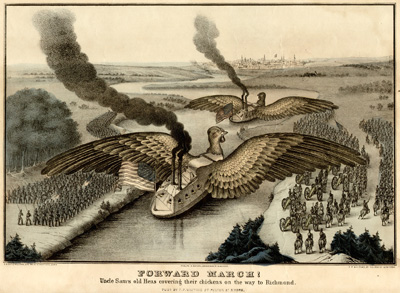
Forward March -- On The Way To Richmond
Uncle Sam's Old Hens Covering Their Chickens
Uncle Sam's Old Hens Covering Their Chickens
This item is sold. It has been placed here in our online archives as a service for researchers and collectors.
- Please inquire as to the availability of similar items currently in stock, or use the navigation bar above to browse our site for currently available items.
- Find guidelines for the use of images from georgeglazer.com.
- To see more archived items, view our directory.
- Find information about selling your art and antiques.

 |
 |
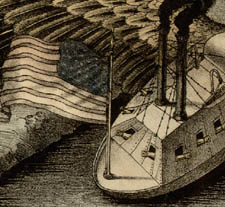 |
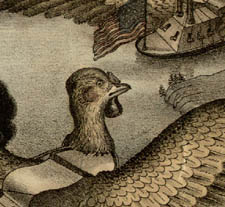
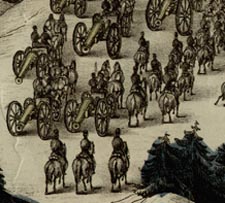
This patriotic Civil War cartoon from the Union point of view represents the Union Navy flotilla as two steamboats in the form of hens with broad, outstretched wings protecting their “chickens” -- the Army of the Potomac, led by General George B. McClellan. Together they make their way up the James River toward Richmond, Virginia the capital of the Confederacy, which can be seen on the horizon. The troops include soldiers marching and on horseback, with cannons in tow. The “old hens” make their way upriver toward Richmond, which can be seen in the distance. The celebratory nature of the print suggests it was done in the spring of 1862, before the Seven Days Battles (June 25 - July 1) dashed the hopes of the northern public that the Union would take Richmond and put a swift end to the war. This print is noted in Harry T. Peters’ classic reference work America on Stone (p. 247) and is in the collection of the Connecticut Historical Society.
In the first two weeks of May 1862, the Army of the Potomac slowly progressed upriver toward Richmond and took Yorktown, Williamsburg and Norfolk. The famous ironclad Confederate ship the Merrimac was scuttled on May 11, a dramatic moment for both sides. By the end of the month, 100,000 Union troops under McClellan had reached the outskirts of Richmond. Leading the Confederate forces in Richmond was Robert E. Lee, who had yet to prove his competence in the eyes of many southerners. An excited northern public expected victory. However, Lee emerged as a leader to be reckoned with, when he successfully repelled the Army of the Potomac during the Seven Days Battles. The Union withdrew to Harrison’s Landing, and the “Seven Days rapidly took on the aura of an unequivocal Confederate triumph” (Gallagher).
This publication credits on this lithograph lists three co-publishers: Kellogg, a prolific printer of the period much in the same genre as Currier and Ives; Phelps & Watson, a prolific New York map publisher that had connections with Kellogg; and F.P. Whiting, with an address given as 87 Fulton Street, which is where Kellogg ran a New York office until around 1860. The Whitings and the Kelloggs evidently issued a number of prints together, including a portrait of Abraham Lincoln when he was running for president. The Indiana Historical Society has a patriotic print from the Civil War era portraying the Union as an allegorical bird, The Eagle’s Nest (1861), that was co-published by George Whiting, 87 Fulton Street, with Kellogg.
The Kelloggs were lithographers active in Hartford, Connecticut, New York City and Buffalo, New York. They produced an immense number of black-and-white and hand-colored lithographs during the 19th century, second only to their contemporaries and competitors Currier & Ives. The Connecticut Historical Society has almost 1,000 lithographs by the Kelloggs in their collection, including sentimental scenes, views of towns and buildings, portraits and historical scenes such as Civil War battles.
The Kellogg firm was founded by Daniel Wright Kellogg (1807-1874), who pioneered publishing inexpensive and popular lithographs in the United States under the name D.W. Kellogg & Co. in Hartford about 1833. Around 1843, he was joined by his brothers Edmund Burke Kellogg (1809-1872) and Elijah Chapman Kellogg (1811-1881), who began trading as E.B. and E.C. Kellogg. Edmund had a background as a journalist and editor and Elijah was trained as an engraver; he also was one of the first in the U.S. to breed trout artificially and wrote treatises on fish culture. Their firm was headquartered at 136 Main Street in Hartford until 1852. The Kelloggs also had offices in New York with Horace Thayer in (1846-47), J.G. Comstock (1849-52), and thereafter without partners until about 1860. Charles E. Kellogg, son of E.B., joined the business in 1860. In 1871, William Henry Bulkeley joined the firm and undertook a major reorganization of the business into a successful printing house called Kellogg & Bulkeley, specializing in colorful chromolithographs. The firm later merged with Case, Lockwood & Brainard to form Connecticut Printers in 1947.
Full publication information: Kellogg, 245 Main Street, Hartford, Connecticut; Phelps & Watson, 18 Beekman Street, New York; F.P. Whiting, 87 Fulton Street, New York.
References:
“Back to the Source: 19th century base-ball texts and guides.” Vintage Base Ball Association. http://www.vbba.org/ed-interp/backtothesource.html (28 June 2006).
“Connecticut’s Currier & Ives: Lithographs by the Kellogg Brothers.” Connecticut Historical Society. 2002. http://www.chs.org/graphcoll/kelloggprint.htm (9 June 2004).
“Eagle’s Nest.” Indiana Historical Society Digital Images Collection. 2003. http://images.indianahistory.org/cdm4/item_viewer.php?CISOROOT=/P0406&CISOPTR=524&REC=3 (28 June 2006).
Gallagher, Gary W. “The Richmond Campaign of 1862.” The Peninsula and the Seven Days. University of North Carolina Press: 2000. Chapter 1 online at: University of North Carolina Press. 2000. http://uncpress.unc.edu/chapters/gallagher_richmond.html (28 June 2006).
“Kellogg Prints: Kellogg and Bulkeley.” Connecticut Historical Society. 2002. http://www.chs.org/graphcoll/kelloggprint4.htm (9 June 2004).
Peters, Harry T. America on Stone. U.S.: Doubleday, Doran, 1931. pp. 242-247.
“Report for 2001-2002.” Connecticut Historical Society. 2002. p. 13. Online at: http://www.chs.org/anreport.pdf (28 June 2006).