Hans Holbein the Younger (1497 or 1498-1543) (after)
Anthony Joseph Walker (1726-1765) (engraver)
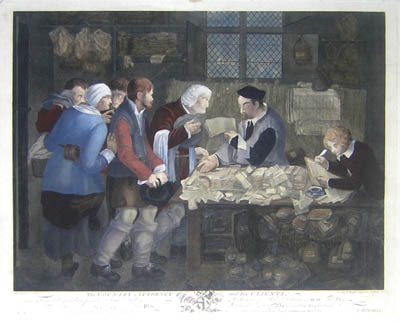
The Country Attorney and his Clients
John Boydell, Cheapside, London: March 1st, 1764
Hand-colored engraving
19 x 23.5 inches, sheet overall
17x 21.25 inches, plate mark
23.25 x 27 inches, matted
Sold, please inquire as to the availability of similar items.

The Country Attorney
British 18th C. Print after Hans Holbein
British 18th C. Print after Hans Holbein
This item is sold. It has been placed here in our online archives as a service for researchers and collectors.
- Please inquire as to the availability of similar items currently in stock, or use the navigation bar above to browse our site for currently available items.
- Find guidelines for the use of images from georgeglazer.com.
- To see more archived items, view our directory.
- Find information about selling your art and antiques.
 |
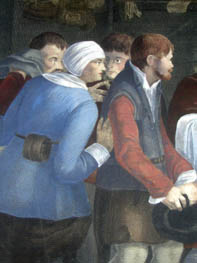 |
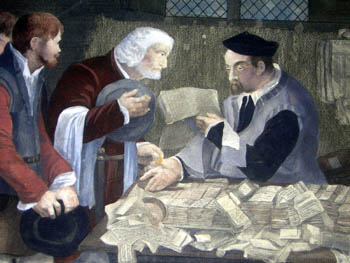
In this genre scene, an attorney hands a document to an elderly man and holds out his hand for a coin in payment. He stands before a desk piled with papers as a young clerk writes out another document with a quill pen. Three rustic men, who have removed their hats in respect, and a woman look on with interest. According to the dedication, the print was made after a painting by the German portrait painter Hans Holbein (the Younger) then in the collection of a British doctor. The engraver produced five works after Old Master paintings for Boydell, which were exhibited at the Incorporated Society of Artists between 1763 and 1765.
Hans Holbein was born in Augsburg, Germany, son of Hans Holbein the Elder. The younger Holbein began his career in Basel, as a painter of altarpieces and designer of woodcuts. He spent the years 1526-28 in England, where he was introduced to Sir Thomas More and obtained patrons. Back in Basel, he completed a number of municipal commissions, then returned to England in 1532, becoming the most important portrait painter there during the Reformation, mainly under the patronage of King Henry VIII and his court. Throughout Europe, Holbein painted portraits of potential wives for the king. He also served as the court fashion designer, designing the king’s state robes, weapons and accessories. Today Holbein’s paintings are in the world’s major art museums, including the Louvre, the Metropolitan Museum of Art, the National Gallery (London), the British Museum and the Frick Collection.
Anthony Joseph Walker was an English printmaker and draftsman. He served an apprenticeship to John Tinney, who produced many topographical plates. Much of his early signed work were engravings after his own drawings for the book trade. Later, he became a sought-after engraver of large single-issue prints, including five after Old Master paintings for John Boydell. He also produced illustrations for instructional books, such as The Complete Drawing Book (London, 1757).
John Boydell was a successful and influential printseller and engraver. Boydell's Shakespeare Gallery is credited with changing the course of English painting by creating a market for historical and literary works. He also encouraged the development of engraving in England with, among other things, his prints illustrating scenes from Shakespearean plays. By the late 1760s he was a successful entrepreneur in print publishing and retailing, successfully marketing his prints across the continent; he also became Lord Mayor of London in 1790. In 1773, his nephew Josiah Boydell (1752-1817) became his business partner and later his successor, trading as J. & J. Boydell.
Full title and inscription, lower margin: “The Country Attorney and his Clients. From the Original Picture painted by Hans Holbein, in the Collection of Robert Bragg M.D. To Whom This Plate is Dedicated; By his most Obliged humble Servant, J. Boydell. Size of the Picture, 3:3 ¾ by 4:3 in length. No. 8.”
References:
“Anthony Joseph Walker.” The Grove Dictionary of Art. New York: Macmillan. 2000. Artnet.com. http://www.artnet.com/library/09/0904/T090459.asp (4 October 2004).
“Hans Holbein (ii).” The Grove Dictionary of Art. New York: Macmillan. 2000. Artnet.com. http://www.artnet.com/library/03/0386/T038603.asp (4 October 2004).
“Hans Holbein the Younger.” J. Paul Getty Trust. 2004. http://www.getty.edu/art/collections/bio/a703-1.html (4 October 2004).
Maxted, Ian. "The London book trades 1775-1800: a preliminary checklist of members." Exeter Working Papers in British Book Trade History. U.K.: Devon Library and Information Services. 20 June 2001. http://www.devon.gov.uk/library/locstudy/bookhist/lonb.html (10 December 2002).
Rusche, Harry. Boydell's Shakespeare Gallery. 1998. http://www.emory.edu/ENGLISH/classes/Shakespeare_Illustrated/Boydell.html (10 December 2002).