Arthur Fitzwilliam Tait (1819-1905) (after)
Charles Parsons (1821-1910) (lithograph artist)
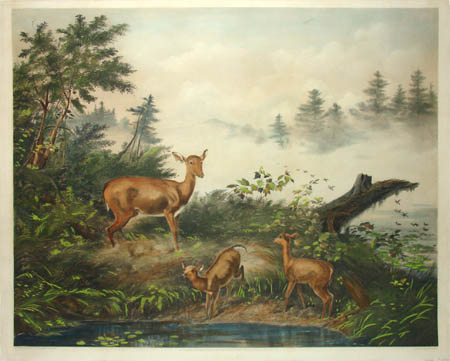
Home of the Deer – Morning in the Adirondacks
Currier & Ives, New York: 1862
Signed and dated in plate: A.F. Tait, 1861
Chromolithograph
18.25 x 23.75 inches, image
19.5 x 23.75 inches, overall
29 x 34 inches, matted in wooden frame
Sold, please inquire as to the availability of similar items.

Home of the Deer – Morning in the Adirondacks
Currier & Ives, New York: 1862
Currier & Ives, New York: 1862
This item is sold. It has been placed here in our online archives as a service for researchers and collectors.
- Please inquire as to the availability of similar items currently in stock, or use the navigation bar above to browse our site for currently available items.
- Find guidelines for the use of images from georgeglazer.com.
- To see more archived items, view our directory.
- Find information about selling your art and antiques.
 |
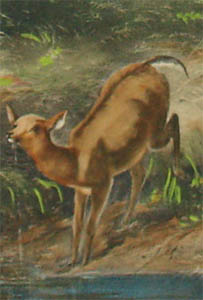 |
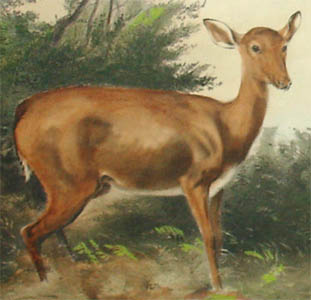
A classic Currier & Ives image of a doe with two fawns in a woodland setting in New York’s Adirondack mountains. The doe stands on the shore of a lake or pond as one of the fawns takes a drink. An early morning mist rises off the water beyond, shrouding the mountains in haze. A flock of ducks takes flight from the water into the distance. Peaceful scenes of rural America were one of Currier & Ives’ specialties. Although many of the firm’s lithographs were unattributed, this one is signed and dated in the plate by the renowned American artist Arthur Fitzwilliam Tait. It is typical of his landscapes, in which detailed renderings of wildlife or figures are set against misty landscapes in his beloved Adirondacks.
Arthur Fitzwilliam Tait was a member of the Hudson River School of painters and one of the most popular American painters during the 19th century. Born in England, he started working for a Manchester art dealer in his teens and taught himself to draw. He assisted George Catlin with his traveling gallery of pictures of Indians in England and Paris, and was inspired by Catlin’s work to emigrate to the U.S. in 1850. He settled in New York City, but spent much of his time in the Adirondacks where he became a skilled hunter and backwoodsman as well as a prolific sporting artist, producing some 200 paintings of deer, as well as depictions of frontier life, hunting scenes and still lifes of dead game. Tait was one of the principal artists who defined the Currier & Ives look with hunting and fishing scenes and landscapes. Today his paintings are in the collections of numerous prominent American museums.
Charles Parsons was a British-born artist who emigrated to America, where he painted in oil and watercolor as well as working in lithography. He was elected an Associate Member of the National Academy of Design and of the New York Water Color Society. Parsons is perhaps best known for his role in helping to create the classic look of Currier & Ives’ popular lithographs, along with the artists Louis Maurer, Arthur Fitzwilliam Tait, Fanny Palmer, Thomas Worth and George Henry Durrie (Bonfante-Warren).
The lithography firm of Currier & Ives was founded in 1834 by Nathaniel Currier as N. Currier, Lithographer, and based in New York. In 1852, he brought his brother-in-law, James Merritt Ives, into the business and renamed the firm Currier & Ives five years later. They were extremely prolific and highly successful, producing almost 7,500 different separately issued art prints through the 19th century until 1907, aptly advertising themselves as "Print-makers to the American People." Their prints were issued in either small, medium or large folio, though some particularly popular images were issued in more than one size. Dozens of American artists in the mid 19th century painted primarily for lithographic reproduction by Currier & Ives and other firms. To please a broad audience, the firm presented a warmly positive vision of America, frequently sentimental, and sometimes with a touch of humor. Currier & Ives prints generally portrayed the American landscape, scenery and landmarks, including the westward expansion, as well as daily life in both urban and rural settings. Their sporting and maritime subjects were particularly popular. These prints are now highly collectible as records of American history, as fine works of American art, and for their decorative appeal.
Full publication information (below image): “Painted by A.F. Tait. On Stone by C. Parsons. Entered according to Act of Congress A.D. 1862 by Currier & Ives in the Clerks Office of the District Court for the Southern District of N.Y. Lith. by Currier & Ives.”
References:
Bonfante-Warren, Alexandra. Currier & Ives: Portraits of a Nation. New York: Metro Books, 1998. pp. 9, 23-41, 49, 71.
Conningham, Frederic A. Currier and Ives Prints: An Illustrated Check List. New York: Crown, 1949. 2865.
Fielding, Mantle. Dictionary of American Painters, Sculptors and Engravers. Green Farms, Connecticut: Modern Books and Crafts, 1926, rev. ed. 1974. p. 271.
Zellman, Michael David, dir. American Art Analog. Vol. I. Chelsea House: New York, 1986. p. 187.