Francis Wheatley (1747-1801) (after)
B. Knight (engraver)
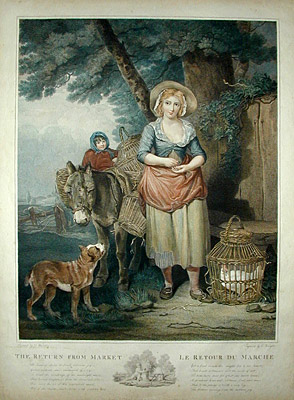
The Return from Market [Le Retour du Marche]
T. Simpson and Darling & Thompson, London: April 21, 1789
Color printed stipple engraving
21 x 15 inches, print
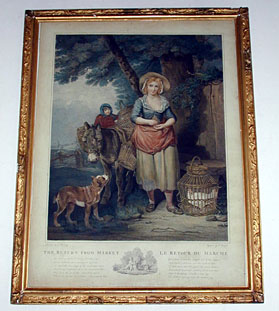
23.5 x 18.25 inches, antique gold-leaf frame
Sold, please inquire as to the availability of similar items.

The Return from Market
After Francis Wheatley
After Francis Wheatley
This item is sold. It has been placed here in our online archives as a service for researchers and collectors.
- Please inquire as to the availability of similar items currently in stock, or use the navigation bar above to browse our site for currently available items.
- Find guidelines for the use of images from georgeglazer.com.
- To see more archived items, view our directory.
- Find information about selling your art and antiques.
 |
 |
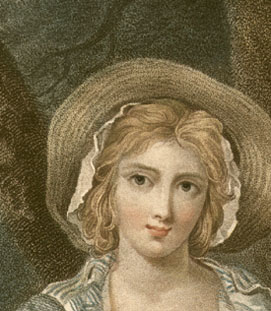 |
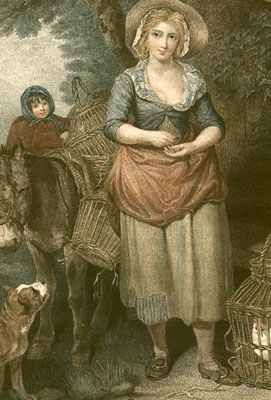
Young woman escorting her son and donkey back from market. The donkey is carrying the son and wicker baskets. A basket on the ground beside the woman holds a live chicken, and the dog at her feet tilts his head toward her. A small engraving of a young boy bundling up grain also appears in the bottom margin. "Fancy pictures," such as this one, a combination portrait and genre scene, became very popular at the end of the 18th century. Wheatley specialized in such pictures, which like this one, presented an idealized picture of lower class rural folk that appealed to members of higher social classes. There generally was a sentimental and moralizing quality to his paintings, depicting the virtues of honest, hardworking people. This concept is underscored here by the accompanying poem, which explains that this young woman has never known luxury. Nevertheless, she is treasured by a "fond swain" who has made her his wife, and the deserving couple has been blessed with an adorable little boy.
The poem appears in the lower margin as follows:
"At luxury's shrine to drink delirious joy,
Grieve without cause, enamour'd of a toy;
To tread the windings of the midnight maze,
And borrow brightness from the diamonds blaze,
Was ne'er the lot of this sequestered maid;
Who of the charm, must charm with simpler aid.
Yet a fond swain has caught her to his heart
And boasts a treasure not the work of art;
To him, more dear for what she never knew,
A prudent housewife, virtuous, fond and true;
And lo'the pledge of truth, a rosy boy;
The father's opening from the mother's joy."
Francis Wheatley trained at William Shipley's Academy in London. He won prizes for drawing from the Society of Artists while still in his teens, and enrolled in the Royal Academy Schools in 1769. Wheatley was elected a fellow of the Society of Artists in 1770 and became a director in 1774. In addition to the genre paintings for which he is best known, Wheatley executed history paintings and portraits. His works are in the collections of the Getty Museum, the National Gallery of Art, Washington, the Tate Gallery, Britain's National Portrait Gallery, the Yale University Center for British Art and many other museums.
William Darling and John Peter Thompson were London engravers. Darling worked on his own from 1771 to 1790, and Thompson worked alone as well, but they joined forces trading as Darling and Thompson from 1791 to 1799. They served as engravers to the Duke and Duchess of York and also engraved many bookplates.
References:
Maxted, Ian. "The London book trades 1775-1800: a preliminary checklist of members." Exeter Working Papers in British Book Trade History. 20 June 2001. http://www.devon.gov.uk/library/locstudy/bookhist/lond.html (31 January 2003).
"Francis Wheatley." The Getty Collections. 2000. http://www.getty.edu/art/collections/bio/a448-1.html (31 January 2003).
"Francis Wheatley." The Grove Dictionary of Art. New York: Macmillan. 2000. Artnet.com. http://www.artnet.com/library/09/0913/T091348.asp (31 January 2003).