Samuel Shelley (c. 1750-1808) (after)
Robert Cooper (fl. 1795-1836) (engraver)
Love Wounded
John Young, 58 Upper Charlotte Street, London: March 14, 1798
Sepia etching on silk later mounted on board
11.75 x 9.25 inches, plate mark
13.75 x 11.25 inches, overall
Sold, please inquire as to the availability of similar items.

Love Wounded
Samuel Shelley, 1798
Samuel Shelley, 1798
This item is sold. It has been placed here in our online archives as a service for researchers and collectors.
- Please inquire as to the availability of similar items currently in stock, or use the navigation bar above to browse our site for currently available items.
- Find guidelines for the use of images from georgeglazer.com.
- To see more archived items, view our directory.
- Find information about selling your art and antiques.
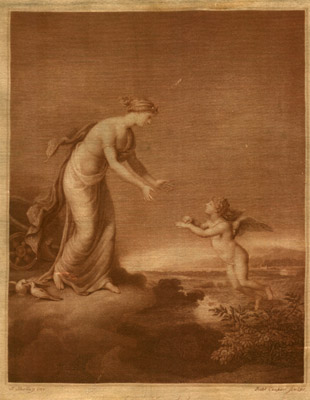
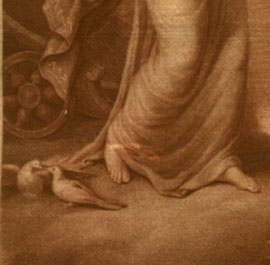
Allegorical print in the neoclassical taste, depicting Venus, the goddess of love, stepping from her chariot and extending her helping open arms to Cupid, messenger of love, who points to an injury on his hand. The scene is set in a classical landscapes, with two doves at Venus's feet. Printed in sepia on silk resulting in a soft but shimmering effect. A rare example of an 18th-century print on silk.
Samuel Shelley was a British painter of miniatures, historical and genre subjects, and occasional stipple engraver of decorative subjects after his own designs. He was basically self-taught, copying from the works of Reynolds, developing over the years an elegant and refined style, especially in his miniatures, which are often treated allegorically. Shelley first exhibited at the Royal Academy in 1774, and was for several years a constant contributor; he also helped found the Water-Colour Society, which originally met in his home, and exhibited works based on Greek mythology in their first exhibition in 1805. He occasionally illustrated books as well, and prints were produced after his paintings by leading engravers of the period, including Ryder and Bartolozzi. Engravings after his portraits and one watercolor are in the collection of the British National Portrait Gallery.
Robert Cooper was an engraver and publisher, mainly of portraits and book illustrations, but also producing bookplates and vignettes. He worked for several magazines and contributed to various collected works and illustrated Sir Walter Scott's novels. He also exhibited with the Associated Engravers in 1821.
John Young (1755-1825) was a mezzotint engraver and publisher, taught by J.R. Smith. Young produced some 80 portraits, including a series of 31 small prints of the emperors of Turkey. He also worked as mezzotint engraver to the Prince of Wales from 1789 to 1820. He served as keeper to the British Institution. In that capacity, he published outline engravings of famous paintings to instruct the public after 1820 as well a series of catalogues of the galleries. He exhibited at the Royal Academy in 1794, and served as honorary secretary of the Artists' Benevolent Fund (1810-1813).
References:
Mackenzie, Ian. British Prints: Dictionary and Price Guide. Woodbridge, Suffolk, England: Antique Collectors Club, 1987. pp. 84, 288.
Maxted, Ian. "The London book trades 1775-1800: a preliminary checklist of members." Exeter Working Papers in British Book Trade History. U.K.: Devon Library and Information Services. 20 June 2001. http://www.devon.gov.uk/library/locstudy/bookhist/lonw.html (26 June 2003).
Redgrave, Samuel. A Dictionary of Artists of the English School: Painters, Sculptors, Architects, Engravers and Ornamentists. London: Longmans, Green, and Col., 1874. pp. 94, 372, 471.