Twas a Calm Still Night
Currier & Ives, New York: 1880
Lithograph on paper
3.25 x 5 inches, overall
Sold, please inquire as to the availability of similar items.

Twas a Calm Still Night
Trade Card by Currier & Ives: 1880
Trade Card by Currier & Ives: 1880
This item is sold. It has been placed here in our online archives as a service for researchers and collectors.
- Please inquire as to the availability of similar items currently in stock, or use the navigation bar above to browse our site for currently available items.
- Find guidelines for the use of images from georgeglazer.com.
- To see more archived items, view our directory.
- Find information about selling your art and antiques.
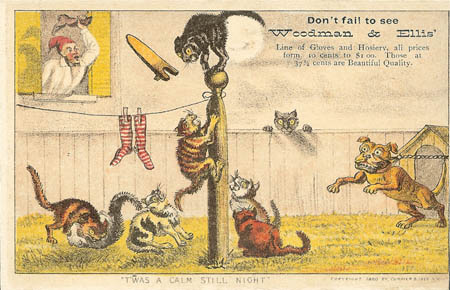
Humorous trade card for Woodman & Ellis, makers of gloves and hosiery with the ironic caption, "Twas a Calm Still Night." A man in a red night cap awakens to the sounds of a chaotic cat fight in his backyard, and is throwing objects to disperse the feline intruders, to no avail. His bulldog, eyes bulging, strains at his chain. A pair of red and white striped socks hangs on the clothesline. Imprinted with the message "Don't fail to see Woodman & Ellis' Line of Gloves and Hosiery, all prices form (sic) 10 cents to $1.00. Those at 37 1/2 cents are Beautiful Quality."
The lithography firm of Currier & Ives was founded in 1834 by Nathaniel Currier as N. Currier, Lithographer, and based in New York. In 1852, he brought his brother-in-law, James Merritt Ives, into the business and renamed the firm Currier & Ives five years later. They were extremely prolific and highly successful, producing almost 7,500 different separately issued art prints through the 19th century until 1907, aptly advertising themselves as "Print-makers to the American People." Their prints were issued in either small, medium or large folio, though some particularly popular images were issued in more than one size. Dozens of American artists in the mid 19th century painted primarily for lithographic reproduction by Currier & Ives and other firms. To please a broad audience, the firm presented a warmly positive vision of America, frequently sentimental, and sometimes with a touch of humor. Currier & Ives prints generally portrayed the American landscape, scenery and landmarks, including the westward expansion, as well as daily life in both urban and rural settings. Their sporting and maritime subjects were particularly popular. These prints are now highly collectible as records of American history, as fine works of American art, and for their decorative appeal.
Reference:
Bonfante-Warren, Alexandra. Currier & Ives: Portraits of a Nation. New York: Friedman/Fairfax, 1998. pp. 9, 23-41.