Daniel Huntington (1816-1906) (after)
William Kurtz (1833-1904) (photographer)
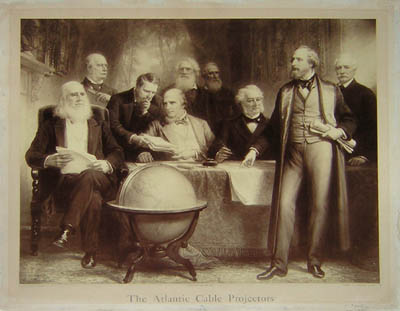
The Atlantic Cable Projectors
The Chamber of Commerce, New York: 1895
Photograph, uncolored,
mounted on titled card as issued
Signed lower left, in the painting as photographed:
D. Huntington 1895
Printed in photograph lower right: Copyrighted by the Chamber of Commerce of New York 1895
18 x 22.25 inches, photograph
19.75 x 22.75 inches, margin on card
22 x 26.5 inches, overall
Sold, please inquire as to the availability of similar items.

Atlantic Cable Projectors
Large Folio Photographic Print
Large Folio Photographic Print
This item is sold. It has been placed here in our online archives as a service for researchers and collectors.
- Please inquire as to the availability of similar items currently in stock, or use the navigation bar above to browse our site for currently available items.
- Find guidelines for the use of images from georgeglazer.com.
- To see more archived items, view our directory.
- Find information about selling your art and antiques.
>
 |
 |
 |
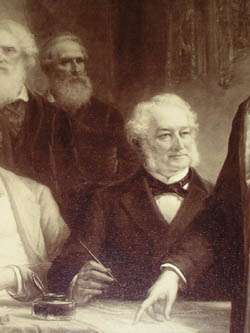 |


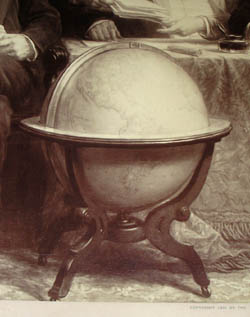
Portrait of the principal persons responsible for the laying of the Atlantic Cable in 1858 and 1866. This is a large photograph of the 9-foot-wide painting that was presented to the Chamber of Commerce of New York on May 23, 1895 by Chamber member and committee chair Morris K. Jesup. The photograph is mounted on a titled card, as issued by the Chamber of Commerce; such photographs were likely presented to dignitaries or members by the organization or sold as souvenirs.
Concerning the painting, the “Introductory Note” of The Atlantic Cable Projectors, published by the Chamber in 1895, states, “Now the Chamber of Commerce completes its gracious office of commemoration by a more permanent memorial of the Atlantic Telegraph in a historical painting of Mr. Field and his honored associates, that, as it hangs upon the walls of the Chamber, will remind those who come after us what manner of men they were who achieved so great a work for their country and for the world. New-York, May 30, 1895.”
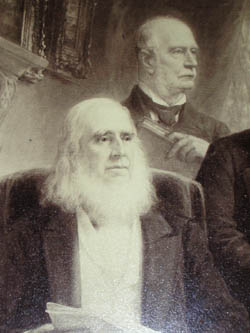
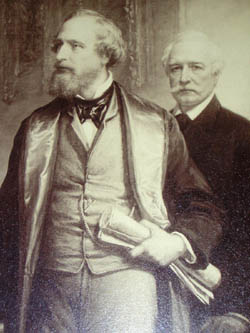
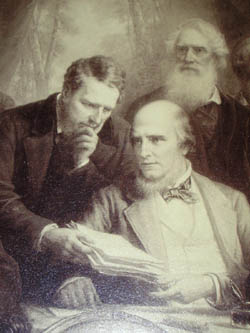
The picture shows investors and officers of the New York, Newfoundland & London Telegraph Co., which undertook the laying of the first cable (the artist also includes himself in the background). From left to right, these are Peter Cooper (President), David Dudley Field, Chandler White (Secretary), Marshall Owen Roberts, Samuel F.B. Morse (Vice President), Daniel Huntington (painter of the portrait), Moses Taylor (Treasurer), Cyrus W. Field and Wilson G. Hunt.
New York inventor and industrialist Peter Cooper (1791-1883) was the first president and a principal investor in the project. The company was formed as a result of a series of meetings in 1854 at the home of Cyrus West Field (1819-1892) and attended by Cooper, Taylor, Roberts (1814-1880), White and Field’s brother David, as well as Robert W. Lowber (not shown). Also shown in the portrait are telegraph inventor Morse and Hunt (1803-1892), who joined with the initial group that formed the company. These men were prominent New York businessmen, which is probably why the Chamber of Commerce of New York took a special interest in their achievement. As an interesting aside, Morse was an artistic mentor of the artist, Daniel Huntington.
Cyrus W. Field, the prime mover of the project, took it on a few years after retiring from a successful business career at the age of 40. The difficult project met with great skepticism from most businessmen, and the practical difficulties resulted in many failed attempts, but eventually Field arranged for the first cable to be sent from Queen Victoria to President James Buchanan in 1858, an event greeted with great popular acclaim. Although the cable broke three weeks later, Field persevered for the next several years, getting additional financing and completing the project in 1866.
Daniel Huntington was a painter based in New York City, and though he painted some landscapes and historical subjects, about 1,000 of his 1,200 known works were portraits. His artistic talent was encouraged as a student of Hamilton College in the 1830s. Returning to New York City, he continued his studies under Henry Inman and Samuel F.B. Morse, who was a prominent painter as well as a telegraph inventor and entrepreneur. As ambitious American artists tended to do, Huntington also spent a few years studying in Europe, mainly in Rome. He was elected to the National Academy in 1840, and served as president of the organization from 1862 to 1870 and 1877-1890.
William Kurtz, who photographed the painting, was a distinguished New York City portrait photographer, known for his mastery of lighting and shadow, dubbed his “Rembrandt style.” By the early 1880s, he was a specialist in taking portraits at night, using flash powder. He photographed such luminaries as Walt Whitman.
Condition: Photograph mounted onto printed card, as issued. Photograph very good with the usual overall light toning and fading. Board a bit brittle, outer margins with mat burn, chipped edges, glue residue, can be matted out.
References:
“1866 Cyrus Field: The Laying of the Atlantic Cable.” CanadaHistory.com. http://www.canadahistory.com/sections/documents/atlanticcable1866.htm (1 December 2004).
“About the Cooper Union: History.” The Cooper Union. http://www.cooper.edu/administration/about/history.html (1 December 2004).
"Cyrus West Field." National Portrait Gallery. http://www.npg.si.edu/exh/brady/gallery/78gal.html (4 March 2003).
Groce, George C. and Wallace, David H. The New-York Historical Society’s Dictionary of Artists in America 1564-1860. New Haven: Yale University Press, 1969. p. 335.
“The Atlantic Cable Projectors.” FTL Design: History of the Atlantic Cable & Submarine Telegraphy. http://www.atlantic-cable.com/Projectors/ (1 December 2004).
“The Whitman Gallery.” Whitman Archive. http://www.whitmanarchive.org/photos/1860s/docs/032.html (1 December 2004).
Welling, William. “The Reader’s Companion to American History: Photography.” Houghton Mifflin. http://college.hmco.com/history/readerscomp/rcah/html/ah_068900_photography.htm (1 December 2004).