Dr. Robert John Thornton (1768?-1837) (editor)
Peter Charles Henderson (d. 1829), Philip Reinagle (1749-1833) (after)
Joseph Constantine Stadler (act. 1780-1812), John Roffe (c.1769-1850), Quilley et al. (engravers)
Botanical Prints
from
The Temple of Flora, or Garden of the Botanist, Poet, Painter, and Philosopher
Dr. Robert John Thornton, London: 1812
Stipple, mezzotint or aquatint, some partially printed in colors, finished by hand and some heightened with gum arabic
11.5 x 8 inches, platemark, average approximate
Sold, please inquire as to the availability of similar items.
To see other Thornton prints on our site, use our site search engine.
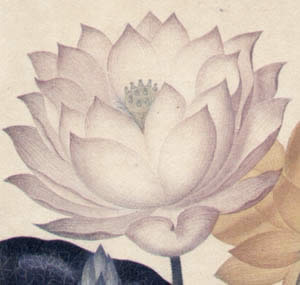
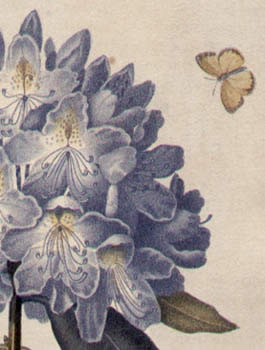
A selection of quarto botanical prints from Dr. Robert Thornton’s The Temple of Flora. This set departed from previous botanical works in illustrating the plants to appear oversized relative the backgrounds, giving them an overall stately, dramatic, or even surreal appearance, and making them decidedly ahead of their time. Each illustration also had poetic narrative underpinnings, ranging from romantic to bizarre. For example, describing the Dragon Arum print, Thornton stated that “[t]he clouds are disturbed, and every thing looks wild and sombre.” The prints of Temple of Flora are now considered the greatest achievement ever in British botanical art. Shown above are four prints from this set: The Blue Egyptian Water Lily, The Night-blowing Cereus, The Sacred Egyptian Bean, and The Pontic Rhododendron.
Robert John Thornton began his career as a doctor. In 1797, he opened a successful practice in London. Meanwhile, he had become deeply interested in botany under the influence of Thomas Martyn’s lectures and the writings of Linnaeus. In 1797, he also began advertising for subscribers to his planned natural history publishing venture, which eventually became known as The Temple of Flora, comprised of 30 folio botanical plates (generally issued with just 28), as well as two classical allegorical plates. It was originally published as the third section of an extensive and ambitious botanical publication titled New Illustration of the Sexual System of Linnaeus.
Thornton retained some of the best artists of the day to compose the various images, as well as the best engravers to translate their work into print. Most of the images were painted by Peter Charles Henderson and Philip Reinagle, with two by Abraham Pether, who also rendered the moonlight in Reinagle’s Night-blowing Cereus, one of the best-known images from the set. The remaining two plates were painted by Sydenham Edwards and Thornton himself, who created the famous plate of Roses. The engravers were a similarly distinguished group, including Richard Earlom, James Caldwall, Thomas Sutherland, and Joseph Constantine Stadler. Some of the plates are executed in one engraved or etched medium, some in a combination of two or more, including stipple engraving, aquatint, and mezzotint. They were printed in basic colors and then enhanced with hand coloring.
In 1812, Thornton had The Temple of Flora set re-engraved on a small scale for a quarto edition, with some of the compositions slightly altered. Some examples from the smaller formatted edition may have been given as prizes during the Royal Botanic Lottery under the patronage of the Prince Regent. Thornton organized the lottery when faced with bankruptcy after sales of the folio publication failed to recoup his investment, having spared no expense in its production. The lottery apparently failed to salvage his finances, and Thornton died with little money. The whereabouts of the original paintings, also included in the lottery are mostly unknown. Nevertheless, The Temple of Flora remains admired as the greatest illustrated botanical set ever published in Britain for its outstanding aesthetic and imaginative qualities.
References:
Blunt, Wilfred, rev. by Stearn, William T. The Art of Botanical Illustration. Woodbridge, Suffolk, England: Antique Collectors Club, 1994. pp. 236-242.
Dunthorne, Gordon. Flower and Fruit Prints of the 18th and Early 19th Centuries. Their History, Makers and Uses, with a Catalogue Raisonne of the Works in Which They are Found. Washington, D.C.: Published by the Author, 1938.
Grigson, Geoffrey and Handasyde Buchanan. Thornton’s Temple of Flora. London: 1951.
King, Ronald, The Temple of Flora by Robert Thornton, London, Weidenfield & Nicolson, 1981.
Sitwell, Sacheverell. Great Flower Books, 1700-1900. New York: The Atlantic Monthly Press, 1990. pp. 77, 127.
Stafleu, Frans A. and Richard S.Cowan. Taxonomic Literature. Utrecht: 1967. 2nd ed., Utrecht: 1976-1988. TL2 8319, Tl2 14.283.
Thomas, Alan G. Great Books and Book Collectors. Littlehampton Book Services, 1975. p.144.