Chinese Export School
Pair of Fruit Paintings
China: 2nd or 3rd Quarter 19th Century
Watercolor on pith paper, mounted as issued on rice paper within blue silk border
11.5 x 8 inches, blue ribbon border
13.25 x 9 inches, overall
Sold, please inquire as to the availability of similar items.

Chinese Export School
Pair of Pith Paintings of Fruit
Pair of Pith Paintings of Fruit
This item is sold. It has been placed here in our online archives as a service for researchers and collectors.
- Please inquire as to the availability of similar items currently in stock, or use the navigation bar above to browse our site for currently available items.
- Find guidelines for the use of images from georgeglazer.com.
- To see more archived items, view our directory.
- Find information about selling your art and antiques.
 |
 |
 |
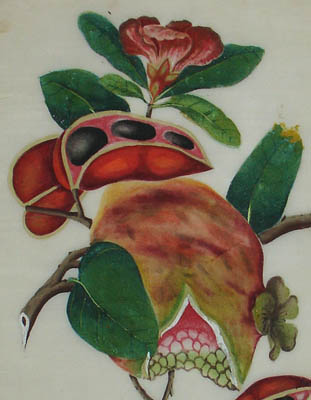 |
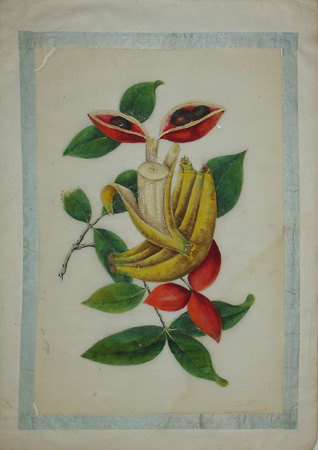
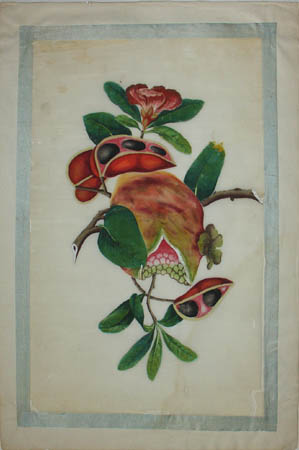
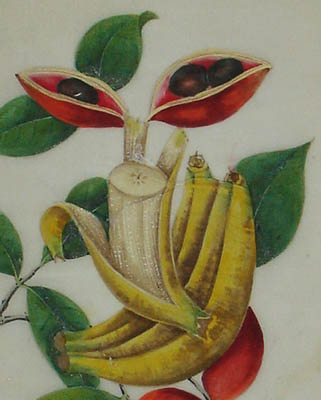
Pair of vividly colored botanical paintings of fruit, one of a bunch of bananas and one of what appears to be a pomegranate. Both feature the fruit in the center entwined with sprigs of another plant with bright red pods split open to reveal large black beans.
They are painted on pith paper, made from thin sheets of pith sliced from Tetrapanax papyriferum, an evergreen shrub also known as the rice-paper plant, native to Southern China and Taiwan and cultivated elsewhere in East Asia. Slices of pith were dried, trimmed and used for paintings, which would typically be bound into albums and sold to travelers as souvenirs. The paintings shown here were mounted on rice paper with a rectangular border formed by strips of pale blue silk affixed to the page. According to the Harvard University Herbaria, this was a typical method of mounting pith paintings. Paintings in their collection similarly mounted can be found on their web site (see References below).
These works are typical of Chinese export paintings, which portrayed natural history subjects including Chinese cultivated flowers and indigenous birds, Chinese acrobats and trades, and renditions of trade ships in Chinese ports. Chinese export art combined the traditional Chinese approach with Western aesthetics concerning light, shadow and the inclusion of realistic detail. The paintings shown here conform to that style in their use of broad flat areas of color with subtle shading and delineation of the veining of the leaves. The particular medium of pith painting seems to have begun around 1820 and reached its peak in the 1830s and 1840s, though it remained in use throughout the 19th century.
Paintings on pith gained popularity among travelers because they were inexpensive relative to works created in other media and easy to take home in luggage, especially since they were generally sold in albums. They tended to be unsigned. In recent years, there has been increased interest in studying and collecting Chinese Export botanicals. For example the Peabody Essex Museum sponsored an exhibit in 2004, “Peonies on Paper: Chinese Export Botanical Painting.” The Peabody Essex Museum has a collection of paintings on pith, as do museums in countries that traded with China such as the British Museum, the Hermitage and the Hong Kong Museum of Art. The Harvard University Herbarium has a two-volume collection of botanical paintings on pith.
References:
DeCesare, Lisa. “Chinese Botanical Paintings, Tetrapanax papyriferum (Hook.) Koch.” HarvardUniversity Herbaria. January 2004. http://www.huh.harvard.edu/libraries/Tetrap_exhibit/ChineseBotanicals.html and http://www.huh.harvard.edu/libraries/Tetrap_exhibit/page2chinesebotanicals.htm (25 August 2009).
“Peonies on Paper: Chinese Export Botanical Painting.” Peabody Essex Museum. 2004. http://pem.org/exhibitions/exhibition.php?id=21 (23 December 2004).
Williams, Ifan. “Chinese Drawings on Pith Paper.” Guest & Gray. November 2003. http://www.chinese-porcelain-art.com/Chinese-Watercolours.htm (25 August 2009).