Peach Tree Salesman's Sample Book
M. Brunswick & Co., Rochester Lithographing and Printing Co. and Vredenburg & Co.
Rochester, New York: c. 1870s to 1890s
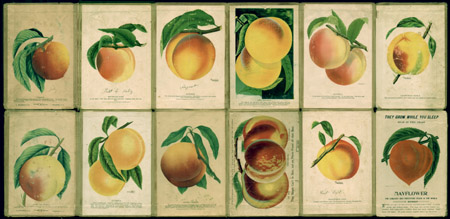
12 chromolithographs on paper, bound into accordion fold book
Print size: 9.25 x 6 inches each
Book size: 18.5 x 38.25 inches unfolded, 9.25 x 6.5 x .75 inches folded
Faint pencil inscription on cover: "Apples, Quinces, Peaches"
Sold, please inquire as to the availability of similar items.

Peach Tree Salesman's Sample Book
Rochester, New York: c. 1870s to 1890s
Rochester, New York: c. 1870s to 1890s
This item is sold. It has been placed here in our online archives as a service for researchers and collectors.
- Please inquire as to the availability of similar items currently in stock, or use the navigation bar above to browse our site for currently available items.
- Find guidelines for the use of images from georgeglazer.com.
- To see more archived items, view our directory.
- Find information about selling your art and antiques.
See also a similar Apple Tree Salesman's Sample Book.
This sample book would have been used by a traveling tree salesman employed by a nursery to sell peach trees to farmers. It consists of 12 colorful prints of larger-than-life size peaches in vivid colors, with their names and brief advertising copy, mostly straightforward descriptions such as: "A new peach from Spalding County, Georgia. A very showy fruit. Fine flavor and juicy, melting and good. Ripe about the first of July." One print of three varieties departs from this format to add a touch of humor: "A New York policeman is styled, 'One of the Finest.' Here you have 'Three of the Finest,' and a New York policeman isn't in it with them for a moment." A few in this set have handwritten notations as to their ripening date, e.g. "Last Sept." Peaches in this set are: Triumph, Mountain Rose, Elberta, New Prolific, Waddell, Crawford's Early, Stump the World, Champion, Chair's Choice, Greensboro, Crawford's Late and Mayflower.
The twelve advertising sheets in this particular book were printed by one of three Rochester, New York, companies. They are bound into light brown cloth covers that open to display them all at once, six on the top row, and six on the bottom row. Inasmuch as the covers are simple, and the varieties are by various printers, it is possible that the portfolio book was custom assembled by or for a salesman with 12 varieties to promote. Two of the images appear to have been pasted over earlier ones -- perhaps an update of ones later substituted for sale, but in the same period.
From the 1850s, Rochester became a center for nursery gardening and a flourishing printing and illustration industry grew up to provide pictures of the flowers, trees and bushes for use as catalogues by nursery salesmen. They greatly resemble the folk art of their time, and were in fact produced via a process also used by folk and amateur artists--stencils were used by the illustrators to produce the basic shapes, with details added freehand. In addition to being charming and decorative slices of Americana, catalogues such as these document agricultural history and the existence of varieties of fruits that are still familiar favorites as well as those that are no longer commonly grown, if not extinct.
References:
Kabelac, Karl Sanford. Nineteenth-Century Rochester Fruit and Flower Plates in The University of Rochester Library Bulletin. (vol.XXXV,1982), pp.93-114.
Raphael, Sandra. An Oak Spring Pomona. Upperville, Virginia: Oak Spring Garden Library, 1990. p. 65.
Reese, William S. Stamped with a National Character: Nineteenth Century American Color Plate Books. p. 72.