John Jonston (1603-1675) (artist)
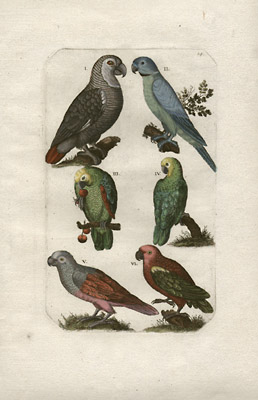
Pair of Parrot Prints (Plates 14 and 15)
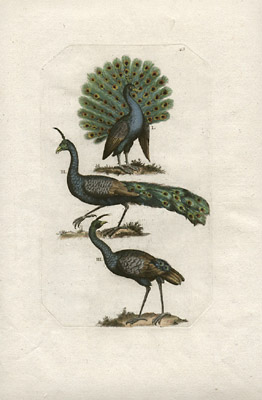
Pair of Peacock Prints (Plates 22 and 23)
from Collection d'oiseaux les plus rares gravés et dessinés d'aprés nature...l'histoire naturelle et raisonnée des différens oiseaux qui habitent le globe ... traduite du Latin de Jonston ... de laquelle on a fait précéder l'Histoire particuliére des oiseaux de la Ménagerie du Roi...
[Collection of the Most Rare Birds Drawn and Engraved From Life, A Natural and Rational History of the Different Birds that Inhabit the Globe...translated from Latin by Jonston..from the Menagerie of the King]
Paris: L.C. Desnos, 1773-1774
Engravings with later hand-coloring
20 x 12.75 inches, sheet
11.5 x 7 inches, platemark
Sold, please inquire as to the availability of similar items.

John Jonston Bird Studies
Paris, 1773-74
Paris, 1773-74
This item is sold. It has been placed here in our online archives as a service for researchers and collectors.
- Please inquire as to the availability of similar items currently in stock, or use the navigation bar above to browse our site for currently available items.
- Find guidelines for the use of images from georgeglazer.com.
- To see more archived items, view our directory.
- Find information about selling your art and antiques.
 |
 |
Pair of Parrot Prints (Plates 14 and 15)
 |
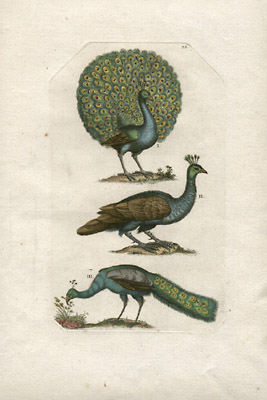 |
Pair of Peacock Prints (Plates 22 and 23)
Finely-executed prints of parrots and peacocks after John Jonston from an 18th-century reissue of two 17th-century natural history works. The reissue combined Nicolas Robert's prints on the birds of the royal menagerie at Versailles, originally published in 1676, with a French edition of John Jonston's 1650 work on birds, taken from a section of Theatrum Universale Omnium Animalium. The prints depict birds of prey, waterfowl, songbirds and tropical species. The entire set originally contained 23 plates by Robert and 62 by Jonston. Jonston's earlier work was translated from Latin and the descriptions of birds expanded. The names of the birds are given in Latin and French in the Robert plates, and sometimes also in other European languages in the Jonston plates. The Robert and Jonston reissue was published as an accompaniment to a new edition of plates by natural history illustrator Maria Sibylla Merian.
John Jonston (or Johnstone), a descendant of a Scottish family, was born in Sambter, Poland. He was interested in both medicine and natural sciences, and studied at St. Andrews, Cambridge, and Leiden. He published major natural history studies, including Thaumatographia Naturalis (Amsterdam 1632), a compendium of contemporary knowledge of natural science including astronomy, paleontology, plants, animals and man. This was followed by Theatrum Universale Omnium Animalium (Frankfurt, 1650), with plates after his drawings engraved by Mattias Merian depicting the entire range of animal species. After having spent most of his life travelling through all parts of Europe, he settled in Silesia.