Raphael Sanzio d'Urbino (1483-1520) (after)
Nicolas Dorigny (1658-1746) (engraver)
Giovanni Pietro Bellori (1613-1696) (text)
Psyches et Amoris Nuptiae ac Fabula...
[The Story of the Wedding of Cupid and Psyche
Painted by Raphael Sanzio d’Urbino in the Farnesina, Rome…]
Set of 8 prints and title page (Plates 1-9 of 12)
Dominico de Rossi, Jo. Jacobi Sons and Heirs, Rome: August 15, 1693
Engravings, uncolored
15.25 x 26.25 inches, platemark
19.5 x 29.5 inches, overall
Sold, please inquire as to the availability of similar items.

Wedding of Cupid and Psyche, Villa Farnesina
8 Engravings of Frescoes
8 Engravings of Frescoes
This item is sold. It has been placed here in our online archives as a service for researchers and collectors.
- Please inquire as to the availability of similar items currently in stock, or use the navigation bar above to browse our site for currently available items.
- Find guidelines for the use of images from georgeglazer.com.
- To see more archived items, view our directory.
- Find information about selling your art and antiques.
{title}
 |
 |
 |
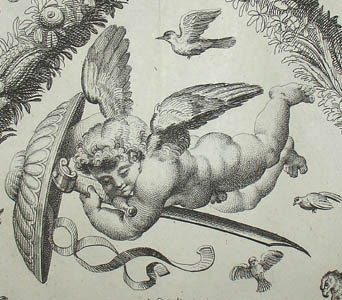 |
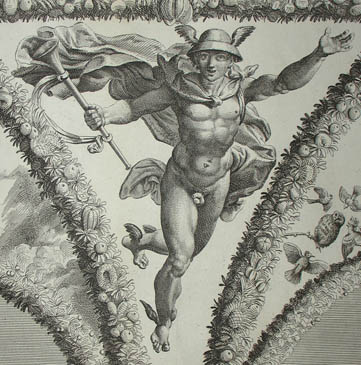
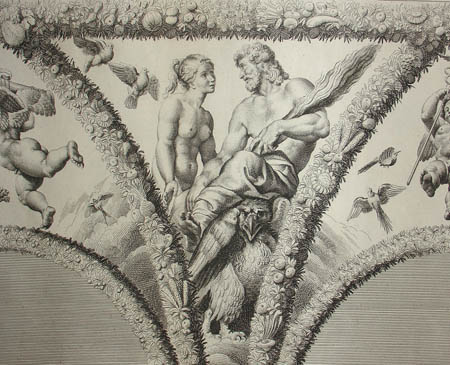
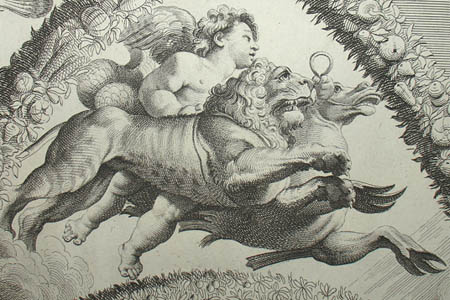
Above: Four Details
Set of eight engravings of Raphael’s frescoes of scenes from the myth of Cupid (also known as Eros) and Psyche in the Villa Farnesina in Rome. Raphael’s paintings illustrate part of the story The Metamorphoses of Lucius Apuleius (the only Latin novel to survive in its entirety). In this work, Venus, jealous of a beautiful mortal girl named Psyche, sends Cupid on an errand to punish the girl. Cupid instead falls in love with Psyche, and after a series of secrets, betrayals, and trials, the lovers are reunited, and Psyche is made immortal.
The frescoes are painted on the vaults and ceiling above demilune reserves on the ground floor at the end of the entrance hall, now known as the Loggia of Psyche. Images of leafy garlands of fruit accentuate the arches of the vaults, also framing the classical images. The frescoes were commissioned by the Sienese banker Agostino Chigi, called “magnifico” by his peers for his richly decorated villa and the elegant entertainments he hosted there. The paintings were recently restored and the Villa Farnesina is open to the public as a museum.
Raphael was one of the three greatest artists of the Italian High Renaissance and an accomplished architect as well. As chief archeologist to the Pope, he was involved in the excavation of the ancient Golden House of Nero, and adapted many of the elaborate Roman frescoes he saw there in creating his own innovative painted wall and ceiling designs in the Vatican and private villas in Rome. Prints made after Raphael’s drawings, designs and paintings were produced during his lifetime by the engraver Marcantonio Raimondi (c.1470-1482 - c. 1527-1534). Raphael prints by other engravers were especially popular in the neoclassical period of the mid 18th century and early 19th century coinciding with the tremendous revival of interest in the classical art of ancient Greece and Rome, as well as the classicism of the Renaissance. Some of these prints served as references for architects and designers because many were based on frescoes that had been incorporated into interior architecture. This interest in Raphael, often reflected in prints, continued throughout the 19th century as he achieved legendary status.
Among the more famous prints after Raphael are series from the late 18th century illustrating his frescoes in the Vatican stanze (notably Picturae Raphaelis Sanctii Urbinatis,Rome: 1722); the Vatican loggia (notably Loggia di Rafaele nel Vaticano, Rome: 1772-77) and the Villa Farnesina in Rome (notably Psyches et Amoris Nuptiae ac Fabula, Rome: 1693). One popular set, variously issued as engravings and lithographs during the 19th century, shows details of Raphael’s allegorical frescoes of 12 hours of the day and night. A related set of engravings depicts the gods and goddesses of the Roman pantheon riding in chariots in their heavenly domain, probably representing the seven days of the week.
Nicolas Dorigny was a French artist who mainly worked as an engraver. Born into a family of artists, he was trained by his father, Michel Dorigny. He went to Italy to continue his studies and wound up staying 28 years. From there, he went to England and was commissioned by King Charles II to make engravings after the Raphael cartoons at Hampton Court, and stayed in London for 15 years. His eyesight began to fail him, so he retired to Paris in 1724. The following year, he was made an academician, and participated in the Paris Salons between 1739 and 1743.
Giovanni Pietro Bellori was a distinguished Italian scholar of art history. He wrote numerous works on antiquarian subjects and a major biography of 17th century artists, The Lives of the Modern Painters, Sculptors, and Architects.
Main text of title page: “Psyches et Amoris nuptiae ac fabula a Raphaele Sanctio Urbinate Romae in Farnesianis hortis rranstyberim ad veterum aemulationem ac laudem colorum luminibus expressa a Nicolas Dorigny ad similitudinem delineata et incisa, et a Joanne Petro Bellorio notis illustrata. Ad Serenissimum Principem Ranutium Secundum Parmae ac Placentiae Ducem &c.”
Full publication information from title page: “Typis ac Sumptibus Dominici de Rubeis Jo. Jacobi Filii ac Heredis Romae Ad Templum Sta. Mariae de Pace cum Privilegio Summi Pontificis, et Sup. Perm. Aedita anno MDCXCIII. die XV Augusti.”
References:
Bénézit, E. Dictionnaire critique et documentaire des Peintres, Sculpteurs, Dessinateurs et Graveurs. France: Librairie Gründ, 1966. Vol. 3, p. 313 (Dorigny).
“Raphael.” The Oxford Dictionary of Art. Online at eNotes.com 2008. http://www.enotes.com/oxford-art-encyclopedia/Raphael (28 October 2008).
“Villa Farnesina.” Accademia Nazionale dei Lincei. 2007. http://www.lincei.it/modules.php?name=Content&pa=showpage&pid=27 (29 October 2008).