Domenico Fontana (1543-1607) (after)
Giovanni Guerra (c. 1540-1618) (drawing)
Natale Bonifacio da Sebenico (1538-1592) (etcher)
Bartolomeo Grassi (c. 1553-1595) (original publisher)
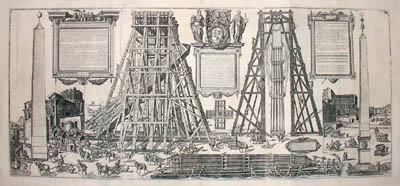
Disegno del Modo di Condurre l'Obelisco dette volgarm[en]te la Guglia dal luogo remoto dietro la Chiesa di S. Pietro...alla piazza di rimpetto la parta principale della med[esi]ma Chiesa
[Drawing of the Method of Moving the Obelisk known familiarly as the Spire from the obscure location behind the Church of St. Peter to the plaza facing the main part of the same Church]
Later imprint from plate originally published Rome: 1586
Etching
23 x 47.5 inches, overall
19.5 x 44.75 inches, plate mark
Sold, please inquire as to the availability of similar items.

Moving & Erecting the Vatican Obelisk
Large Engraving after Domenico Fontana
Large Engraving after Domenico Fontana
This item is sold. It has been placed here in our online archives as a service for researchers and collectors.
- Please inquire as to the availability of similar items currently in stock, or use the navigation bar above to browse our site for currently available items.
- Find guidelines for the use of images from georgeglazer.com.
- To see more archived items, view our directory.
- Find information about selling your art and antiques.
 |
 |
 |
 |
 |
 |
 |
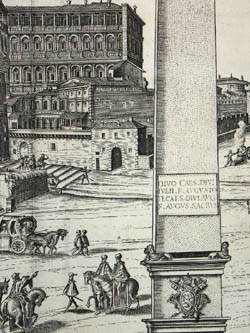 |
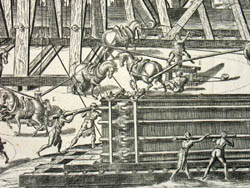
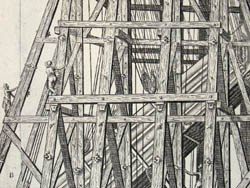
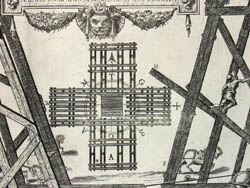
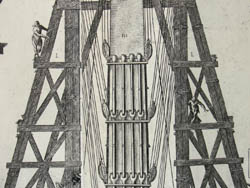
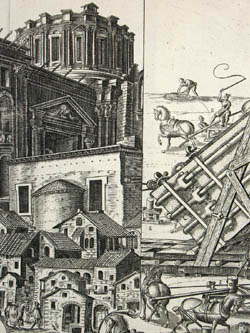
This engraving illustrates part of the complex process of moving and re-erecting the ancient Egyptian obelisk that now stands before St. Peter's Basilica in Rome. The obelisk was moved there in 1586 by Pope Sixtus V from a location about 275 yards away, under the supervision of architect Domenico Fontana (1543-1607). The massive project took 13 months. The monument still stands in St. Peter's Square today, over 400 years later.
The obelisk was quarried in Egypt during the age of the pharaohs in the 13th century BCE, and stood in Alexandria. There it had fallen and been re-erected by the Romans during the reign of Augustus. In 37 AD, the Roman Emperor Caligula transported it by an enormous barge to Rome where it was set up in the center of his chariot racecourse. By the 1500s, nobody knew how these earlier civilizations had managed to erect these enormous monuments, and at 83 feet high and weighing 330 tons, the risk of having it fall and shatter during the process of maneuvering it into place made Fontana's feat a daring one. Using massive 51-foot levers, 40 winches and huge teams of men and horses to power the operation, his plan was a triumphant success, and encouraged Sixtus to unearth and restore other Egyptian obelisks brought to Rome by the ancient emperors that had long since fallen.
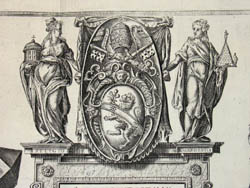
Center cartouche: Sixto. V. Ponto. Opt. Max/ Quod singulari pietate, & magnificentia, Obeliscummirade magnitudinis ex Aegypto olim ab Octaviano Aug. in Urbe aduectum, & in Circo dem Vaticano Collocatum…Natalis Bonifatius Sebenicensis in Aere Inciderat.
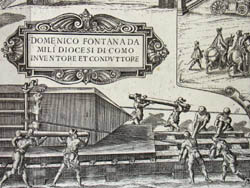
Small cartouche: Domenico Fontana da/ Mili Diocesi di Como/ Inventore et Conduttore
Obelisk inscriptions: DIVO CAES. DIVI/ IVLII. F. AUGUSTO/ TLCAES. DIVI AVG/F. AUGUS. SACRUM
Inscription lower left: Io. Guerra M. Lin. NB. F. [Giovanni Guerra drew it, Natale Bonifacio made it]
Allegorical women in center cartouche: Religio and Magnificentia
References:
"Alessandro Specchi." The Grove Dictionary of Art. New York: Macmillan. 2000. Artnet.com. http://www.artnet.com/library/08/0804/T080478.asp (27 January 2006).
Bradley, Bruce. "Moving the Vatican Obelisk." 28 October 2002. Linda Hall Library fpr Science, Engineering and Technology. http://www.lindahall.org/events_exhib/exhibit/exhibits/civil/vatican.shtml (26 January 2006).
Grassi, Giulia. "Da Caligola a San Pietro." Scuola d'Italiano - Roma. MATDID. http://www.scudit.net/mdobel_vaticano.htm (26 January 2006).
Lunde, Paul. "A Forest of Obelisks." Originally published in Saudi Aramco World. March/April 1979, Vol. 30, No. 2. Online at Aramco Services Company. 2004. http://www.saudiaramcoworld.com/issue/197902/a.forest.of.obelisks.htm (26 January 2006).