Giovanni Battista Piranesi (1720-1778) (after)
Giovanni Battista Piranesi & Francesco Piranesi (1758 - 1810) (engravers)
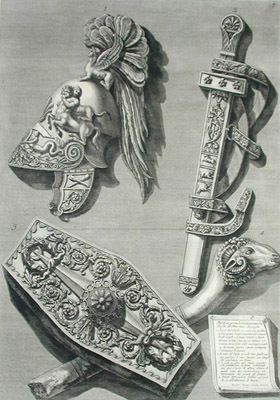
Parti in grande restaurati de'Trofei di Ottaviano Augusto
[Restored detail of the Trophies of Octavian Augustus]
from Trofei di Ottaviano Augusto innalzati per la Vittoria ad Actium e conquista dell'Egitto… [Trophies of Octavian Augustus Erected to Commeorate the Victory at Actium and Conquest of Egypt]
Bouchard, Rome: 1753
Black and white etchings
30 x 22 inches, overall, approximate average
20.75 x 15.25 inches, plate mark
Sold, please inquire as to the availability of similar items.

Piranesi Architectural Prints
Trofei di Ottaviano Augusto
Trofei di Ottaviano Augusto
This item is sold. It has been placed here in our online archives as a service for researchers and collectors.
- Please inquire as to the availability of similar items currently in stock, or use the navigation bar above to browse our site for currently available items.
- Find guidelines for the use of images from georgeglazer.com.
- To see more archived items, view our directory.
- Find information about selling your art and antiques.
 |
 |
Pair of prints from a series whose full title (translated) is: "Trophies of Octavian Augustus erected to commemorate the victory at Actium and the conquest of Egypt with various other ornaments carefully recovered from the most valuable fragments of ancient Roman buildings, useful to painters, sculptors and architects, drawn and etched by G. B. Piranesi, Venetian architect." One print illustrates two shields, a helmet, and axe and the other illustrates a shield, helmet, sword, and a ram's head club.
The series on the trophies of Octavian Augustus was completed after two decades of archaeological research through which Piranesi aspired to document the achievements of Roman antiquity for the inspiration of the architectural and decorative arts designers of his time. This body of work revolved mostly around two of the so-called Trophies of Marius, which had been taken from the fountainhead of the Acqua Giulia and installed at the Capitol in Rome in 1590. Piranesi concluded that these trophies were erected under the authority of Augustus Caesar in commemoration of his naval victory at Actium. Piranesi also incorporated architectural fragments into his documentary work. Some plates from the Trofei series were reused by Piranesi in his later work.
Giovanni Battista Piranesi was a multi-talented and accomplished man of the enlightenment who combined supreme artistic ability and historical scholarship with an entrepreneurial business sense. He was at once an artist, architect, archeologist, designer, collector, and print and antiquities dealer. Many consider him one of the most influential artists in the development and popularization of the neoclassical style of the late 18th Century. According to scholar John Wilton-Ely, the distinguishing characteristics of Piranesi’s early works were “the unorthodox combination of classical motifs, the manipulation of superhuman scale, the organization of powerfully receding perspectives upon diagonal axes, and the modulation of space by means of skilful lighting.” Piranesi’s work was recognized with his election as a Fellow of the Society of Antiquaries in England in 1757. He was knighted by the Pope in 1765. Although Piranesi composed and etched many of his works, his son Francesco (1758-1810) and studio assistants such as Vincenzo Dolcibene also etched a significant number of the prints, especially in later years.
Piranesi etched and published numerous folio print sets of art, architecture and archaeology of Rome and environs, that served as source material for other architects and designers. They were sold as souvenirs to English aristocrats on the Grand Tour in Italy or by subscription directly to British patrons. Among those influenced by Piranesi was the great British architect Robert Adam (1728-92), who was a colleague of Piranesi while in Rome on the Grand Tour in the 1750s. From the 1760s onward, Piranesi supplemented his printing business by joining the thriving trade in the restoration and sale antiquities to Grand Tour travelers. Piranesi's interest in these objects went well beyond historical restoration and marketing -- he also advocated emulating the creativity of the Roman designers and integrating motifs from Greek and Roman antiquities with a contemporary sensibility to produce new and strikingly original works. The British were particularly good customers, so he set up his workshop and showrooms close to the British quarter of Rome. After Giovanni Battista Piranesi’s death in 1778, Francesco and another son, Pietro, continued to republish Piranesi prints and sell antiquities.
References:
John Wilton-Ely. Giovanni Battista Piranesi: The Complete Etchings. San Francisco: Alan Wofsy Fine Arts, 1994. 2 volumes. Chapter D.I, Volume I, passim (referring to these two plates but not illustrating them).