Giovanni Battista Piranesi (1720-1778) (after)
Giovanni Battista Piranesi & Francesco Piranesi (1758–1810) (engravers)
Les Ruines des Plus Beaux Monuments de la Grece, XXXI
[The Ruins of the Most Beautiful Monuments in Greece]
from Della Magnificenza ed Architettura de’Romani
[Concerning Magnificence
and Roman Architecture]
Rome: 1761
Black-and-white copperplate etching and engraving
Wilton-Ely Number 791
14 x 9.5 inches, plate mark
22 x 16 inches, overall
Sold, please inquire as to the availability of similar items.

Columns from Piranesi's Della Magnificenza
Etching, Rome: 1761
Etching, Rome: 1761
This item is sold. It has been placed here in our online archives as a service for researchers and collectors.
- Please inquire as to the availability of similar items currently in stock, or use the navigation bar above to browse our site for currently available items.
- Find guidelines for the use of images from georgeglazer.com.
- To see more archived items, view our directory.
- Find information about selling your art and antiques.

 |
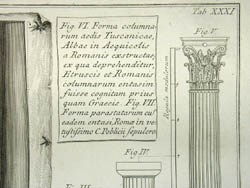 |
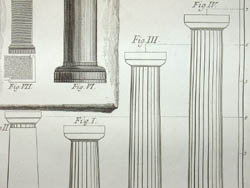
Piranesi architectural study comparing Julien-David Le Roy's studies of Greek columns to Etruscan and Roman examples (the latter inset in the upper left corner). Le Roy, a French architect, had published Les ruines des plus beaux monumnets de la Grèce [Ruins of the Most Beautiful Monuments of Greece] in 1758, in which he advanced the argument that Roman architecture was merely a debased version of Greek forms. In response to this work and other contemporary writers disparaging of Roman achievements, Piranesi produced Della Magnificenza ed Architettura de’Romani, an essay arguing the superiority of the Etruscan and Roman tradition, and directly taking on Le Roy with 38 illustrated plates that utilized drawings and quotes from his book.
Giovanni Battista Piranesi was one of the leading figures in the development of the neoclassical style in the late 18th Century. As architect, archeologist, artist, designer, collector, and antiquities dealer, he and his son Francesco produced a series of etchings and engravings depicting the glories of ancient Rome. These fine prints served as source material for other architects and designers, such as his colleague, the great English neoclassical architect, Robert Adam, and were souvenirs for other English aristocrats on the Grand Tour in Italy.
Piranesi was a well-rounded man of the Enlightenment who combined scholarly knowledge with a flair for design and a shrewd entrepreneurial business sense. From the 1760s onward, Piranesi supplemented his printing business by joining the thriving trade in the restoration and sale antiquities to foreigners on the Grand Tour of Italy. The British were particularly good customers, so he set up his workshop and showrooms close to the British quarter of Rome.
Piranesi's interest in these objects went well beyond historical restoration and marketing -- he also advocated emulating the creativity of the Roman designers and integrating motifs from Greek and Roman antiquities with a contemporary sensibility to produce new and strikingly original works. While some of his contemporaries criticized these pastiches, they inspired and influenced architects and decorative arts designers of the period.
References:
John Wilton-Ely. Giovanni Battista Piranesi: The Complete Etchings. San Francisco: Alan Wofsy Fine Arts, 1994. 2 volumes. Chapter E.II. Volume II, pp. 820-21.
"Rome and Southern Italy: 1600–1800 A.D.: Various Roman Ionic capitals compared with Greek examples…" Metropolitan Museum of Art Timeline of Art History. 2002-2005. http://www.metmuseum.org/toah/hd/neoc_1/hod_41.71.1.7.20.htm (19 December 2005).